How to Start an Online Coaching Business in 2026 (Without Burning Out)
Reading Time
7
Published On
Updated On

Brian Moran
Founder

Samara Lemon
VP of Marketing

Leilani Treuting
Marketing Director

Scott Moran
Co-Founder

SamCart is the digital business platform that builds, runs, and scales your online business. AI handles the hard parts, so you keep more of what you earn.
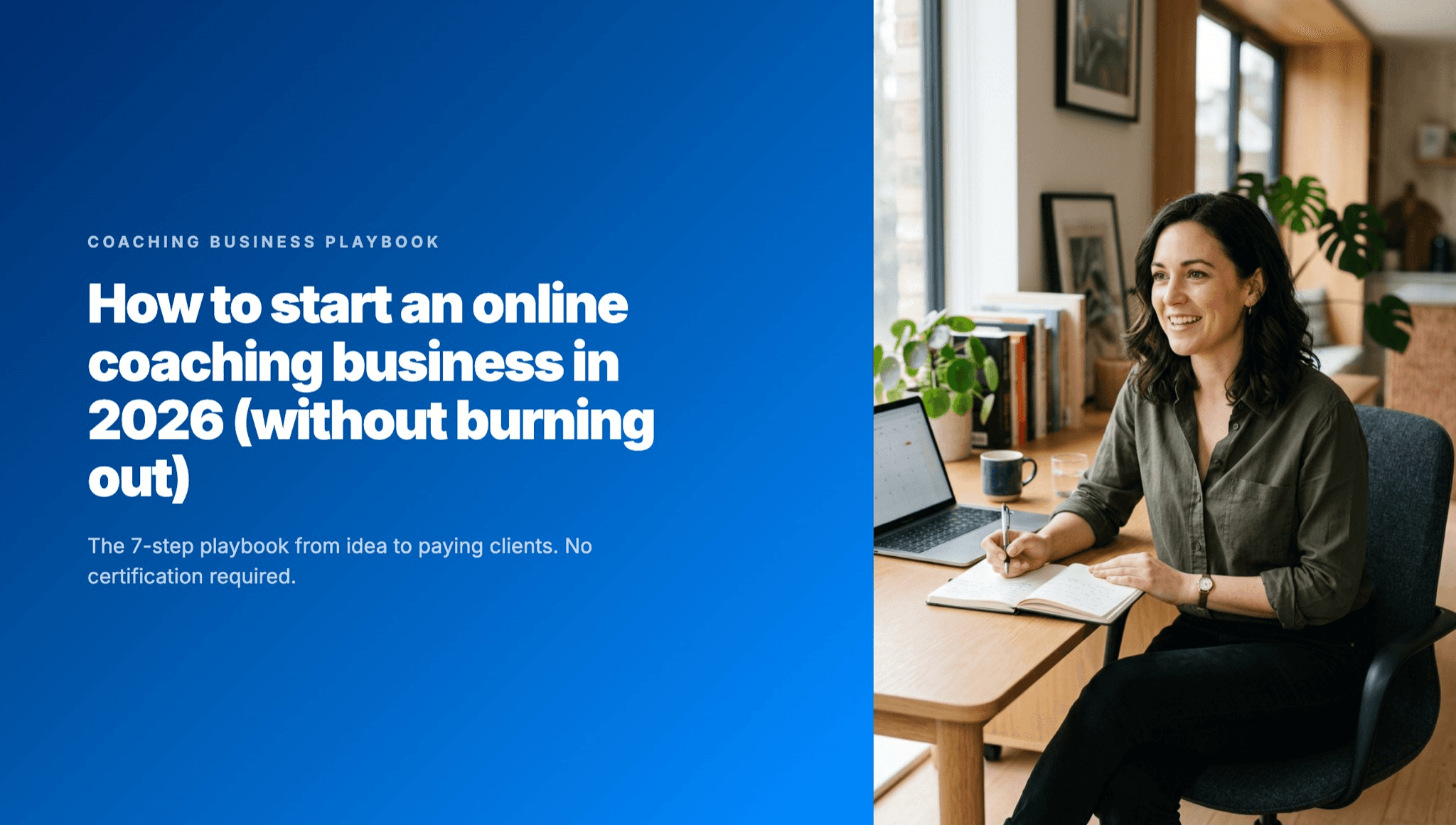
Table of Contents
Title
Share this article
Starting an online coaching business in 2026 takes seven steps: pick a niche that pays, define your transformation, choose a delivery model, price for real income, build an offer page, set up payments, and land your first 5 clients. You don't need a certification, a huge audience, or six months of planning.
The online coaching industry is projected to exceed $6.79 billion by 2030, and the coaches winning right now aren't the ones with the most credentials. They're the ones who treat coaching like a business from day one, price for profit instead of comfort, and use AI to handle the parts that used to require a team. SamCart has processed over $7B across 75,000+ businesses, and coaching is consistently the #2 revenue niche on the platform.
Here's what I've watched happen over and over: someone with real expertise, real results, and real ability to help people spends 6 months picking a logo, building a website, and "getting ready" to launch. They burn out before they ever get a client.
That's backwards. The coaches making $10K, $30K, $100K/mo all did the same thing: they started ugly, got clients fast, and figured out the business as they went.
This is the 7-step playbook. No fluff, no theory, no "find your passion" exercises. Just the fastest path from "I want to coach" to "I have paying clients."
The online coaching market in 2026: who's winning and who's dying
Online coaching is not new. What's new is how fast the bad models are dying.
The coaches struggling in 2026 are the ones charging $50/hour, booking clients one at a time through DMs, and manually sending invoices. Their income is directly tied to their calendar. Miss a week, income drops. Take a vacation, income drops. Get sick, income drops.
The coaches winning are the ones who built a product stack: a core coaching offer (1:1 or group), a digital product for scale (course, membership, or ebook), and a checkout process that adds revenue at every step (order bumps, upsells).
The difference isn't talent. It's business model.
Should you start a coaching business? A 5-question gut check
Before you build anything, answer these honestly:
Have you gotten results for yourself or others in a specific area? Not "I'm interested in wellness." Specific, provable results.
Can you articulate what changes for someone after working with you? If you can't describe the transformation in one sentence, your niche isn't clear enough.
Are people already paying for help in this area? If nobody is spending money on this problem, you don't have a market.
Are you willing to sell? Coaching is a business. If the idea of asking someone to pay you feels wrong, fix that first.
Can you commit to 90 days without quitting? Most coaching businesses fail because the coach quits in month 2. Not because the model doesn't work.
If you answered yes to all five, keep reading. If not, the honest move is to fix whatever got a "no" before you spend money on tools.
Step 1: Pick a coaching niche that pays (not just one you like)
The biggest mistake new coaches make is picking a niche based on passion alone. "Life coaching" is not a niche. "Business coaching" is barely a niche. The coaches making real money picked a specific problem for a specific person.
Good niches in 2026:
Career transition coaching for mid-career professionals
Business coaching for service-based solopreneurs
Health coaching for busy parents
Mindset coaching for entrepreneurs scaling past $100K
Fitness coaching for women over 40
The niche test: Can you fill in this sentence? "I help [specific person] achieve [specific result] in [specific timeframe]." If you can't, narrow down.
The highest-earning coaching niches on SamCart are business education, fitness, and finance/investing. These aren't random. They have two things in common: the client has money, and the problem has a measurable outcome.
Step 2: Define your transformation, not your method
Nobody buys coaching. They buy the result coaching produces.
"6 weekly calls with homework and accountability" is a method. "Go from stuck at $5K/mo to consistently hitting $15K/mo in 90 days" is a transformation.
Write your transformation statement before you build anything else. It becomes your sales page headline, your elevator pitch, and your pricing anchor. Every piece of marketing you create should point back to this one sentence.
Step 3: Decide your delivery model
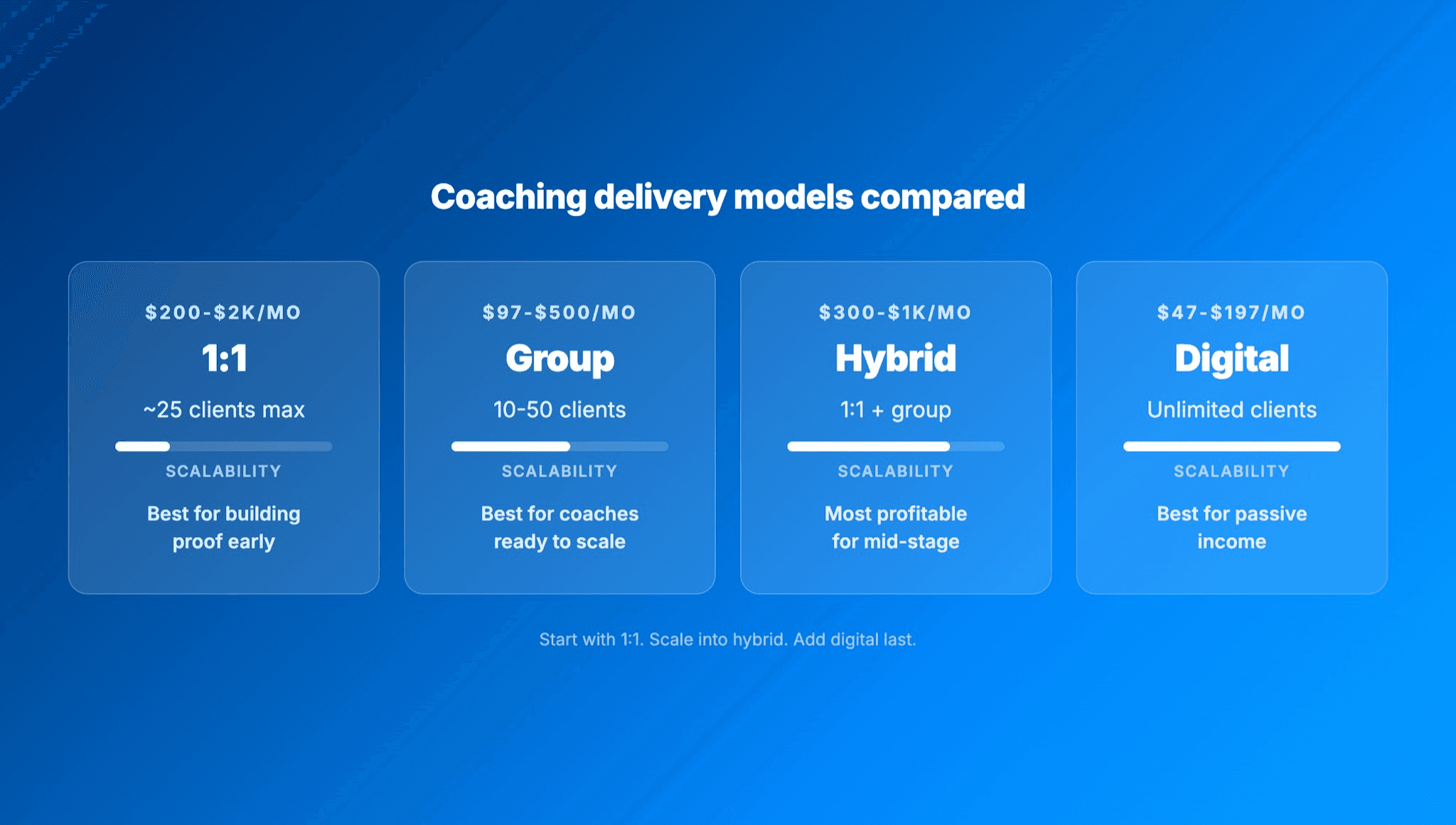
Model | Price range | Scalability | Best for |
|---|---|---|---|
1:1 coaching | $200-$2,000/mo | Low (capped at ~25 clients) | New coaches building proof |
Group coaching | $97-$500/mo | Medium (10-50 clients) | Coaches ready to scale |
Hybrid (1:1 + group) | $300-$1,000/mo | Medium-high | Most profitable for mid-stage |
Async/digital only | $47-$197/mo | Very high | Coaches wanting passive income |
My recommendation for new coaches: start with 1:1 at $300-$500/mo. Get 5-10 clients. Prove the transformation works. Then package what you learned into a group program and scale.
Starting with a group program before you've proven the 1:1 model is like writing a textbook before you've taught a class.
Step 4: Price your coaching for real income
Most new coaches underprice by 50-80%. Here's the math that should change how you think about pricing.
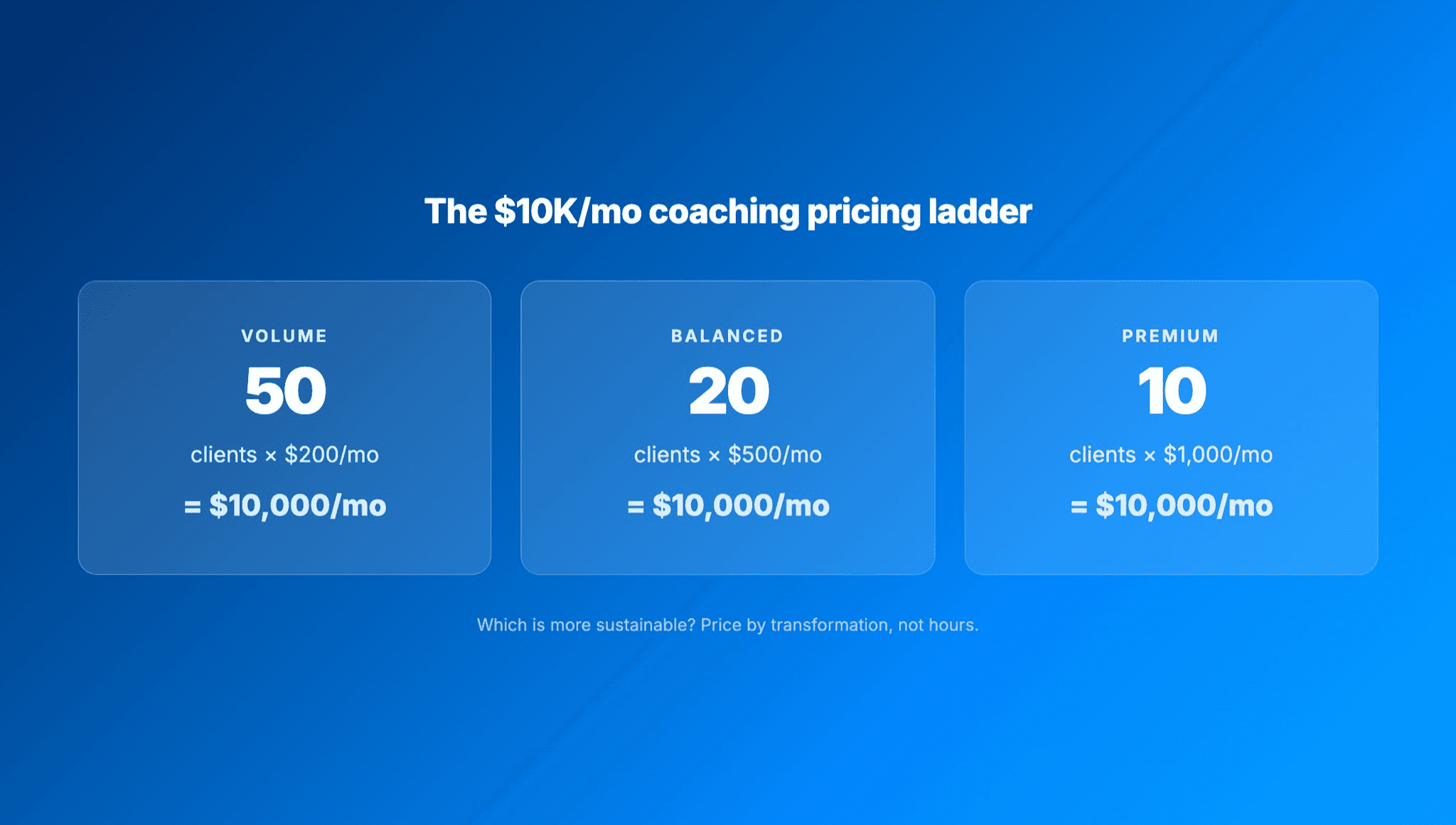
The $10K/mo pricing ladder:
20 clients at $500/mo = $10,000/mo
10 clients at $1,000/mo = $10,000/mo
50 clients at $200/mo = $10,000/mo
Which sounds more sustainable? 10 clients you can actually serve well, or 50 clients where everyone gets thin attention?
Price based on the value of the transformation, not the number of hours. A career coach who helps someone land a $30K raise can charge $3,000 for that engagement. That's a 10x return for the client. A fitness coach who helps someone lose 30 pounds and keep it off for a year can charge $200/mo without blinking.
If you're charging less than $200/mo for 1:1 coaching, you're subsidizing your clients' results with your time.
Step 5: Build the offer page that closes cold traffic
Your offer page is where coaching businesses live or die. It's not a website. It's not a portfolio. It's a single page that explains the transformation, shows proof, and makes it easy to buy.
What your offer page needs:
Headline: The transformation statement from Step 2
Who it's for: 3-5 bullet points describing your ideal client
What they get: Deliverables (calls, access, materials), but framed as outcomes
Social proof: Testimonials, results, case studies (even 1-2 is enough to start)
Price and CTA: Clear, simple, no confusion
SamCart's AI builds your offer page in minutes. Tell it your coaching niche, your transformation, and your price. It writes the copy, designs the layout, and connects it to checkout. You don't need a web designer, a copywriter, or a week of your time.
Step 6: Set up payments, recurring billing, and onboarding in one place
Coaching businesses run on recurring revenue. You need a platform that handles monthly billing, failed payment recovery, and client onboarding without you manually chasing invoices.
What you need from your payment setup:
Recurring billing (monthly or quarterly)
Order bumps at checkout (add a resource library, workbook, or community access for an extra $19-$47). SamCart data across 75,000+ businesses shows order bumps add up to 68% to average order value.
Upsells after purchase (offer a VIP tier, quarterly planning session, or done-for-you audit). Upsells can add another 42% to every sale.
Failed payment recovery (automatic dunning so you don't lose clients to expired cards)
Client portal for delivering resources
SamCart handles all of this in one platform at $79/mo flat. No stitching together Calendly + Stripe + Kajabi + a landing page builder. One tool. The platform converts at 3-4x the industry average checkout rate, which means more of the people who click "buy" actually complete payment.
Step 7: Get your first 5 paying clients without an audience
You don't need 10,000 followers. You need 5 people who trust you enough to pay. Here's how to find them in 30 days.
Week 1-2: Direct outreach
Message 30-50 people you already know who fit your ideal client profile
Don't pitch. Ask: "I'm building a coaching program for [niche]. Would you be open to a 15-minute call so I can learn about your biggest challenge with [topic]?"
From those calls, offer 3-5 people a "founding client" spot at 50% off your target price
Week 3-4: Content + referrals
Post 3x/week on one platform (LinkedIn for B2B coaching, Instagram for health/fitness/mindset)
Share specific, tactical advice. Not motivational quotes. Not "here are 5 tips." Real, detailed breakdowns of how to solve the problem your coaching addresses.
Ask every founding client to refer one person
Five clients at $300-$500/mo = $1,500-$2,500/mo recurring. That's enough to validate the business and fund the next phase.
Scaling: when to add a course, group program, or community
Don't scale until you've had at least 10 clients go through your 1:1 program. You need the data.
After 10 clients, you'll know:
Which parts of your coaching produce the biggest results (keep those)
Which parts are repetitive and can be recorded (turn those into a course)
What questions come up every single time (turn those into a resource library)
Whether group coaching works for your topic (test it with your next 5 clients)
The most profitable coaching business model in 2026: a $97-$197 digital product as the front door, a $500-$1,000/mo group coaching program as the core, and a $2,000+ 1:1 tier for VIP clients. This is exactly the product stack SamCart is built for.
Coaching business mistakes that kill momentum
Spending months on branding before getting clients
Your logo doesn't matter. Your website doesn't matter. Getting paid to help someone matters. Everything else can wait.
Charging by the hour
Hour-based pricing kills coaching businesses. It caps your income, incentivizes longer sessions (not better results), and makes clients think of you like a consultant instead of a partner. Price by the transformation.
Building a course before coaching anyone
Courses are a packaging of what you've already proven works. If you haven't coached anyone 1:1, you're guessing what to put in the course.
No order bumps or upsells
Every coaching checkout should have at least one add-on. A workbook, a resource vault, a community pass, a planning template. The math is real: order bumps add 68% to your average order value and upsells add another 42%. On a $500 coaching package, that's potentially $340 more per client.
Waiting for a certification
Most coaching niches don't legally require certification. Business coaching, career coaching, mindset coaching, fitness coaching (in most states) - none require a license. Certifications can help your credibility, but they're not a prerequisite for getting started. The coaches making the most money got certified AFTER they were already coaching, not before.
Your next step: build and launch this week
CreatorU (free with every SamCart account, 100K+ creators, 12+ courses) teaches the exact frameworks top coaches use to build, price, and sell their programs. SamCart's AI builds your offer page, writes the sales copy, and connects to checkout in one afternoon.
Stop planning. Start coaching. The best business plan is 5 paying clients.
Start your free trial and build your coaching offer page today.
SamCart Editorial Team
Brian Moran
Founder
Samara Lemon
VP of Marketing
Leilani Treuting
Marketing Director
Scott Moran
Co-Founder
Frequently Asked Questions
How much money do online coaches make?
Online coaching income ranges wildly. The median for coaches with 5-15 active clients is $3,000-$10,000/mo. Top coaches in business, health, and career niches clear $30,000-$100,000+/mo by stacking 1:1, group coaching, and digital products. The biggest variable isn't expertise, it's pricing and business model. Coaches who price by transformation (not hourly) consistently earn 3-5x more.
Do I need a certification to be an online coach?
No. Most coaching niches (business, career, mindset, fitness in most states, marketing, relationship) don't legally require certification. Certifications can boost credibility, but they're not required to start or to charge premium prices. The highest-earning coaches on SamCart built their reputation through client results, not credentials.
What's the best platform for an online coaching business?
For coaches who want sales pages, recurring billing, order bumps, upsells, and client delivery in one place, SamCart is the strongest fit. It's built for digital product businesses (coaching included), processes checkout at 3-4x the industry conversion rate, and starts at $79/mo. Kajabi hosts your content. SamCart builds, runs, and scales the business around it.
How do I get my first coaching client?
Direct outreach to people you already know. Message 30-50 people in your network who fit your ideal client profile. Don't pitch. Ask for a 15-minute conversation about their biggest challenge. From those conversations, offer 3-5 founding client spots at a discounted rate. Most coaches land their first 5 clients within 2-4 weeks using this approach.
How long does it take to make full-time income coaching online?
With focused effort, most coaches hit $3,000-$5,000/mo within 90 days and $10,000/mo within 6 months. The biggest factor is speed to first client, not perfection of the offer. Coaches who get their first paying client in week 1 consistently outperform coaches who spend 3 months "getting ready."