Best platform to sell ebooks in 2026 (10 options compared)
Published On
Updated On

Brian Moran
Founder

Samara Lemon
VP of Marketing

Leilani Treuting
Marketing Director

Scott Moran
Co-Founder

SamCart is the digital business platform that builds, runs, and scales your online business. AI handles the hard parts, so you keep more of what you earn.
Table of Contents
Title
Share this article
The question isn't "what's the best platform to sell ebooks." It's "what are you trying to do with your ebook?"
Sell directly to your email list and keep 95%+ of every sale? That's one answer. Get discovered by strangers browsing a marketplace? Completely different answer. Bundle your ebook with a course, coaching program, or membership? Different again.
Most "best ebook platform" articles are written by the platform recommending itself. Payhip's blog recommends Payhip. Easytools recommends Easytools. Sellfy recommends Sellfy. You already know how that story ends.
This list ranks 10 platforms by what they're actually good at, not by who paid to be included. We're transparent: SamCart is our platform, and we think it's the best option for direct ebook sales. But we'll also tell you where Amazon KDP, Gumroad, and others legitimately win. Based on revenue data from 75,000+ businesses that have processed $7B+ through SamCart.
How to choose an ebook platform (before you compare features)
Before you look at pricing tables, answer four questions:
Do you already have an audience? If yes, you want a direct sales platform. If no, you need marketplace reach (Amazon KDP) or a way to build traffic from scratch.
How much do you want to keep per sale? Marketplaces take 30-65% of your revenue. Direct platforms charge a flat monthly fee and let you keep the rest.
Will you sell more than just an ebook? If you plan to add upsells, order bumps, coaching, courses, or bundles, you need a platform built for that. Most aren't.
Who owns the customer relationship? On Amazon, Amazon owns your buyer's email. On a direct platform, you do. That matters when you want to sell them something else later.
The trade-off is simple. Marketplaces give you reach but take a massive cut and keep your customer data. Direct platforms let you keep everything, but you bring the traffic. Most successful ebook sellers eventually do both: direct sales to their audience, marketplace for discovery.
The 10 best platforms to sell ebooks in 2026
1. SamCart
Best for: Creators who want AI to write, design, and sell their ebook from a single platform. Idea to income in one afternoon.
Pricing: Starts free (trial). Plans from $79/mo. 0% platform transaction fee.
Every other platform on this list expects you to show up with a finished ebook. SamCart starts earlier. Tell the AI Assistant what you know, who you want to help, and it does the rest: picks the right angle, writes chapters in your voice, and designs every page with professional layouts as it writes. You end up with a finished, branded ebook without opening a separate writing tool, hiring a designer, or fighting with templates.
Here's what that actually looks like for ebook sellers:
AI writes your ebook. Share your expertise and the AI Assistant outlines chapters, writes content in your voice (not robot-speak), and suggests the right title and angle based on what sells.
AI designs every page as it writes. The AI Designer applies professional layouts, images from a built-in library of 100M+ photos (Getty + Unsplash), and your brand colors/fonts/logo automatically. No separate design step.
Magic Wand redesign. Highlight any section and generate new layout variations instantly. One click.
AI builds your sales page. Headlines, copy, CTAs, all designed and ready to publish. No copywriter needed.
Remix: one ebook, endless content. Turn your finished ebook into social media posts, presentation slides, YouTube thumbnails, and banner ads. One click. Your ebook becomes your entire content engine.
Checkout built in. Your ebook connects directly to the highest-converting checkout on the web. Instant digital delivery. Buyers pay and get the file immediately.
Order bumps + 1-click upsells. Add a companion workbook as a bump, a video course as an upsell. Creators who add just one upsell see a 68% higher average order value.
AI-suggested offers. The AI recommends which upsells and bundles fit your ebook based on what actually converts.
Checkout Anywhere. Embed your ebook checkout on your blog, landing page, or link-in-bio with one line of code. Buyers never leave your site.
Payments, taxes, delivery handled. Processing, tax calculations, payouts, and file delivery all built in.
CreatorU included with every account. 12+ training courses (updated every 12 weeks) that teach you how to pick your idea, price it, launch it, and scale it. 100,000+ creators have gone through the program. Other platforms give you software and wish you luck. SamCart gives you the playbook too.
Limitations:
$79/mo is not free. If you're selling a $5 ebook with no upsells and no audience, validate the concept on a free platform first.
No built-in marketplace. You bring the traffic (or build it through SamCart's sales pages and Remix content).
Not designed for fiction authors who need Kindle-style distribution to millions of strangers.
Verdict: The only platform that takes you from "I have an idea" to "I'm selling a professionally designed ebook with upsells" in a single afternoon. Best for creators who want AI to handle writing, design, sales page, and checkout so they can focus on what they know. Not the right fit if you need Amazon's mass-market discovery.
2. Amazon KDP
Best for: Mass marketplace reach and discoverability.
Pricing: Free to publish. Amazon keeps 30-65% of your revenue (35-70% royalty depending on pricing and distribution).
Amazon KDP is the 800-pound gorilla. If you want strangers to find your ebook while browsing the Kindle store, nothing else comes close. Amazon's search algorithm, recommendation engine, and Kindle Unlimited program put your book in front of millions of readers.
But there's a cost. Amazon owns the customer relationship. You don't get buyer emails. You can't upsell them. You can't add order bumps. And depending on your pricing, they're keeping 30-65% of every sale.
For fiction authors and nonfiction writers targeting a broad audience, KDP is still essential. For creators selling to their own list? It's leaving money on the table.
Limitations:
No customer email capture. Amazon keeps the relationship.
No upsells, bumps, or bundles.
Royalty rates squeeze margins, especially under $9.99 pricing.
Verdict: Essential for mass-market reach. Poor for creators who want to own their audience and maximize per-sale revenue.
3. Gumroad
Best for: Simple, low-volume digital sales with minimal setup.
Pricing: 10% + $0.30 per sale. No monthly fee.
Gumroad is the easiest way to start selling an ebook today. Create an account, upload your PDF, set a price, share the link. That's it. No design decisions, no funnel building, no monthly commitment.
The downside is the 10% cut on every sale. Sell a $27 ebook 100 times and Gumroad takes $270 plus $30 in per-transaction fees. That adds up. And the checkout experience is generic. No order bumps, limited upsell options, basic email features.
Limitations:
10% fee eats into margins as volume grows.
Limited upsell/bump capabilities.
Basic email and automation tools.
Verdict: Great starter platform. Outgrow it fast if your ebook takes off.
4. Payhip
Best for: Beginners with no website who want to start selling immediately.
Pricing: Free plan (5% fee), Plus $29/mo (2% fee), Pro $99/mo (0% fee).
Payhip removes every barrier to getting started. Free plan, no website needed, instant product delivery. You can be selling an ebook in 15 minutes. It handles VAT/sales tax automatically, which is a genuine headache most beginners don't anticipate.
The trade-off is limited customization and basic marketing tools. Your storefront looks like a Payhip page, not your brand. And the 5% free-tier fee means you're paying for simplicity.
Limitations:
Limited branding and design customization.
No AI content creation tools.
Basic analytics.
Verdict: Lowest barrier to entry. Not built for scale or revenue optimization.
5. Sellfy
Best for: Creators selling ebooks alongside physical merchandise.
Pricing: $29-$159/mo depending on annual revenue cap.
Sellfy gives you a storefront that handles digital products, physical goods, subscriptions, and print-on-demand in one place. If you're an author who also sells merch, branded notebooks, or physical copies, it's a clean solution.
The design templates are functional but generic. Marketing tools are adequate but not sophisticated. It works, it just doesn't optimize.
Limitations:
Revenue caps on lower plans.
Generic templates.
Limited checkout optimization (no order bumps or 1-click upsells).
Verdict: Solid for mixed digital/physical product sellers. Not optimized for ebook-only revenue growth.
6. Kajabi
Best for: Bundling ebooks with online courses and memberships.
Pricing: $179-$399/mo.
Kajabi is the premium option for creators building a content empire. Courses, communities, coaching, memberships, and yes, ebooks. It hosts everything in one ecosystem with built-in email marketing and a polished student experience.
The catch: $179/mo minimum. For selling ebooks alone, that's expensive. Kajabi hosts your content. SamCart builds, runs, and scales the business around it.
Limitations:
$179/mo starting price is steep for ebook-only sellers.
Checkout conversion rates are lower than specialized platforms.
Designed for course creators first, ebook sellers second.
Verdict: Worth it if you're building a course + ebook + membership bundle. Overkill (and overpriced) for standalone ebook sales.
7. Podia
Best for: Digital-first creators bundling ebooks with memberships.
Pricing: $39-$199/mo.
Podia sits between Gumroad's simplicity and Kajabi's depth. Clean interface, supports ebooks, courses, memberships, and webinars. Email marketing is built in. The checkout experience is decent but not optimized for maximizing revenue per customer.
Limitations:
No order bumps or advanced upsell flows.
Limited checkout customization.
Smaller ecosystem than Kajabi.
Verdict: Good middle-ground for creators who want more than Gumroad but don't need Kajabi-level depth.
8. Shopify
Best for: Ecommerce sellers who want to add ebooks to an existing store.
Pricing: $39-$399/mo plus a digital download app (free or paid).
Shopify is built for physical products. Selling ebooks on it requires a third-party app for digital delivery. If you already run a Shopify store and want to add an ebook as a product, it works. Starting fresh on Shopify just to sell ebooks? There are better options.
Limitations:
Requires third-party apps for digital delivery.
Checkout optimized for physical goods, not digital.
No built-in ebook-specific features.
Verdict: Makes sense if you already use Shopify. Don't start here just for ebooks.
9. Stan Store
Best for: Link-in-bio ebook sales to social media audiences.
Pricing: $29/mo (Creator plan).
Stan Store is a link-in-bio tool that lets you sell digital products, including ebooks, directly from your social profiles. It's clean, it's fast, and it converts social followers into buyers without sending them to a separate website.
The limitation is depth. No order bumps. Limited upsell options. Basic analytics. It's a starter storefront, not a revenue optimization platform.
Limitations:
No order bumps or sophisticated upsell flows.
Limited checkout customization.
Designed for social sellers, not search/organic traffic.
Verdict: Solid for creators with large social followings who want fast, simple sales. Limited upside as you scale.
10. ThriveCart
Best for: One-time-payment buyers who want lifetime access to a checkout tool.
Pricing: $495 lifetime license (one-time payment).
ThriveCart's pitch is simple: pay once, use forever. For sellers who hate monthly fees, it's appealing. The checkout pages are solid, bump/upsell features exist, and the affiliate management is decent.
The downside: ThriveCart is a checkout tool, not a business platform. No built-in website, no AI content tools, no email marketing. You're stitching together other tools around it. And the $495 upfront cost means you're committing before you've validated.
Limitations:
No website builder, email, or content hosting.
$495 upfront before making a single sale.
Development pace has slowed compared to SaaS competitors.
Verdict: Good value long-term if you already have traffic and other tools in place. Not a complete solution for ebook sellers starting from scratch.
Side-by-side comparison
Platform | Price | Tx fees | Upsells / bumps | AI tools | Best for | |
|---|---|---|---|---|---|---|
SamCart | $79/mo | 0% | Yes (68% higher AOV) | Delivery + abandonment (integrates for full email) | Yes (AI writes + designs ebook, sales page, checkout) | Direct sales + idea-to-income + CreatorU training included |
Amazon KDP | Free | 30-65% cut | No | No | No | Mass marketplace reach |
Gumroad | $0/mo | 10% + $0.30 | Limited | Basic | No | Simple one-off sales |
Payhip | Free-$99/mo | 0-5% | No | Basic | No | Beginners, no website |
Sellfy | $29-$159/mo | 0% | No | Basic | No | Digital + physical product mix |
Kajabi | $179-$399/mo | 0% | Limited | Yes | Limited | Course + ebook bundles |
Podia | $39-$199/mo | 0% | No | Yes | No | Ebook + membership bundles |
Shopify | $39-$399/mo | 0% | Via apps | Via apps | No | Existing ecommerce stores |
Stan Store | $29/mo | 0% | No | Basic | No | Social/link-in-bio sellers |
ThriveCart | $495 one-time | 0% | Yes | No | No | Budget-conscious, established sellers |
Direct sales vs marketplace: the revenue math
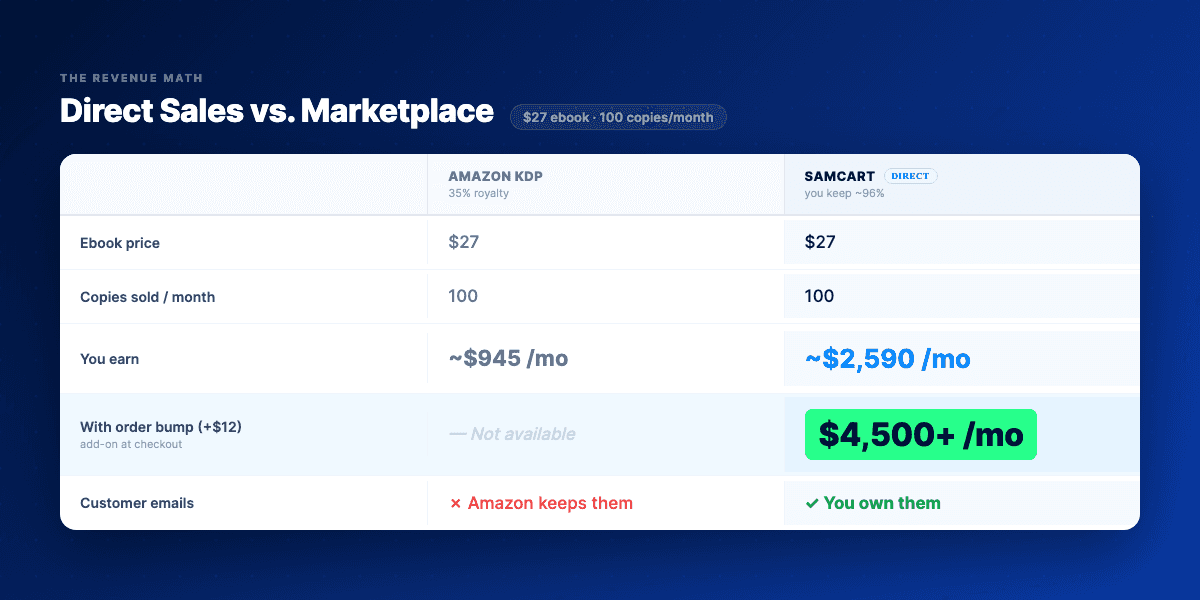
Let's make this concrete. You're selling a $27 ebook and moving 100 copies per month.
Amazon KDP (35% royalty) | SamCart (direct) | |
|---|---|---|
Ebook price | $27 | $27 |
Copies sold/month | 100 | 100 |
You earn | ~$945/mo | ~$2,590/mo |
With order bump ($12) | N/A (not available) | $4,500+/mo |
Customer emails | No (Amazon keeps them) | Yes (you own them) |
Same ebook. Same 100 buyers. The difference: $2,099/month.
The catch: on Amazon, those 100 buyers found you through Amazon's search engine. On a direct platform, you brought them through your email list, content, ads, or social following. If you don't have traffic, the math doesn't matter yet.
The smart play? Sell direct to your audience and list KDP for discovery. Keep Amazon as a top-of-funnel channel, make your real money on the direct sale.
Which platform should you pick?
Skip the analysis paralysis. Here's the decision tree:
"I have an email list or audience and want to maximize every sale" SamCart. The upsells, bumps, and checkout conversion pay for themselves.
"I want strangers to discover my book" Amazon KDP. Nothing matches its search volume and recommendation engine.
"I'm testing an idea with zero budget" SamCart is the only platform with AI to help you build your idea from scratch.
"I'm bundling my ebook with a course or coaching" SamCart (if you want conversion optimization and basic course hosting) or Kajabi (if you need advanced course hosting).
"I sell from Instagram/TikTok and need a link-in-bio solution" Stan Store for simplicity, or SamCart's Checkout Anywhere to embed directly.
"I hate monthly fees" ThriveCart's one-time payment, if you can stomach $495 upfront with limited features.
The bottom line
The best platform to sell ebooks is the one that matches how you plan to sell.
If you're a creator with an audience (even a small one) who wants to keep more of every sale and grow revenue per customer with bumps, upsells, and email follow-up: start with SamCart. The AI builds your page, the checkout converts, and you own every customer relationship.
If you're a fiction author who needs mass-market discoverability, Amazon KDP is still the best game in town.
If you're day one with no audience and no budget, grab Gumroad or Payhip's free plan, make your first 10 sales, and upgrade when the math works.
Whatever you pick, don't overthink it. The ebook sitting on your hard drive isn't making you money. The one listed for sale somewhere is.
Ready to sell your ebook and actually maximize what you earn? Start your free SamCart trial and let our AI build your ebook sales page in minutes.
Not sure what you could earn? Use the Creator Revenue Calculator to estimate your ebook revenue potential.
SamCart Editorial Team
Brian Moran
Founder
Samara Lemon
VP of Marketing
Leilani Treuting
Marketing Director
Scott Moran
Co-Founder
Frequently Asked Questions
What's the best free platform to sell ebooks?
Payhip and Gumroad both offer free plans. Payhip charges 5% per sale on free; Gumroad charges 10% + $0.30. Both work for low-volume testing. SamCart doesn't have a free plan but offers a 7-day trial.
Can I sell ebooks on multiple platforms at once?
Yes, and you should. A common strategy: sell directly to your audience through SamCart (or another direct platform) while listing on Amazon KDP for marketplace discovery. Direct sales get the margin. Amazon gets the reach.
Do I need an LLC to sell ebooks?
No. You can sell as a sole proprietor. An LLC adds liability protection and looks more professional, but it's not a legal requirement to start. Don't let business structure be the thing that stops you from launching.
What file format should my ebook be?
PDF for direct sales (works everywhere, preserves formatting). EPUB for Amazon KDP and other marketplace distribution. If you're selling direct only, PDF is all you need.
How much do ebook sellers actually earn?
It ranges wildly. A $27 ebook with no upsells to a small list might generate $500-$2,000/month. The same ebook with order bumps and upsells on SamCart can hit $3,000-$5,000+/month. The platform, pricing, and funnel matter as much as the ebook itself.
Is Amazon KDP still the best way to sell ebooks?
For discovery? Yes. For revenue per sale? No. Amazon's 30-65% cut and lack of upsell features cap your earnings. If you have your own audience, direct sales through a platform like SamCart will almost always generate more revenue from the same number of buyers.