Ecommerce Conversion Rate Optimization: The Complete Guide
Published On
Updated On

Brian Moran
Founder

Samara Lemon
VP of Marketing

Leilani Treuting
Marketing Director

Scott Moran
Co-Founder

SamCart is the digital business platform that builds, runs, and scales your online business. AI handles the hard parts, so you keep more of what you earn.

Table of Contents
Title
Share this article
Ecommerce conversion rate optimization (CRO) is the practice of increasing the percentage of visitors who complete a purchase, calculated as conversions divided by total visitors. The highest-leverage CRO work isn't tweaking button colors. It's reducing checkout friction and restructuring your offer so each customer spends more, because conversion rate and average order value are the same revenue lever pulled from two directions.
The one thing to know: Most stores treat CRO as a user-experience problem (page speed, trust badges, button copy). That's table stakes. The revenue actually hides in the offer. SamCart has processed $7B+ in creator sales, and adding a single upsell produces an average 42% jump in Day 1 average order value. You can double revenue without adding a single new visitor.
Here's the trap almost every store owner falls into. Traffic feels like the answer. More visitors, more sales, and the math looks obvious. So you pour money into ads and SEO, watch traffic climb, and revenue barely moves. The leak was never at the top of the funnel. It was at the bottom, where visitors decide whether to buy and how much to spend.
This guide covers the CRO fixes that actually move money in 2026: the checkout problems everyone gets wrong, the offer-side levers almost nobody talks about, the trust signals that close the sale, a testing framework so you stop guessing, and a 30/60/90-day checklist to tie it all together.
7 Ecommerce CRO Tactics Ranked by Impact
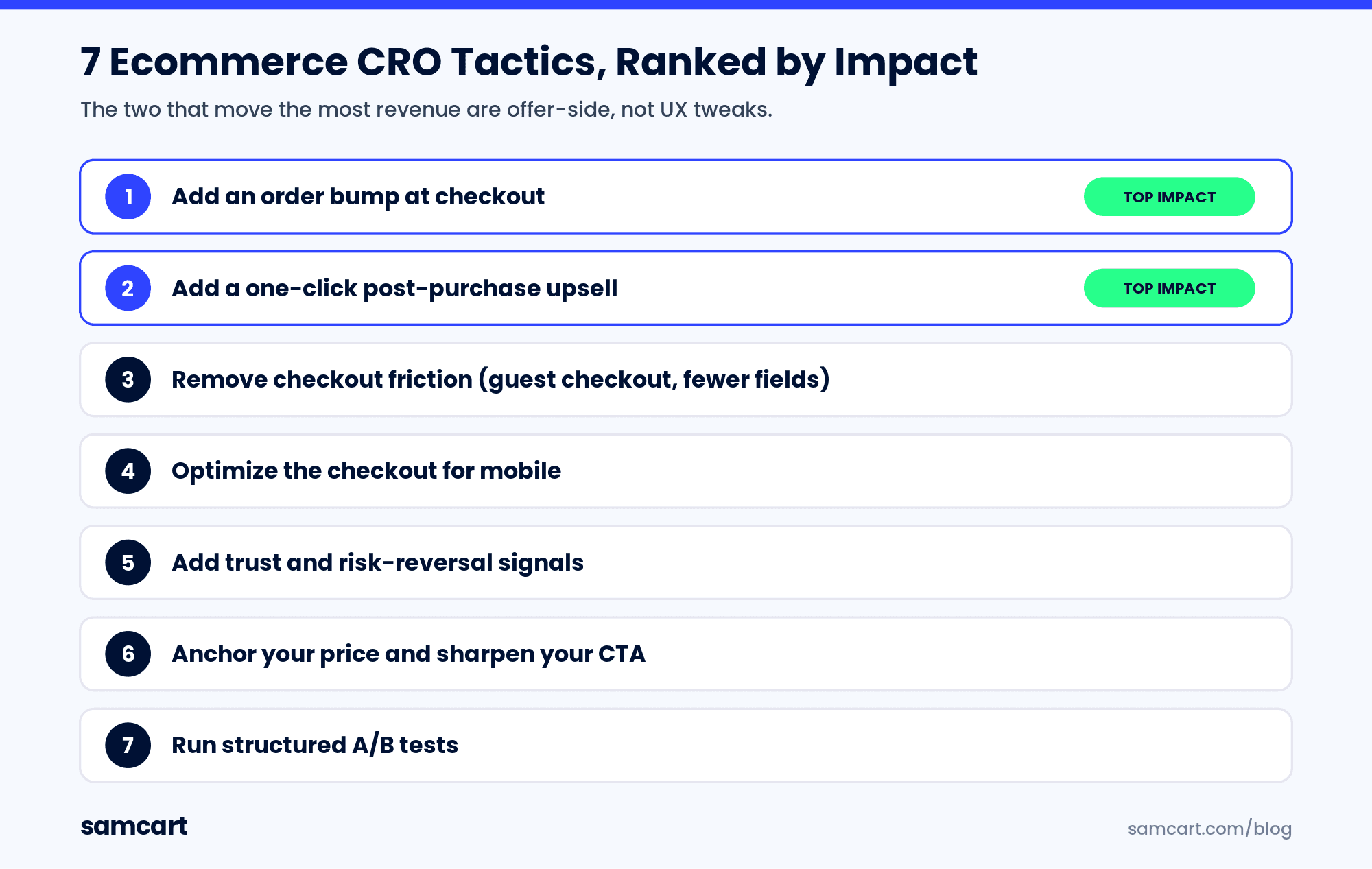
Before the deep dive, here's the short version, the tactics that move revenue, ordered by how much they typically return relative to effort:
Add an order bump at checkout. Lifts average order value and conversion of the core offer at the same time.
Add a one-click post-purchase upsell. Captures more revenue after the "yes," with zero added friction.
Remove checkout friction. Cut form fields, enable guest checkout, and offer one-page checkout.
Optimize for mobile. Most carts are abandoned on phones, so a broken mobile checkout is a silent revenue killer.
Add trust and risk-reversal signals. Guarantees, reviews, and security badges near the buy button.
Anchor your price and sharpen your CTA. Framing changes what feels expensive.
Run structured A/B tests. Validate the changes above instead of guessing.
The first two are the differentiators. Nearly every competing guide stops at three through seven. Keep reading for why the offer side is where the real money is.
What Is Ecommerce Conversion Rate Optimization?
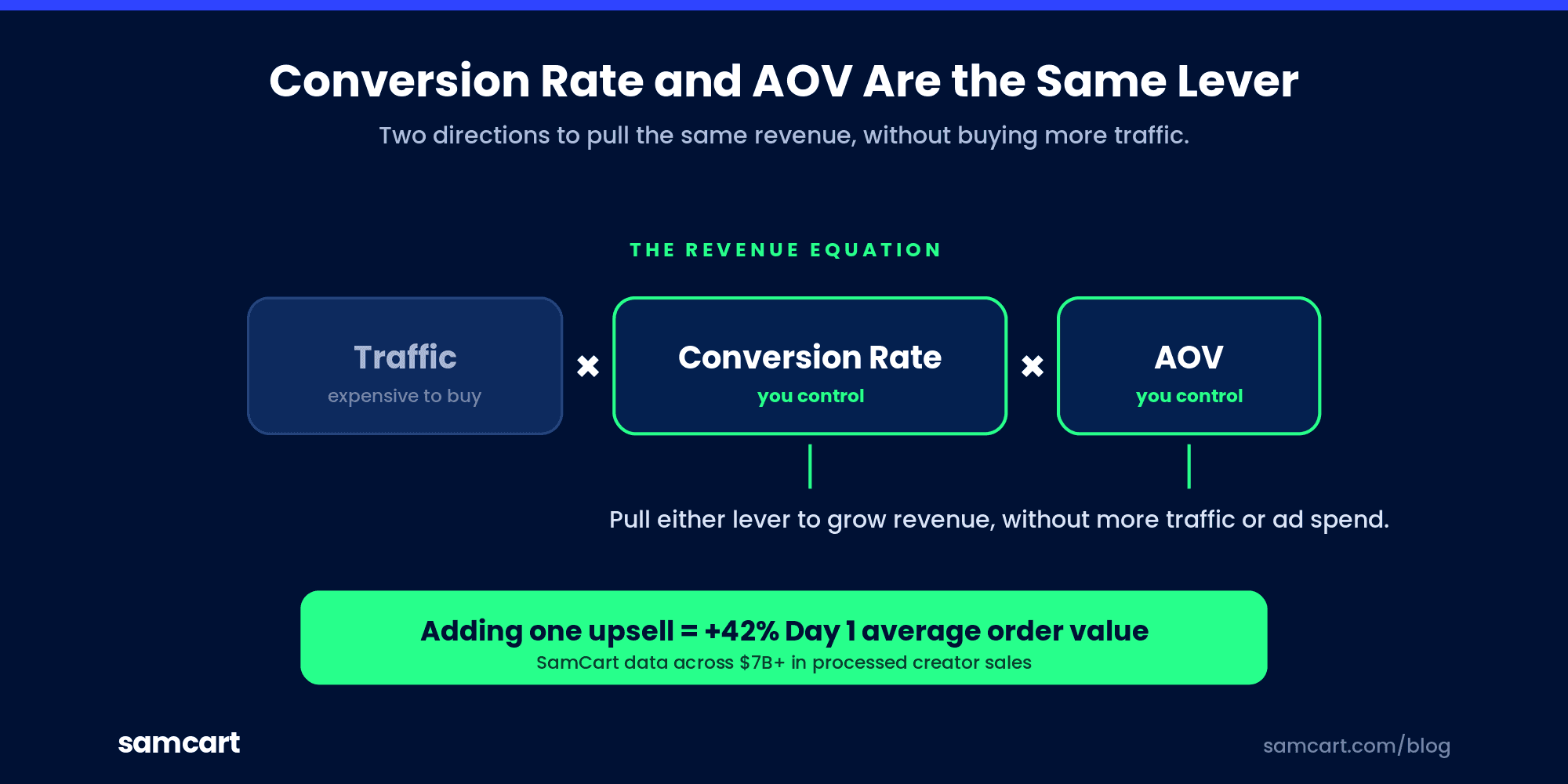
Ecommerce conversion rate optimization is the systematic process of increasing the share of your visitors who take a desired action, usually completing a purchase. The core formula is simple:
Conversion rate = (conversions ÷ total visitors) × 100
If 1,000 people visit your store and 20 buy, your conversion rate is 2%. CRO is the discipline of moving that number up without necessarily changing your traffic.
Here's why the math matters more than most people realize. Say you're converting at 2% on 10,000 monthly visitors at a $100 average order, which is $20,000 a month. To grow to $30,000, you have two options. Option one: buy 50% more traffic, which costs money and gets more expensive every year as ad prices rise. Option two: raise your conversion rate to 3% and your average order to $110, a modest and achievable combination, and hit the same number with the traffic you already have. One option compounds your acquisition cost. The other compounds your margin.
More traffic is almost always the wrong first lever. Traffic amplifies whatever conversion machine you already have. If that machine is leaky, you're just pouring more water through the holes. Fix the conversion and offer structure first, then scale traffic into a system that actually captures the value.
What is a good ecommerce conversion rate?
A good ecommerce conversion rate is generally between 2% and 4%, with the average sitting around 2% to 3% across most industries. Anything above 4% puts you in the top tier. But raw benchmarks can mislead you. A coaching offer at $2,000 and an impulse product at $19 will never convert at the same rate, and they shouldn't. The number that matters is your own baseline and whether it's trending up.
The Checkout Fixes Everyone Gets Wrong
Checkout is where intent goes to die. A visitor who reaches your checkout has already decided they want what you sell, so losing them here is the most expensive kind of loss because you paid to get them all the way to the finish line.
The usual friction points are well documented: too many form fields, forced account creation, surprise costs, a clunky multi-step flow, and no clear sense of what happens after clicking "buy." The standard fixes work, and you should do all of them:
Enable guest checkout. Forcing account creation before purchase is one of the most reliable ways to lose a sale. Let people buy first and create an account after, if at all.
Cut the form to the essentials. Every field is a chance to abandon. Ask only for what you need to fulfill the order and charge the card.
Show trust where the decision happens. Security badges, accepted payment logos, and a visible guarantee belong right next to the buy button, not buried in a footer.
Make mobile flawless. More than half of ecommerce traffic is mobile, and mobile carts are abandoned at higher rates than desktop. If your checkout requires pinching, zooming, or fighting an autofill bug, you're leaking sales on the majority of your traffic.
Here's the honest part most guides won't tell you: this is table stakes, not a competitive advantage. Every store your customer has ever bought from has a decent checkout. Removing friction gets you to the starting line. It doesn't win the race. The stores that pull ahead do something the friction-obsessed crowd ignores entirely. They change the offer itself.
The Offer-Side CRO Nobody Talks About
This is where the money actually is. Almost every CRO guide treats conversion rate and average order value as separate problems handled by separate teams. They're not. Order bumps and one-click upsells increase both at once. They convert more of your traffic and raise what each buyer spends.
The insight is simple but rarely stated: the moment a customer has decided to buy is the moment they are most receptive to buying more. You've already cleared the hardest hurdle, the decision to trust you and pull out a card. Adding a relevant, well-priced offer at that moment doesn't feel like a hard sell. It feels like a helpful upgrade.
SamCart's data backs this up directly. Across $7B+ in processed creator sales, adding a single upsell produces an average 42% lift in Day 1 average order value. That's not a rounding error. That's the difference between a business that scales and one that stalls. And critically, it happens without changing your traffic, your ad spend, or your top-of-funnel conversion rate at all.
Think about what that means for the business math. If your acquisition cost is fixed, every dollar of additional order value drops closer to pure margin. The offer stack is the cheapest revenue you will ever generate.
Order Bumps at the Point of Sale
An order bump is a small, complementary offer presented right on the checkout page, usually a checkbox the customer can add with a single click before they pay. Think a $27 template pack alongside a $197 course, or an extended warranty next to a physical product.
The reason bumps work isn't greed. It's relevance and timing. A well-chosen bump increases the perceived value of the whole purchase. The customer sees a complete solution instead of a partial one. Buying the course alone feels like getting the information; adding the templates feels like getting the outcome. The bump reframes the entire transaction as a better deal, which is why a good bump can actually lift conversion on the core offer, not just tack on revenue.
The keys to a bump that converts: keep it cheap relative to the main offer (roughly 20% to 40% of the core price), make it genuinely complementary, and describe the result it delivers, not its features.
Post-Purchase Upsells
A one-click post-purchase upsell is an offer shown after the customer completes their initial purchase, on a confirmation-style page, that they can accept without re-entering payment details. This is the single most underused lever in ecommerce.
Why does asking after the yes convert better than asking before? Because you've removed every remaining objection. Payment info is already entered. Trust is already established, because they just bought. There's no risk of losing the original sale, because it's already banked. All that's left is a single decision on a single offer, with a single click to accept. You're not asking them to buy from a stranger anymore. You're asking an existing customer if they want more.
The classic sequence for a creator: sell the course, then offer a coaching call or done-for-you upgrade as the one-click upsell. The buyer who wants faster results says yes, and your order value can climb well past the original price on the same customer, with no new ad spend required.
For the deeper tactical playbook here, see our guide to post-purchase upsell tactics, and if you want to model the upside for your own numbers, run them through the Creator Revenue Calculator to calculate your AOV upside.
Checkout Fix vs. Offer Fix: Where the Revenue Actually Comes From
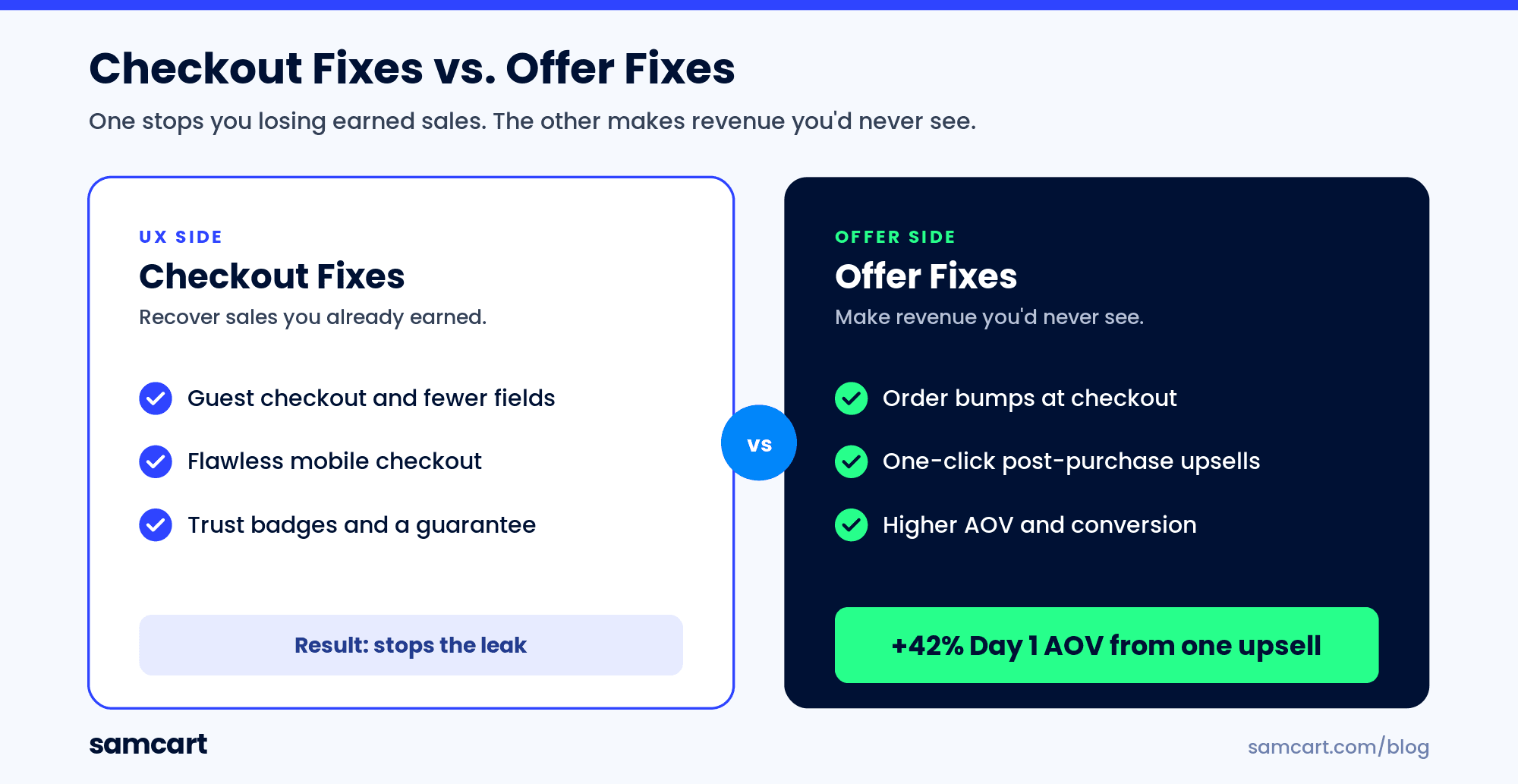
The clearest way to see the difference between UX-side CRO and offer-side CRO is side by side:
Lever | Type | What it changes | Typical impact | Effort |
|---|---|---|---|---|
Guest checkout + fewer fields | Checkout fix | Fewer abandoned carts | Recovers lost sales | Low |
Mobile optimization | Checkout fix | Completion rate on phones | Recovers lost sales | Medium |
Trust badges + guarantee | Checkout fix | Buyer confidence at purchase | Incremental lift | Low |
Order bump | Offer fix | Perceived value + order size | Higher AOV and conversion | Low |
One-click upsell | Offer fix | Revenue per customer after the sale | 42% avg Day 1 AOV lift (SamCart data) | Low |
Read that table honestly and the strategy writes itself. The checkout fixes stop you from losing money you already earned. The offer fixes make money you'd otherwise never see. Do both, but if you can only do one this week, add the bump.
Trust and Social Proof Tactics That Convert
Trust is the invisible tax on every online purchase. The customer can't hold your product, can't shake your hand, and has been burned before. Your job is to remove the doubt at the exact moment it surfaces, right before they click buy.
The proven signals, in rough order of impact: a money-back guarantee stated plainly ("30-day, no-questions-asked") does the heaviest lifting because it moves the risk from the buyer to you. Customer reviews and testimonials work best when they're specific and name a real result, not "great product!" Security and payment badges reassure on the mechanics of the transaction. And scarcity or social proof counters ("2,000+ creators use this") can nudge fence-sitters, as long as they're true, because fake urgency is a trust-killer that AI shoppers and savvy buyers now spot instantly.
Place these signals where the decision happens. A guarantee on your homepage is nice; a guarantee two inches from the buy button is what actually converts.
An A/B Testing Framework for Ecommerce CRO
A/B testing is how you replace opinions with evidence. But most store owners test the wrong things in the wrong order and conclude that testing doesn't work.
Test in order of impact. Start with the elements that change the most money per visitor: your headline and value proposition, your price anchor and offer structure, then your primary call to action. Only after those should you touch button colors and micro-copy. Testing a button shade before you've tested your offer is like repainting a car with no engine.
Respect sample size. A test needs enough conversions to be meaningful. As a rough floor, aim for a few hundred conversions per variation before trusting the result, not a few hundred visitors. Calling a winner after 20 sales is how you fool yourself.
Test one thing at a time. If you change the headline, the price, and the CTA all at once and conversion goes up, you've learned nothing about why. Isolate the variable so the result is usable.
Common mistakes to avoid: stopping a test the moment it looks good (regression to the mean will humble you), ignoring seasonality, and testing trivial changes while your offer structure sits untouched. The biggest testing mistake of all is testing button colors for months while never once testing whether adding an order bump would lift revenue 40%.
Your CRO Checklist: A 30/60/90-Day Plan
You don't fix conversion in a weekend, but you can sequence it so the highest-impact work happens first. Here's the plan:
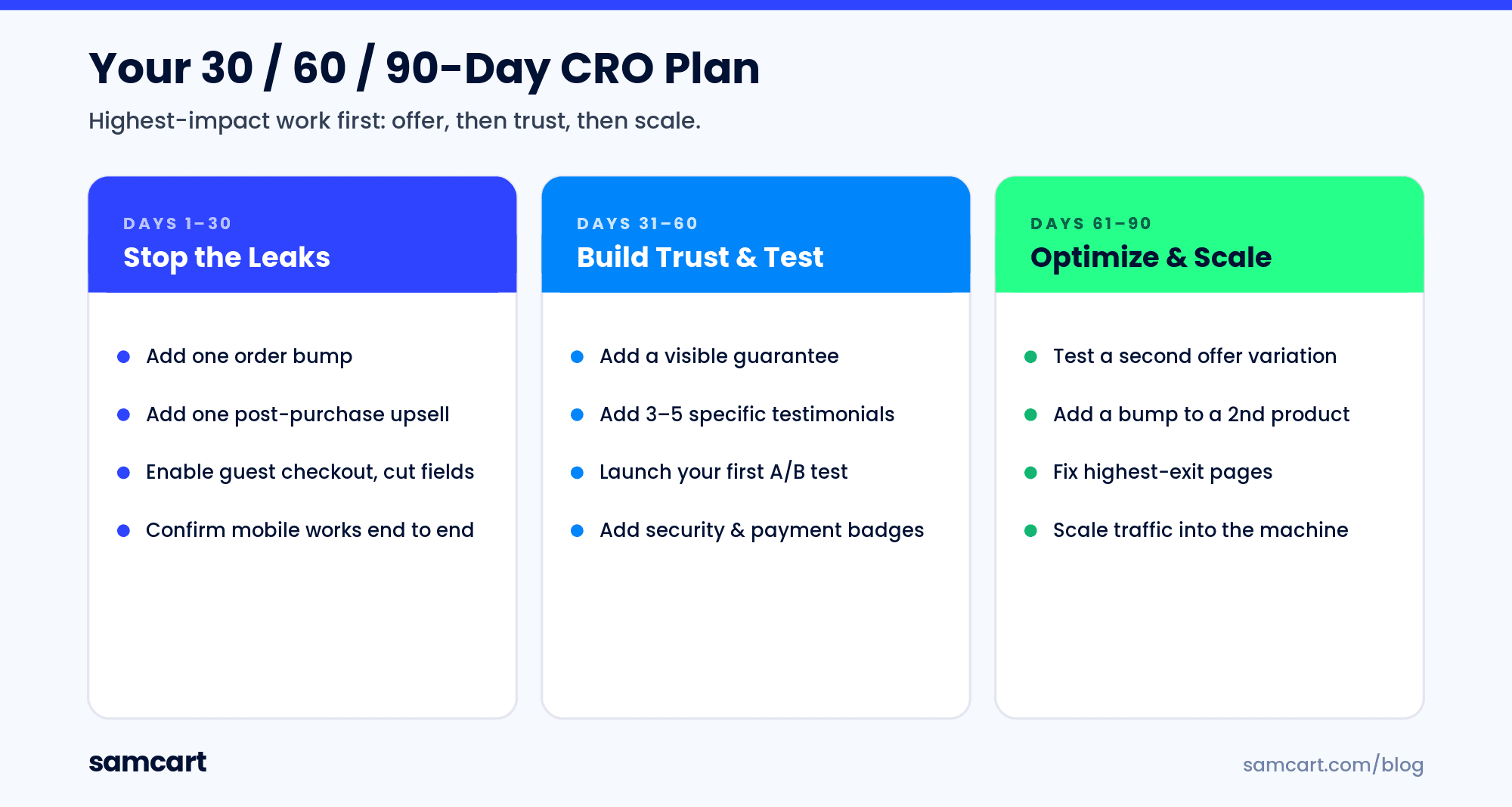
Timeframe | Focus | Actions |
|---|---|---|
Days 1–30: Stop the leaks | Offer + checkout basics | Add one order bump to your best-selling product. Add one post-purchase upsell. Enable guest checkout, cut form fields, and confirm mobile checkout works end to end. |
Days 31–60: Build trust + test | Conversion confidence | Add a visible guarantee and 3 to 5 specific testimonials near the buy button. Launch your first A/B test on your headline or price anchor. Add security/payment badges at checkout. |
Days 61–90: Optimize + scale | Refine and expand | Test a second offer variation. Add a bump to a second product. Review your analytics for the highest-exit pages and fix them. Only now, start scaling traffic into the improved machine. |
Notice what comes first. Not traffic. Not a redesign. The order bump and the upsell, the offer-side levers, lead the plan, because they return the most revenue for the least effort and they compound everything you do afterward.
Conclusion
Ecommerce conversion rate optimization isn't a button-color game. The stores that win in 2026 understand that conversion rate and average order value are one lever pulled from two directions, and the offer side, order bumps and one-click upsells, is where the biggest, cheapest revenue lives. Fix your checkout so you stop losing earned sales, then restructure your offer so every customer is worth more.
SamCart was built for exactly this. Order bumps and one-click upsells are built-in conversion tools, not add-ons you duct-tape together, and they're the same tools behind $7B+ in processed creator sales and an average 42% Day 1 AOV lift.
Start your free trial and add your first order bump today, or see plans that include order bumps and upsells.
SamCart Editorial Team
Brian Moran
Founder
Samara Lemon
VP of Marketing
Leilani Treuting
Marketing Director
Scott Moran
Co-Founder
Frequently Asked Questions
What is a good ecommerce conversion rate?
A good ecommerce conversion rate is typically between 2% and 4%, with most stores averaging around 2% to 3%. Rates above 4% are excellent. That said, your ideal benchmark depends heavily on your price point and traffic source. The more useful measure is whether your own rate is improving over time.
How do I calculate my ecommerce conversion rate?
Divide your number of conversions by your total number of visitors, then multiply by 100. For example, 30 sales from 1,500 visitors equals a 2% conversion rate. Track it over a consistent window (usually monthly) so seasonal swings don't distort the trend.
Do order bumps increase conversion or just average order value?
Both. An order bump raises average order value directly, and a well-chosen, relevant bump can also lift conversion on the core offer by increasing the perceived value of the whole purchase. SamCart data shows adding a single upsell produces an average 42% jump in Day 1 average order value.
What should I optimize first in ecommerce CRO?
Optimize your offer structure and checkout before your traffic. Add an order bump and a post-purchase upsell, remove checkout friction, and make mobile flawless. These changes increase revenue per visitor immediately, so any traffic you add later converts more efficiently.
Is more traffic the fastest way to increase online sales?
Usually not. Traffic amplifies your existing conversion machine, so buying more visitors before fixing conversion just scales your leaks. Improving conversion rate and average order value grows revenue from the traffic you already have, and makes future traffic far more profitable.