Why you should stop selling templates on Etsy (and what to do instead)
Reading Time
6
Published On
Updated On

Brian Moran
Founder

Samara Lemon
VP of Marketing

Leilani Treuting
Marketing Director

Scott Moran
Co-Founder

SamCart is the digital business platform that builds, runs, and scales your online business. AI handles the hard parts, so you keep more of what you earn.
Table of Contents
Title
Share this article
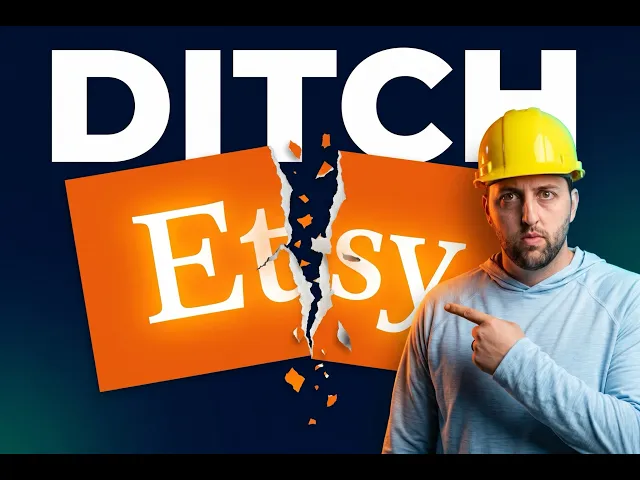
If you're selling templates on Etsy, you're giving away 30-40% of every sale, you don't own your customer list, and you can't sell buyers anything else after checkout. You should sell templates on your own site instead, where you keep 100% of revenue (minus processing), own every customer email, and can add order bumps and upsells that double your income per buyer.
Etsy, Creative Market, and Amazon are discovery engines, not business platforms. SamCart data across 75,000+ businesses shows that 12% of customers become repeat buyers, and that 12% generates 44% of total revenue. On Etsy, you never build that list. Every sale is a stranger. On your own site, every sale is the start of a relationship that compounds over time.
Watch the full breakdown:
Templates are one of the best digital products you can sell. They cost nothing to create, solve a specific problem, and convert like crazy because buyers want a shortcut, not a blank canvas. But selling them on a marketplace is the most expensive way to build a business that doesn't actually belong to you.
Here's what the million-dollar template sellers figured out, and why most of them wouldn't touch Etsy with a ten-foot pole.
What does Etsy actually cost you?
Most template sellers focus on the listing fee and the 6.5% commission. That's not the real cost.
The fees you see:
Etsy: listing fee + 6.5% transaction fee + payment processing
Creative Market: 30% commission on every sale
Gumroad: ~10% + payment processing
The fees you don't see:
You don't get the customer's email address (Etsy keeps it)
You can't add order bumps or upsells (the transaction ends at one item)
Etsy promotes your competitors on your own product page ("similar items" and "you might also like")
You're building Etsy's customer base, not yours
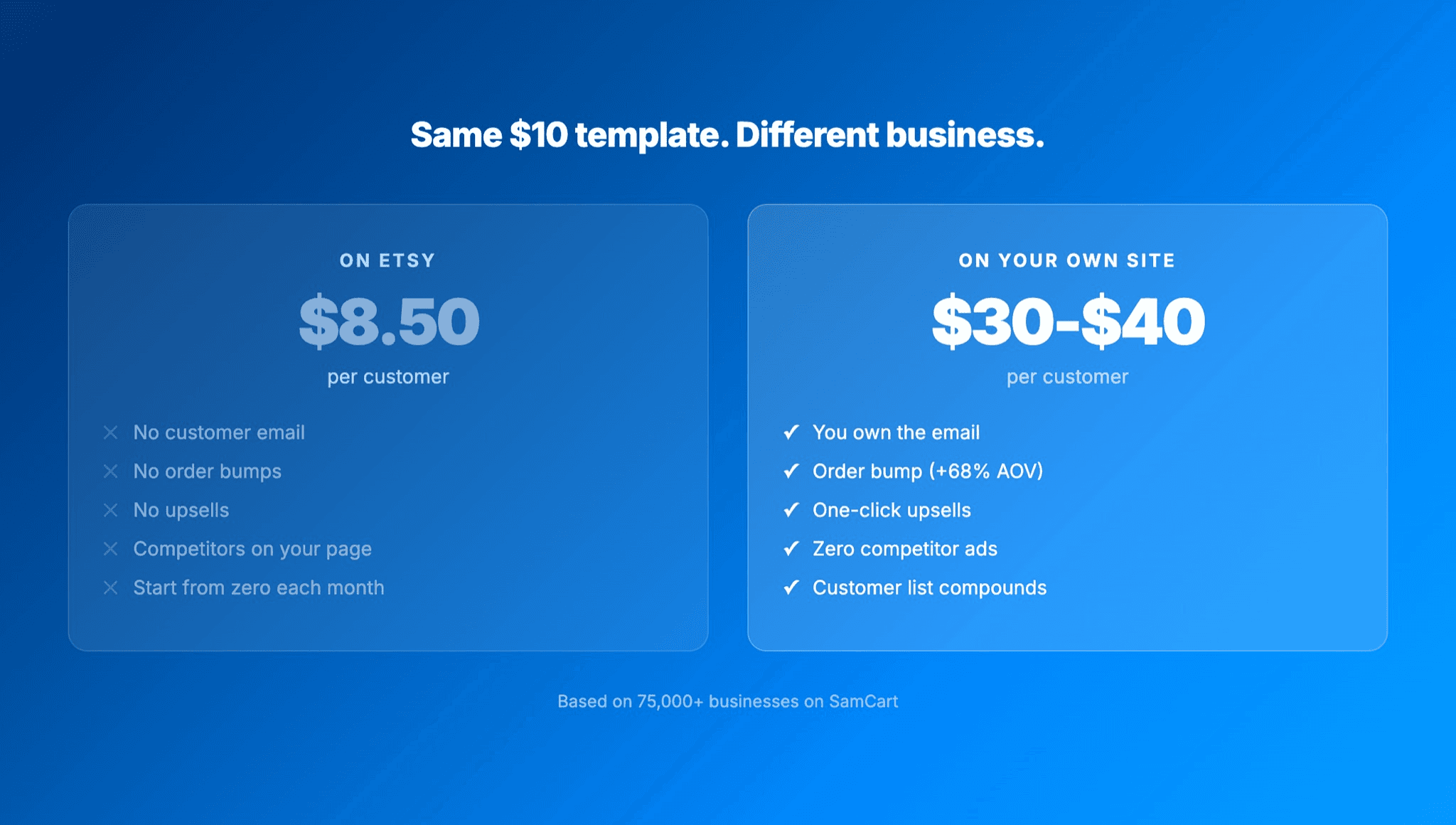
A $10 template on Etsy nets you roughly $8.50 after all fees. That same template on your own site with a $29 order bump (35-40% take rate) and a $97 upsell (20% take rate) generates about $30-$40 per buyer on average. Same template. Same traffic. Completely different business.
Why marketplaces keep your business stuck
The real problem with Etsy isn't the fees. It's that the transaction ends at the first sale.
On a marketplace, someone buys your Canva template for $10. Done. You get a payout notification. That's the entire relationship. You can't email them when you launch a bundle. You can't offer them a course. You can't build recurring revenue. Every month, you start from zero.
On your own sales page, that $10 template buyer sees an order bump at checkout, might grab the bundle, gets a one-click upsell after purchase, and joins your email list. Next month when you launch something new, you've got hundreds of past buyers ready to hear about it.
And while you're paying Etsy a commission, they're actively showing your competitors' products on your listing page. Your customer is literally looking at alternatives while buying your template. You're paying for the privilege of giving Etsy more data to sell against you.
The real math: $10 templates can build a six-figure business
Here's what the product ladder looks like when you own the customer.
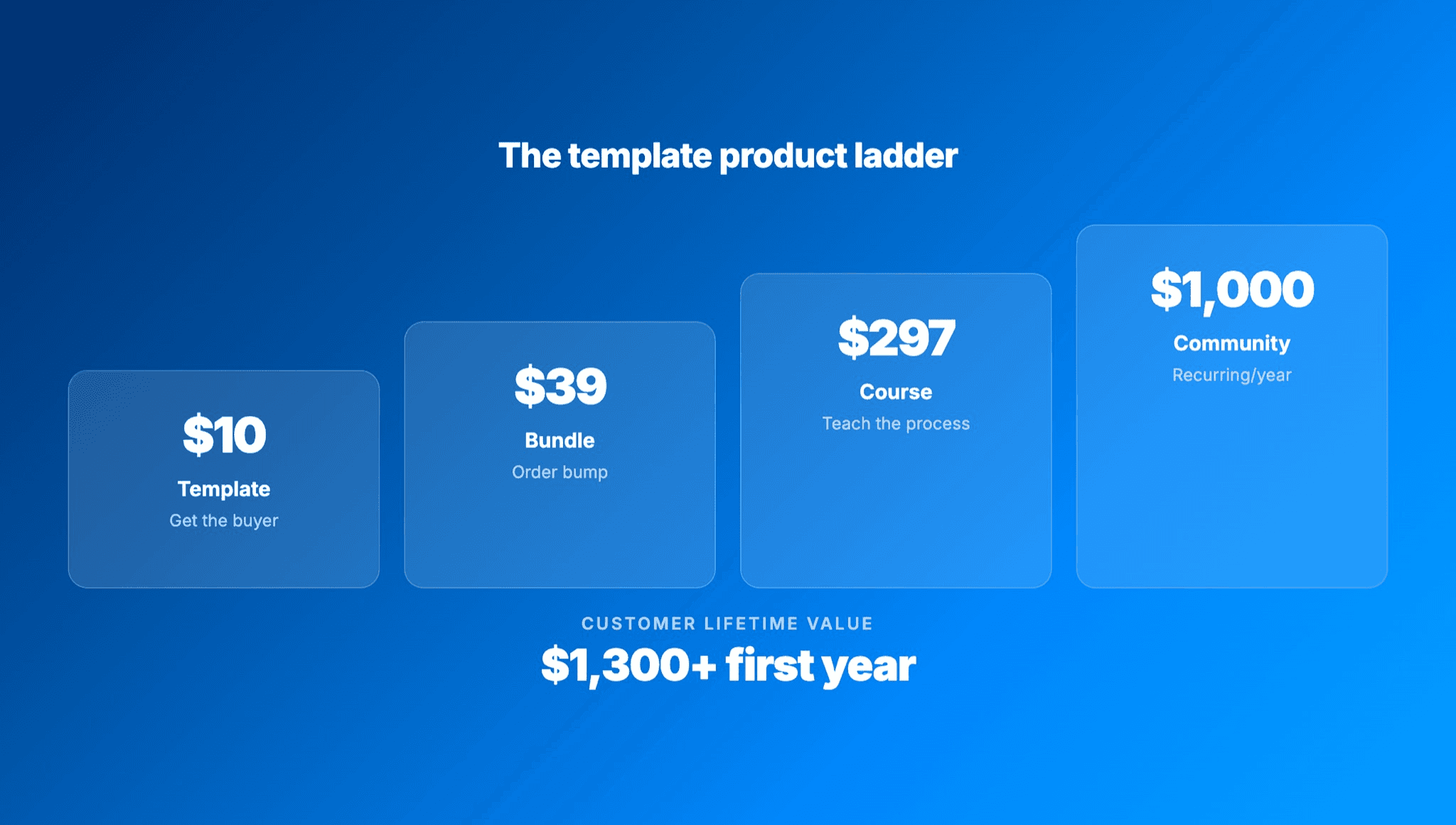
Step 1: $10 template (customer acquisition)
A single Canva template, Notion workspace, or Figma component. The only job of this product is to get someone to trust you with their credit card. Zero cost of goods, pure margin.
Step 2: $39 template bundle (order bump)
Three to ten related templates packaged together. This sits on the checkout page as a one-checkbox add-on. At a 35-40% take rate, this alone changes your business.
Step 3: $297 course or workshop
Your template buyers want to learn how you built the templates. How you think about design systems. How you structure workflows. They're the warmest possible audience for a course.
Step 4: $1,000/year community or membership
Ongoing access to new templates monthly, direct access to you, and a group of people building the same kind of business. This is where revenue becomes recurring and predictable.
The math: A customer enters at $10 and over the next few months moves to a $39 bundle, a $297 course, and a $1,000 annual membership. Your best customer is worth over $1,300 in the first year. All from a $10 template.
On Etsy? That's a notification that you made $8.50. Nothing else happens.
How to sell templates on your own site (step by step)
1. Build one template product
Pick the template type you know best: Notion, Canva, Figma, spreadsheets, Airtable, whatever. Package it as a clean, ready-to-use download. If you're already selling on Etsy, you already have this.
2. Create a sales page
SamCart's AI writes the copy and designs the layout based on your template description. You don't need a web designer or a copywriter. Describe what your template does, who it's for, and the AI builds the page and connects it to checkout.
3. Add an order bump
A bundle, a bonus template pack, or a resource library for $19-$47 extra. It shows up as a checkbox on the checkout page. SamCart data shows order bumps add up to 68% to average order value. This one step alone can double what you make per customer.
4. Add a one-click upsell
After the buyer completes checkout, show them a higher-value offer: a full template vault, a course, or a membership. Their payment info is already saved. One click to buy. Upsells can add another 42% to every sale.
5. Build your email list from day one
Every buyer's email goes into your list. Use it. When you launch new templates, bundles, or courses, you've got a built-in audience of people who already trust you enough to pay.
6. Keep Etsy as a discovery channel (optional)
You don't have to delete your Etsy shop. But every piece of traffic you control - your social media, your link in bio, your ads - should point to your own sales page. Use Etsy for discovery. Own everything else.
What about the marketplace traffic?
The biggest objection: "But Etsy has built-in traffic. People are searching there."
That's real. Etsy does have traffic. But you don't need Etsy's traffic to sell templates. You need 100-200 buyers per month to build a real business. Here's where they come from:
Social media (free): Post 3x/week showing your templates in action. One viral TikTok or Instagram Reel showing a Canva template transformation can drive hundreds of sales.
Pinterest (free): Templates are one of the best-performing product types on Pinterest. Pin your template previews with a link to your sales page.
Your existing Etsy customers: If you have Etsy reviews, screenshot them for social proof on your own page. If Etsy buyers follow you on social media, redirect them.
Paid ads ($5-$20/day): Once your funnel converts at 2%+, a small ad budget on Instagram or Facebook scales fast. Your order bumps and upsells mean you can afford to pay more per click than competitors who only sell a $10 template.
The traffic argument for marketplaces breaks down when you realize that same traffic doesn't build YOUR business. It builds theirs.
The bottom line: own your customers or rent them
There are two ways to sell templates online.
You can rent access to someone else's customers on Etsy, give up 30-40% of revenue, never build an email list, and start from zero every month.
Or you can own your customers on your own site, keep 100% of revenue minus processing, add order bumps and upsells that 2-4x your income per buyer, and build a customer list that compounds over time.
SamCart is $79/mo flat. The AI builds your sales page, writes the copy, designs the checkout, and sets up order bumps and upsells. It's trained on $7B+ in real transaction data across 75,000+ businesses.
Start your free trial and build your first template sales page today. The video above walks through the full strategy.
SamCart Editorial Team
Brian Moran
Founder
Samara Lemon
VP of Marketing
Leilani Treuting
Marketing Director
Scott Moran
Co-Founder
Frequently Asked Questions
Why shouldn't I sell templates on Etsy?
Etsy takes 6.5% commission plus fees, doesn't give you the customer's email, promotes competitors on your listing page, and doesn't support order bumps or upsells. You keep about $8.50 on a $10 sale and can never sell that buyer anything else. On your own site, the same $10 template generates $30-$40 per buyer with order bumps and upsells, and you own the customer relationship.
What's the best alternative to Etsy for selling templates?
SamCart is built for digital product sellers who want to own their customers, add order bumps and upsells at checkout, and build recurring revenue. It starts at $79/mo flat with no transaction fees beyond standard processing. The AI builds your sales page and designs the checkout for you.
How much does Etsy take from template sales?
Etsy charges a $0.20 listing fee, 6.5% transaction fee, and payment processing fees. Creative Market takes 30%. Gumroad takes about 10% plus processing. On SamCart, you pay $79/mo flat and keep everything except standard credit card processing (about 2.9% + $0.30 per transaction).
Can I sell Canva templates on my own website?
Yes. You don't need a custom website. SamCart gives you a hosted sales page with checkout, order bumps, upsells, and automatic file delivery. Upload your Canva template files, and buyers get instant access after purchase. The AI writes your sales page copy and designs the layout.
How do I sell templates without a marketplace?
Build a sales page on SamCart (the AI creates it in minutes), add your template as a digital download, set up an order bump and upsell, then drive traffic from social media, Pinterest, or small paid ad budgets. You'll make more per customer than on any marketplace because you control the entire buying experience.
Is it worth selling templates for just $10?
A $10 template isn't where you make your money. It's how you acquire a customer for almost nothing. With an order bump ($29-$39) and upsell ($97-$297), your average customer value jumps to $30-$40+. Over time, repeat buyers and your product ladder push lifetime value to $1,300+. Templates are the front door, not the business.