How to Sell Fitness Programs Online: The 2026 Creator Playbook
Reading Time
13
Published On
Updated On

Brian Moran
Founder

Samara Lemon
VP of Marketing

Leilani Treuting
Marketing Director

Scott Moran
Co-Founder

SamCart is the digital business platform that builds, runs, and scales your online business. AI handles the hard parts, so you keep more of what you earn.
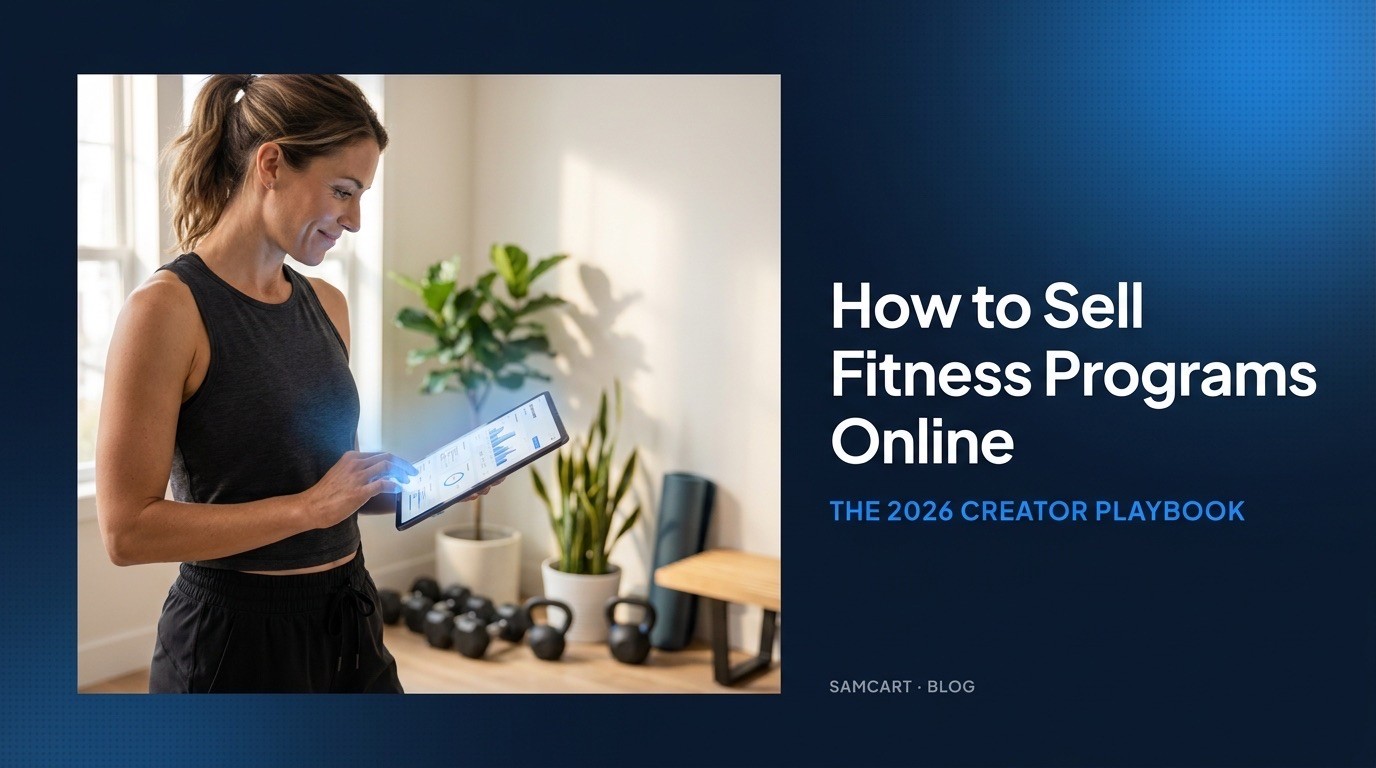
Table of Contents
Title
Share this article
Why fitness creators are quietly out-earning the influencers (the math)
There is a quiet group of personal trainers, gym owners, and coaches making more money than the fitness influencers most people follow. They are not viral. They have under 50,000 followers. Some have under 5,000.
What they have is a digital product, a sales page, and a checkout that converts.
Here is the math that makes this work. A trainer with 4,000 engaged followers can sell a $97 program to 1% of that audience and clear $3,800 in a launch week. Add an order bump and a one-click upsell, and the same launch lifts to roughly $5,400. Run it once a quarter, layer in evergreen sales between launches, and the same trainer is building a six-figure business from a small audience that most people would call "too small to monetize."
The trainers actually doing this are not waiting on a million followers. They are running tight digital businesses on top of a real client base.
The piece most people miss is the platform underneath. You do not need a million followers to sell fitness programs online. You need a way to package the program, charge for it, deliver it, and increase what each customer is worth. Get those four pieces right and the audience size becomes a multiplier on something that already works.
That is what this guide walks you through.
What you actually need to start selling fitness programs online
The starter stack is shorter than most people make it out to be. You need:
A clear program. One thing, one outcome, one type of buyer.
A sales page. Where cold and warm traffic decides if this is for them.
A checkout that converts. Where the wallet actually opens.
A delivery method. Where the buyer accesses the workouts, plans, or coaching after they pay.
A way to lift order value. Bumps, upsells, recurring billing.
That is it. Anything else is optional in month one.
The mistake most fitness creators make is duct-taping five tools together. A landing page builder, a separate checkout, a different course platform, an email tool, and a Zapier subscription holding it all together. That stack costs more than $300/mo before you sell a single program, and every handoff between tools is a place the funnel breaks.
SamCart is the digital business platform that builds, runs, and scales your online business in one place. Sales page, checkout, delivery, upsells, recurring billing, and AI that builds the page for you. From your first program to your first million, with no engineering team needed. Plans start at $79/mo.
The rest of this playbook walks through each step.
Step 1: Pick the program format that fits your client (1:1, group, hybrid, on-demand)
There are four formats that work for selling fitness online in 2026. Pick one. Do not run all four out of the gate.
1:1 coaching. Highest price point, lowest scale. Sells for $300 to $2,000+ per month per client. Right when you are starting and need cash flow. Wrong when you want to step away from the calendar.
Group coaching. Cohort or rolling enrollment. Live calls plus a shared training plan. Sells for $97 to $497 per month. Good middle ground between income and time. Builds community, which lifts retention.
Hybrid (group plus 1:1 check-ins). What most $10K to $30K/mo fitness coaches actually run. Group container with periodic 1:1 calls. Sells for $197 to $997. Best ratio of revenue to hours.
On-demand programs. PDF plans, video library, app-based delivery, or a 4 to 12 week training arc. Sells for $27 to $297 one time, or $19 to $97/mo for membership access. Highest scale, lowest hours per buyer. The format that breaks the time-for-money trade.
For a first launch, pick on-demand if you want scale and 1:1 if you need cash this week. Most fitness creators start at 1:1 and move to on-demand once they can prove the program works.
The good news is the platform decision does not change between formats. Same checkout, same delivery, same upsell stack. You can launch 1:1 today and add an on-demand version next quarter without rebuilding anything.
Step 2: Price your fitness program for real income, not vanity downloads
The number one pricing mistake fitness creators make is pricing for downloads instead of pricing for income.
Selling a $9 PDF feels easy. The math is brutal. You need 1,000 buyers to clear $9,000. You need a hook strong enough to cut through saturated fitness content and convert at a tiny price point that signals it is not serious.
Selling a $197 program changes everything. 50 buyers gets you to roughly $9,850. The buyer is more committed, sticks with the program longer, and is open to an upsell. The math is friendlier and the customers are better.
Here is the pricing logic that actually works for fitness programs:
Beginner trainers. $97 to $197 for an 8 to 12 week program. Test the offer, build the case studies, then raise.
Trainers with 1+ year of paying clients. $297 to $497 entry. The proof is there. Charge for it.
Coaches with documented transformations. $497 to $1,997 for a flagship program. Add a $97 to $197 starter offer underneath as a tripwire.
Almost everyone underprices on the first launch and overcorrects six months later. The faster move is to price at the upper end of where your testimonials support, and let the price filter for the buyers who will actually finish the program.
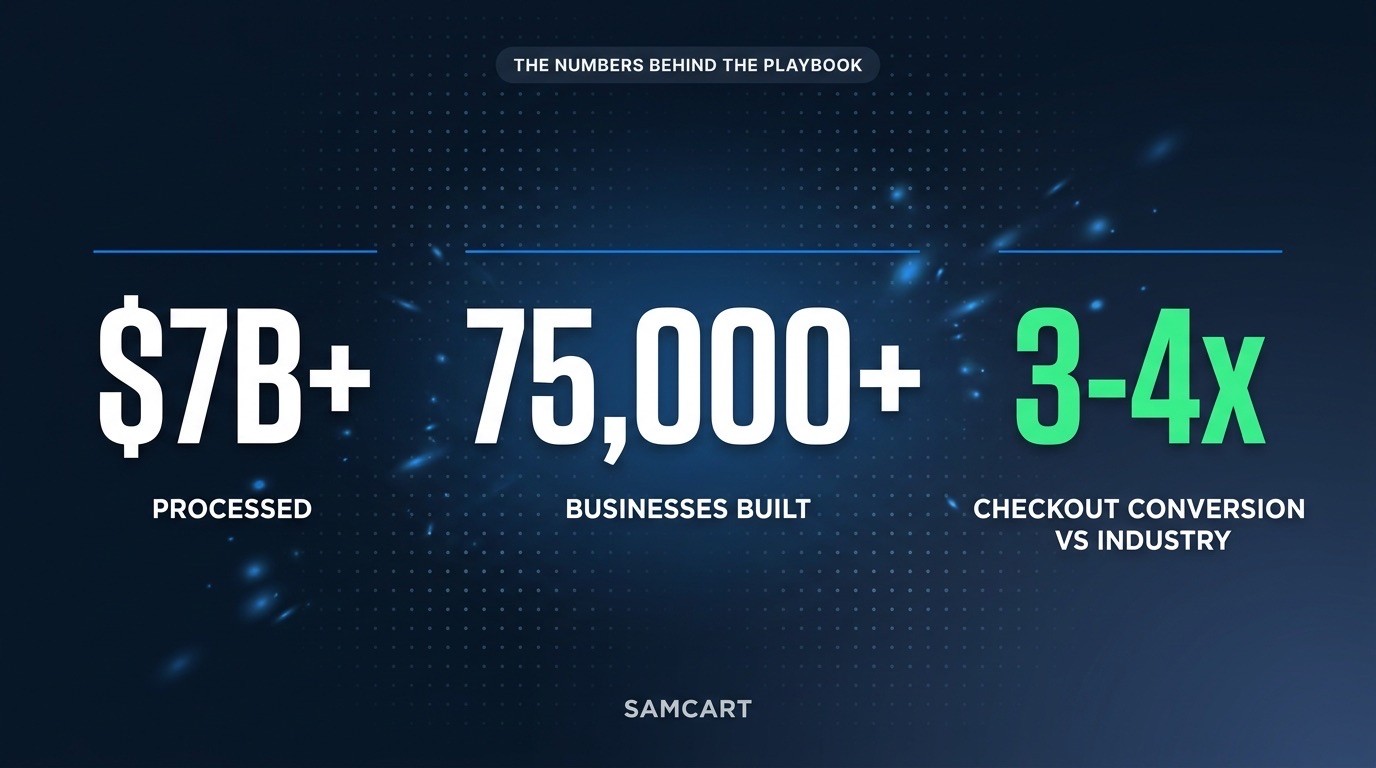
A note on $7B+ of real transaction data across 75,000+ businesses: front-end fitness products at $97 to $197 consistently produce more total revenue than the same product priced at $27 to $47, even with lower conversion rates. The dollar volume per visitor is what matters, not the percentage of buyers.
Price is not what you charge. Price is who you attract.
Step 3: Build the sales page that converts cold traffic
The sales page is where the program either sells itself or dies quietly.
A fitness sales page that converts has six things on it, in this order:
Headline that names the outcome and the timeline. "How busy moms drop 15 pounds in 12 weeks without giving up wine night." Specific outcome, specific buyer, specific timeframe. Not "transform your life with fitness."
A short story or hook video. 60 to 90 seconds. The buyer needs to know who you are and why you, in under two minutes.
The promise. What they get. What changes. The problem before, the result after.
Proof. Before and afters, testimonials with real names, screenshots of client wins. Three to seven proof points beats one or two. Twenty starts to look like noise.
What is included. Training plan, video library, app access, support group, anything physical. Bullet it out so the buyer can see the value stack.
The CTA and price. One offer. One button. One price. Add a money-back guarantee if it fits the program.
Sales pages with these six pieces convert 2 to 4 times better than pages missing two or more. This is true across every fitness niche we have processed across $7B+ in transactions: weight loss, strength training, postpartum, masters athletes, mobility, sports performance.
The easier version of this is the page builder doing it for you. SamCart's AI is fine-tuned on $7B+ in real transaction data across 75,000+ businesses, and it writes the page and designs it at the same time. You answer a few questions about the program and the buyer, the AI Designer formats every page, and what comes out is structured to convert from the first draft. From there you tweak instead of starting from a blank canvas.
For most fitness creators, this is the difference between launching in three days and launching in three months.
Step 4: Set up checkout, upsells, and recurring billing in one place
This is where most fitness funnels break.
The buyer reads the sales page, decides to buy, hits the button, and lands on a checkout that loads slowly, asks for too much information, looks like a different brand, or breaks on mobile. Conversion rate gets cut in half on the page that should close the sale.
A checkout that converts has four things:
Loads fast on mobile. More than 60% of fitness program purchases happen on phones. A two-second delay tanks the close rate.
One page, not three. Cart, payment, confirm, all in one flow. Every extra step is a drop-off.
Trust signals. Money-back guarantee, secure badge, real testimonials at the bottom of the checkout.
Bumps and upsells built in, not bolted on. This is the part that actually moves the math.
SamCart checkouts convert 3 to 4 times higher than the industry average, and the reason is simple: every piece is built around what makes a buyer click "complete order" instead of bouncing. One-page flow, mobile-tuned, bumps below the price, one-click upsell after the buy. Same checkout your favorite fitness creator is probably using right now whether they post about it or not.
The recurring billing piece matters too. If you are running a coaching membership or a monthly app subscription, the platform handles the rebill, the failed card recovery, and the cancellation flow without a developer. Rebills that recover roughly 25% of declined cards over the next 14 days are not a "nice feature." That is real revenue most platforms quietly leak.
Step 5: Deliver the program (PDF plans, video workouts, member portal)
Delivery is the boring part everyone gets wrong.
The buyer just paid. They are excited. The next 30 minutes decides whether they finish the program, ask for a refund, or quietly disappear. If the delivery experience is messy, the refund rate climbs and the testimonials never come.
Three formats that work:
PDF plus video library. Simple, fast, low overhead. Best for a first program. Hosted in a member area or sent direct after purchase.
Member portal with weekly drip. Modules unlock weekly to keep the buyer pacing through the program. Good for 8 to 12 week arcs. Reduces overwhelm.
App-based delivery. Highest perceived value, highest cost to build. Worth it once the program is proven and the buyer base is big enough to justify the build.
You do not need a custom app to start. PDF plus video, delivered through a clean member area, beats a half-finished app every time.
SamCart handles delivery natively. The buyer gets login access the moment payment clears, the program shows up in a member portal that matches your brand, and you control whether content drips or unlocks all at once. No Zapier, no separate course platform, no second monthly fee.
If you have already built a program inside an app like Trainerize or TrueCoach, you can use SamCart as the front door (sales page, checkout, upsells) and pass the buyer into the app on the back end. Most six-figure fitness creators run that exact stack.
Step 6: Add an order bump that lifts AOV by 42%
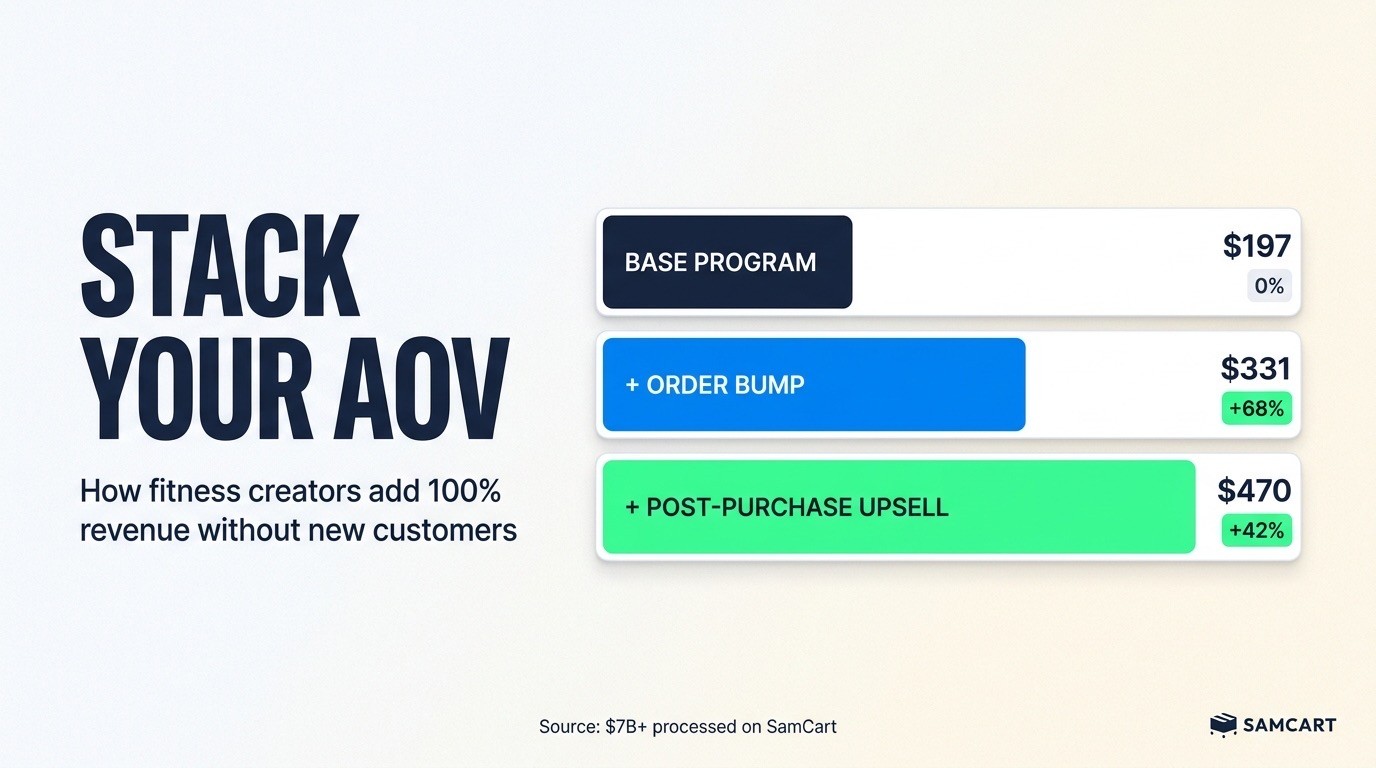
This is the step almost every fitness creator skips, and it is the single fastest way to add 30 to 60% revenue without changing your offer.
An order bump is a small add-on offered on the checkout page itself, with a single checkbox. The buyer is already in payment mode. Adding a $19 nutrition guide to a $197 program is a much smaller decision than convincing a stranger to buy the $197 program in the first place.
Real numbers from $7B+ processed across 75,000+ businesses: order bumps add up to 68% to average order value, and post-purchase upsells lift AOV by 42% on top of that. Compounded together, the same 100 buyers can generate 50 to 100% more revenue without a single new customer.
What works as a fitness order bump:
A nutrition guide or meal plan PDF ($19 to $39)
A mobility or warm-up routine ($14 to $29)
A printable workout journal ($9 to $19)
A "first 30 days" video walkthrough ($27 to $47)
A supplement protocol or grocery list ($14 to $24)
The rule is simple: the bump should make the main program work better, not solve a different problem. If the program is a 12-week strength plan, the bump is a nutrition guide that pairs with it, not an unrelated yoga course. For a full breakdown of how to structure these, see the complete guide to order bumps.
After the buy, layer a one-click upsell. This is where you offer the next tier (group coaching, advanced program, monthly community) for one click of upgrade. Buyers who just bought are 5 to 10 times more likely to buy again in the next 60 seconds than they are at any other point in the relationship. See upselling strategies for how to sequence these the right way.
If you are running a fitness funnel without a bump and an upsell, you are leaving roughly half of your possible revenue on the table. That is not a guess. That is the average across tens of thousands of businesses doing this.
Step 7: Use AI to scale without burning out
The honest version of running a fitness business in 2026 is that the work doubles right when you start to win. You sell more programs, you have more clients to onboard, more questions to answer, more launches to plan, more emails to write, more pages to update.
AI is what keeps this from breaking you.
Three places it actually moves the needle:
Page creation and refresh. SamCart's AI Designer writes and designs the sales page based on your offer, your buyer, and what is already converting across the platform. When you launch a new program, you do not start from a blank canvas. You start from a page that is 80% there and refine the last 20%.
Email and follow-up. The AI drafts launch sequences, abandoned cart flows, and post-purchase delivery emails. You edit for voice and ship.
Repurposing. A program launch turns into social posts, ad copy, an email sequence, and a webinar slide deck without rewriting from scratch.
The piece that matters is that the AI is not a generic chatbot. It is fine-tuned on $7B+ in real transaction data across 75,000+ businesses, which means the suggestions are based on what is actually converting in fitness, coaching, and digital products right now. Not what worked in 2019.
Done right, AI is what lets a one-person fitness business operate like a team of five.
Real fitness creators making $10K to $100K/mo
Three quick patterns from across the SamCart customer base. Names anonymized.
The strength coach who sold 1,200 copies of a $47 program. Started with a single PDF plan and a 30 minute walkthrough video. Sold to her existing email list of 6,000 over a 4-day launch. Added a $19 nutrition bump on checkout. Total launch: roughly $58,000, with the bump adding $14,000 of that. Did the same launch every quarter for a year.
The masters athlete coach with a $297/mo group program. Charged for hybrid coaching: weekly group call, training plan, private community. Capped at 100 members. Hit cap in month four. Roughly $30K/mo recurring with one part-time assistant. The platform stack: sales page, checkout, recurring billing, member portal, all in SamCart.
The postpartum trainer with a $497 flagship and a $97 starter. Ran the starter as a tripwire. About 18% of starter buyers upgraded to the flagship within 30 days. Average revenue per buyer landed near $190 across the funnel. Scaled to $25K/mo with paid traffic feeding the starter offer.
None of these are influencers. None of them have huge followings. All three figured out the product, the page, the checkout, the bump, and the delivery, and let the math work.
Common mistakes that kill fitness program sales
A short list of the patterns we see kill fitness programs before they get traction:
Pricing too low. $9 to $27 PDFs need huge volume to clear meaningful revenue. Most never get there.
Selling to "everyone." Programs that promise "transform your life" sell worse than programs that promise "drop 15 pounds in 12 weeks for busy moms." Specific beats broad every time.
No proof on the page. A sales page without testimonials, before/afters, or real client wins converts at a fraction of one with proof. Even three is enough to start.
Skipping the bump and upsell. Single-product checkouts leave 30 to 60% of revenue on the table. The math is not optional, it is the difference between hobby income and real income.
Five tools instead of one. Every handoff between landing page, checkout, course platform, and email tool is a place the funnel breaks. One platform that does the whole thing has fewer leaks.
Launching without an audience warm-up. A cold launch to people who have never heard of you converts at less than 1%. Three to seven days of warm-up content beforehand can lift the launch by 3 to 5 times.
Building the program before testing the offer. The faster move is to sell the program first with a sales page and a 2-week delivery window, and build the content during week one. If nobody buys, the program was wrong, not the build.
The fix for almost every one of these is the same. Pick a smaller, more specific buyer, charge more for a clearer outcome, run a real launch with a bump and an upsell, and use a platform that handles the whole stack.
SamCart Editorial Team
Brian Moran
Founder
Samara Lemon
VP of Marketing
Leilani Treuting
Marketing Director
Scott Moran
Co-Founder
Frequently Asked Questions
How much should I charge for an online fitness program?
For most fitness creators, $97 to $497 is the sweet spot. New trainers should start at $97 to $197 to validate the offer. Trainers with 1+ year of paying clients can price at $297 to $497. Coaches with documented transformations can run $497 to $1,997 for a flagship program with a smaller starter offer underneath.
Do I need a website to sell workout plans?
No. You need a sales page and a checkout. SamCart provides both in one platform, with a custom domain attached, so the program looks like it lives on its own site without you building a full website. Most six-figure fitness creators run a single sales page per program, not a full website.
What is the best platform to sell fitness programs?
The best platform is one that handles the sales page, checkout, upsells, recurring billing, and delivery in one place, without bolting tools together. SamCart is the digital business platform built for this exact use case, with checkout conversion 3 to 4 times higher than the industry average and AI that builds the page for you. For a broader look at platform options, see the 2026 platform comparison. For a direct head-to-head, see
How do I deliver a fitness program after someone buys?
The simplest delivery is a member portal with the program PDF, video library, and any bonus content. Members log in immediately after purchase and access everything in one place. SamCart handles delivery natively, so you do not need a separate course platform. If you already use a training app like Trainerize, SamCart can pass the buyer into the app on the back end.
Can I sell fitness programs without a huge social following?
Yes. The math works on small audiences. A coach with 4,000 engaged followers can clear $30K to $60K/year on a single program with a real launch, an order bump, and an upsell. Audience size matters less than offer specificity, sales page quality, and checkout conversion.