How to Increase Average Order Value: 9 Proven Strategies (With Real Data)
Reading Time
8
Published On
Updated On

Brian Moran
Founder

Samara Lemon
VP of Marketing

Leilani Treuting
Marketing Director

Scott Moran
Co-Founder

SamCart is the digital business platform that builds, runs, and scales your online business. AI handles the hard parts, so you keep more of what you earn.
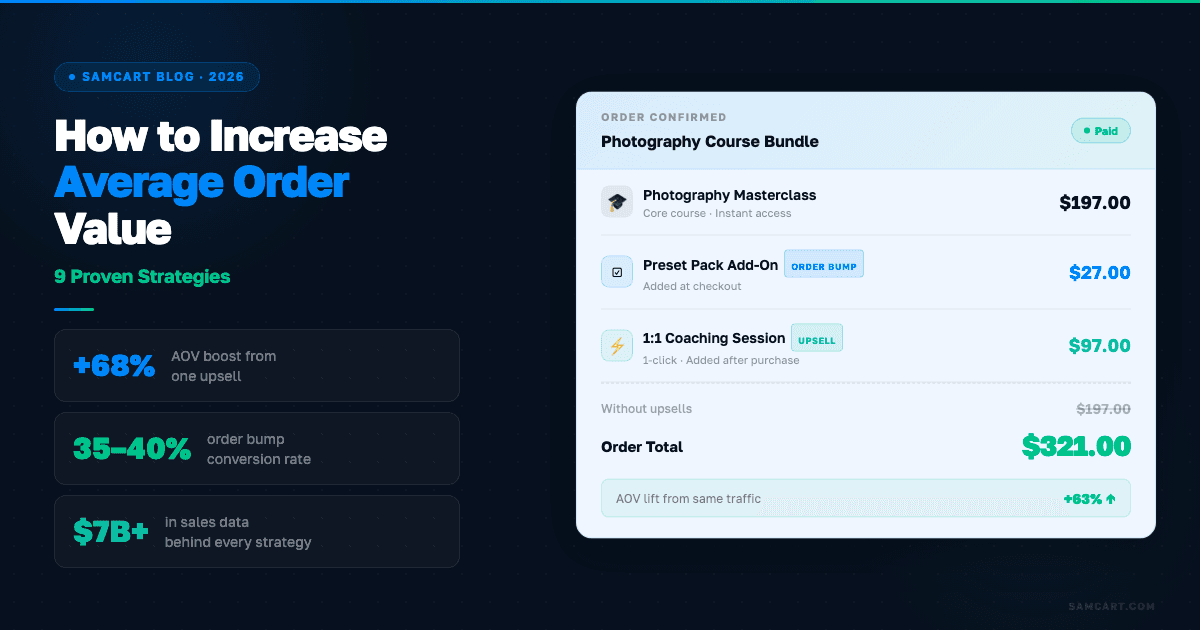
Table of Contents
Title
Share this article
The fastest way to increase average order value is to add post-purchase upsells and pre-checkout order bumps to your existing sales flow. How fast? A $47 product with a $47 order bump and a $497 upsell turned into $154 per customer on SamCart. Same traffic. Same audience. Same product. Completely different business.
That is not a hypothetical. That order bump converted at 56%. The upsell converted at 6.87%. And the seller tripled their effective AOV without spending another dollar on ads. SamCart's data from $7B+ in processed sales across 75,000+ businesses shows that creators who add a single one-click upsell see an average 68% increase in average order value, and order bumps convert between 35-40% of the time.
Most creators pour their energy into getting more eyeballs. More ads. More content. More launches. And traffic matters. But if you are not optimizing what happens after someone decides to buy, you are working three times harder for the same revenue.
This post breaks down 9 strategies to increase your average order value, backed by real conversion data from digital product sales. No theory. No Shopify-centric advice that does not apply to courses and digital products. Just the playbook that works.
What Is Average Order Value (And Why It's the #1 Revenue Lever Most Creators Ignore)?
Average order value (AOV) is the average amount a customer spends per transaction. The formula is simple: total revenue divided by total number of orders.
Here is where it gets interesting for digital product sellers. Increasing AOV is 3-5x easier than increasing traffic. You have already done the hardest part: getting someone to pull out their credit card. Everything after that decision point is incremental revenue at near-zero cost.
The math makes this obvious. Say you sell 100 orders per month at $47 each. That is $4,700. Now add a $27 order bump that 35% of buyers accept and a $97 upsell that 25% take. Your effective AOV jumps to about $80, and your monthly revenue hits $8,000, almost double, from the same 100 customers.
That is $39,600 more per year without spending another dollar on ads.
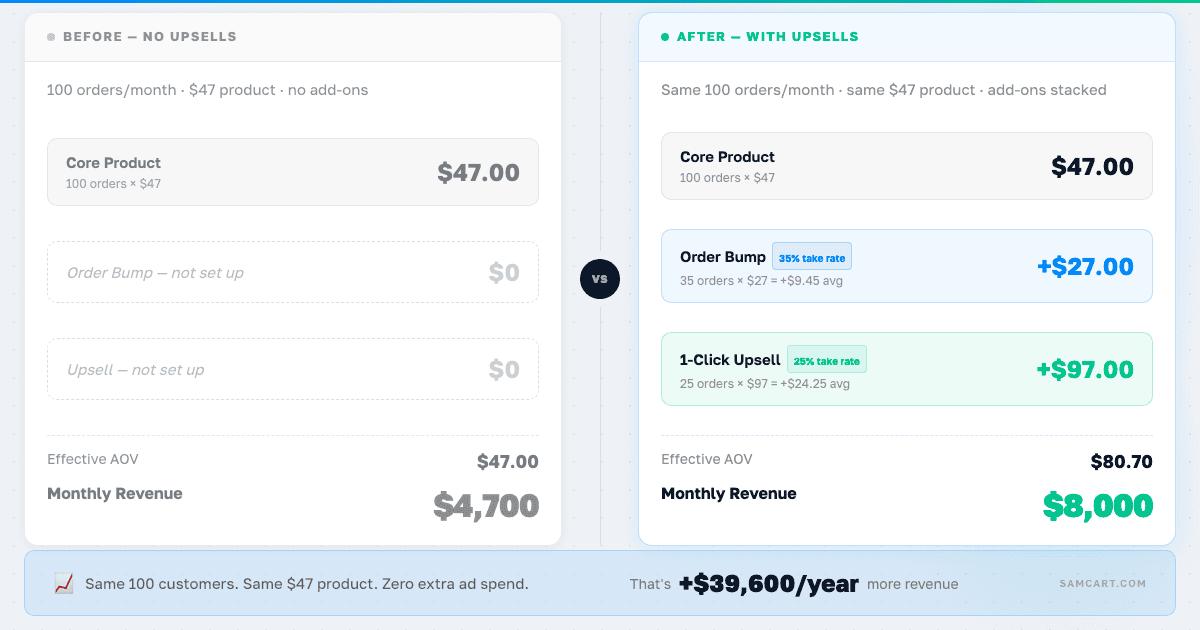
Most creators obsess over getting more customers. The smart ones obsess over getting more from each customer. This is the Business Math that separates five-figure sellers from six-figure sellers using the exact same traffic.
What's a "Good" Average Order Value?
Average order value varies significantly by product type. Here are real benchmarks from digital product businesses:
Product Type | Typical AOV Range | AOV With Upsells/Bumps |
|---|---|---|
Online courses | $150–$400 | $250–$650+ |
Coaching programs | $500–$2,000 | $700–$3,000+ |
Templates and tools | $40–$120 | $65–$200+ |
Memberships (first-year value) | $50–$150 | $80–$250+ |
eBooks and digital downloads | $15–$50 | $30–$90+ |
These are not survey numbers pulled from marketing blogs. They are based on actual transaction patterns from 75,000+ businesses processing through SamCart. The gap between the "typical" column and the "with upsells/bumps" column represents money that most sellers are currently leaving on the table.
If your AOV sits below the typical range for your product type, the strategies below will move the needle fast. If you are already in the typical range, adding just one upsell or order bump can push you into the higher column.
9 Strategies to Increase Average Order Value
1. One-Click Upsells (The Biggest Win)
A one-click upsell is an offer presented immediately after a customer completes their purchase. The customer's payment information is already stored, so they can accept with a single click. No re-entering card details. No friction.
This is the single most impactful AOV strategy for digital product sellers. SamCart creators who use one-click upsells see an average 68% increase in average order value. That is not a marginal improvement. It changes the entire economics of your business.
Here is what a strong upsell looks like: someone buys your $197 course, and on the next page you offer a $97 implementation coaching add-on. At a 25-30% take rate, that single upsell adds roughly $25-$29 to every order on average.
The key to high-converting upsells is congruence. The upsell must be the logical next step for someone who just bought your main product. A course buyer wants help implementing what they just learned. A template buyer wants the advanced version or a video walkthrough. The more directly your upsell connects to what the customer just purchased, the higher your conversion rate.
Avoid this common mistake: making your upsell completely unrelated to the front-end product. A fitness course buyer does not want a business coaching program on the next page, no matter how good it is.
2. Order Bumps (The Easy Money)
An order bump is a checkbox offer that appears directly on the checkout page, before the customer completes their purchase. Think of it like the impulse buy at the grocery store register, except it can add serious revenue.
Order bumps convert at 35-40% across SamCart, and adding a single order bump increases average customer value by about 31%. That is pure incremental revenue from customers who were already buying.
The best order bumps for digital products are low-friction, complementary add-ons: companion workbooks, checklists, quick-start guides, bonus templates, or resource libraries. Price them in the $17-$47 range for maximum conversion. They should feel like a no-brainer addition, not a separate purchase decision.
One SamCart creator selling photography editing courses added a $47 preset pack as an order bump and saw a 40% increase in revenue from the same traffic. Another course creator hit a 56% order bump conversion rate on a $47 add-on, which is unusually high but demonstrates what is possible when the offer is perfectly congruent.
The rule of thumb: if your order bump costs roughly the same as or less than your main product and directly enhances it, you are in the sweet spot.
3. Product Bundles
Bundling packages complementary products together at a perceived discount. Instead of selling your course, templates, and community access separately, you offer all three for $297 and show the individual value at $447.
Bundles increase AOV because customers spend more in a single transaction than they would buying one product alone. They also increase perceived value, because the buyer feels like they are getting a deal even though you are collecting more revenue per order.
For digital product sellers, bundles work especially well because there is no incremental cost of goods. Adding a template pack to a course bundle costs you nothing but increases the order value significantly.
Strong bundle structures follow the "good/better/best" model: the standalone course at one price, the course plus templates at a slightly higher price, and the full bundle with coaching access at the premium tier. This naturally anchors buyers toward the middle or top option.
4. Tiered Pricing (Good/Better/Best)
Three pricing tiers, anchored by a premium option, consistently outperform single-price offers. The psychology is straightforward: the highest tier makes the middle tier look like the "smart" choice, and the lowest tier exists to make the middle tier look like the better value.
Businesses with three or more pricing tiers typically see 15-25% higher AOV than those with a single price point. The premium tier does not need to be your highest seller. Its job is to reframe what the middle tier is worth.
Here is how this might look for a course creator. Tier one: the course alone for $197. Tier two: the course plus a workbook and bonus module for $297 (most popular). Tier three: the course plus everything in tier two, plus group coaching calls for $497. Most buyers pick tier two, which is $100 more than they would have paid with a single $197 price. (If you are still building out your course offer, this guide on how to sell online courses covers the full process from idea to revenue.)
The key is making the middle tier feel like the obvious choice by loading it with enough value that skipping it feels like leaving money on the table.
5. Payment Plans (The AOV Paradox)
This one surprises most sellers. Offering a payment plan can actually increase your total collected revenue per customer.
Here is why: a buyer who would pay $197 as a single payment might hesitate at $297. But offer three payments of $99 ($297 total), and resistance drops because the per-payment commitment feels manageable. You collect $100 more per customer. They get the same product with a lower monthly commitment. Both sides win.
Payment plans are especially powerful for coaching programs, premium courses, and high-ticket digital products. They remove the price objection without requiring you to discount.
The math: if 30% of your buyers choose a $297 payment plan instead of paying $197 upfront, your effective AOV increases even though fewer people pay in full. The total revenue collected is higher.
One important consideration: payment plans do increase the risk of failed payments over time. A strong subscription recovery tool, like the kind built into SamCart's platform, protects against this by automatically recovering failed charges.
6. Cross-Sells on the Thank-You Page
The thank-you page is the most underutilized real estate in digital commerce. Your buyer just committed. Trust is at its highest. And most sellers show a generic "thanks for your purchase" message and walk away.
Instead, use the thank-you page to surface related products, upcoming workshops, or premium upgrades. This is not the same as an upsell, because the buyer has already completed the full checkout flow. Think of it as a gentle recommendation: "Customers who bought this course also enrolled in..."
For course creators, this is where Course Cross-Sells become powerful. A student who just enrolled in your beginner photography course sees a recommendation for your advanced editing workshop. They already trust you. They are already in learning mode. Conversion rates on well-placed thank-you page cross-sells consistently outperform cold offers.
7. Quantity Discounts (Team and Group Pricing)
"Buy 3 licenses for 20% off" is an instant AOV multiplier. This strategy works for course creators selling to companies, coaches offering team access, and anyone whose product can serve multiple people.
Group pricing works because the buyer is spending more in total, even at a per-unit discount. A single $297 course license generates $297. Three licenses at $237 each (20% off) generates $711. Your AOV just tripled.
This is particularly effective for B2B-adjacent digital products: leadership training, team productivity courses, professional development programs. The decision-maker buying for a team has a different budget than an individual buyer.
8. Personalized Recommendations
Using purchase data to suggest relevant add-ons creates a tailored buying experience that increases AOV. When a buyer sees "customers who bought X also bought Y," it feels like a helpful suggestion rather than a sales pitch.
SamCart's platform surfaces conversion data for every product in your catalog, so you can identify which upsells and bumps perform best with which front-end products. This is not guesswork. It is data-driven matching.
The highest-converting recommendations follow a simple principle: the suggested product should help the buyer get better results from what they just purchased. A course buyer gets recommended the implementation toolkit. A template buyer gets recommended the video tutorial. The connection should be immediate and obvious.
9. Strategic Price Anchoring
How you frame the price matters as much as what the price is. Price anchoring means showing a higher reference point before revealing the actual price, making the real price feel like a deal.
Common anchoring techniques for digital product sellers: show what the individual components would cost if purchased separately ("$847 value, yours for $297"). Show what comparable coaching or consulting would cost on an hourly basis. Show the ROI in concrete terms ("If this course helps you land one additional client at $2,000, it pays for itself 10x over").
Anchoring is not about deception. It is about helping the buyer understand the actual value of what they are getting relative to the price. When buyers perceive a gap between value and price, they buy more confidently, and they are more open to adding bumps and upsells because the whole transaction already feels like a win.
The AOV Stack: Putting It All Together
Here is what a fully optimized digital product funnel looks like when you layer these strategies:
Front-end product: $197 online course
Order bump: $27 companion workbook (35% take rate = +$9.45 per order)
One-click upsell: $97 implementation coaching (25% take rate = +$24.25 per order)
Effective AOV: $230.70
That is a 17% AOV increase with zero additional traffic, zero additional ad spend, and zero additional content creation. Every one of those 100 monthly customers is now worth $33.70 more to your business.
Annualized, that is $40,440 in additional revenue from the same customers you are already acquiring.
Now add a second upsell, a payment plan on the front end, and group pricing for your coaching tier. The compounding effect is where digital product businesses break through revenue plateaus.
How to Choose the Right Tools for Increasing AOV
The tools you use matter because they determine how much friction sits between your customer and their next purchase. Here is what to look for:
Built-in upsells and order bumps. If your platform requires third-party plugins or custom code to offer post-purchase upsells, you are adding friction and losing conversions. SamCart includes one-click upsells, order bumps, and smart upsell funnels natively. Every SamCart plan includes these features starting at $79/mo.
Real conversion data. You need to know which upsells convert, at what rate, and with which front-end products. Guessing costs money. SamCart's Offers Report shows exactly how every bump and upsell performs, so you can double down on winners and cut what is not working.
AI-powered page creation. Your upsell and bump pages need to convert. SamCart's AI writes your sales copy and designs your pages, trained on data from $7B+ in transactions across 75,000+ businesses. That means every page you create is informed by what actually works.
Stored payment information. True one-click upsells require stored credit card data. If your customer has to re-enter payment details, it is not a one-click upsell. It is a second checkout, and your conversion rate will reflect that.
Common AOV Mistakes to Avoid
Upselling something unrelated. Your upsell must be the logical next step. A customer who just bought a meal planning course does not want an unrelated business coaching program. Congruence is the number one predictor of upsell conversion rates.
Too many offers creating decision fatigue. One order bump and one or two upsells is the sweet spot for most sellers. Showing five different add-ons at checkout overwhelms buyers and can actually decrease your overall conversion rate.
Not testing upsell pricing. A $97 upsell might convert at 20%, but a $67 upsell might convert at 35%. Which generates more revenue? You will not know unless you test. Run the math on total revenue, not just conversion rate.
Ignoring post-purchase opportunities. The thank-you page, the course dashboard, the follow-up email sequence. Every touchpoint after the initial sale is a chance to increase lifetime value.
Running no order bump at all. This is the biggest miss. Order bumps are the lowest-effort, highest-return AOV strategy available. If you are selling digital products without an order bump on your checkout page, you are leaving the easiest revenue on the table.
Ready to increase your average order value? Start your free SamCart trial and set up your first upsell in minutes. Every plan includes one-click upsells, order bumps, smart upsell funnels, and AI-powered page creation, starting at $79/mo.
SamCart Editorial Team
Brian Moran
Founder
Samara Lemon
VP of Marketing
Leilani Treuting
Marketing Director
Scott Moran
Co-Founder