8 Upsell Strategies That Increased AOV by 68% [Real Data]
Published On
Updated On

Brian Moran
Founder

Samara Lemon
VP of Marketing

Leilani Treuting
Marketing Director

Scott Moran
Co-Founder

SamCart is the digital business platform that builds, runs, and scales your online business. AI handles the hard parts, so you keep more of what you earn.
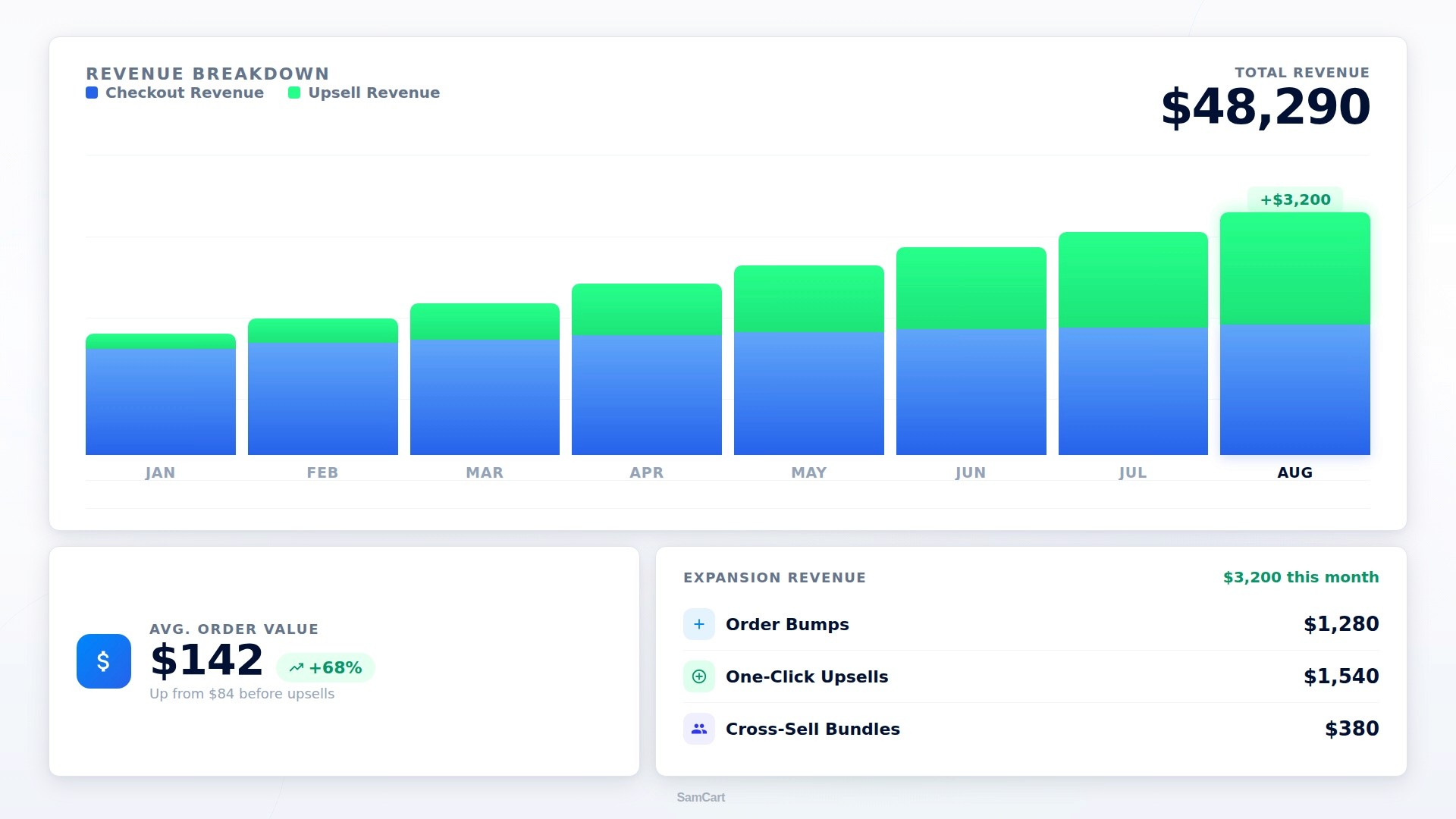
Table of Contents
Title
Share this article
The highest-impact upsell strategies for digital products are one-click post-purchase offers, order bumps, product bundles, premium tier upgrades, subscription conversions, complementary product offers, time-limited deals, and strategic downsells. Creators who add even a single one-click upsell to their checkout see an average 68% increase in average order value.
SamCart’s data from $7B+ in processed sales shows that the single fastest way to grow revenue isn’t more traffic. It’s making more per customer you already have. Creators using one-click upsells increase their average order value by 68.1%, and 58% of all revenue processed through SamCart comes from upsell transactions. The math is clear: upselling isn’t optional if you want to scale.
Most digital creators pour time and money into getting new traffic. More ads. More content. More launches. And sure, traffic matters. But here’s the thing: if you’re not upselling, you’re leaving the easiest money on the table.
This isn't a theory. We’ve processed over $7 billion in creator sales through SamCart. We know exactly which upsell strategies move the needle, and by how much. No guessing.
In this post, you’ll get the 8 highest-converting upsell strategies based on real data, when to use each one, how to set them up step by step, and the mistakes that tank conversion rates.
Let’s get into it.
Why do upsells matter more than new traffic?
Here’s the Business Math that changes everything.
Say you sell a $97 course and get 100 orders this month. That’s $9,700 in revenue.
Now, you have two options to grow:
Option A: Get more traffic. You spend $2,500 on ads to drive 10 more customers. That’s another $970 in revenue, minus the $2,500 you spent. You actually lost money.
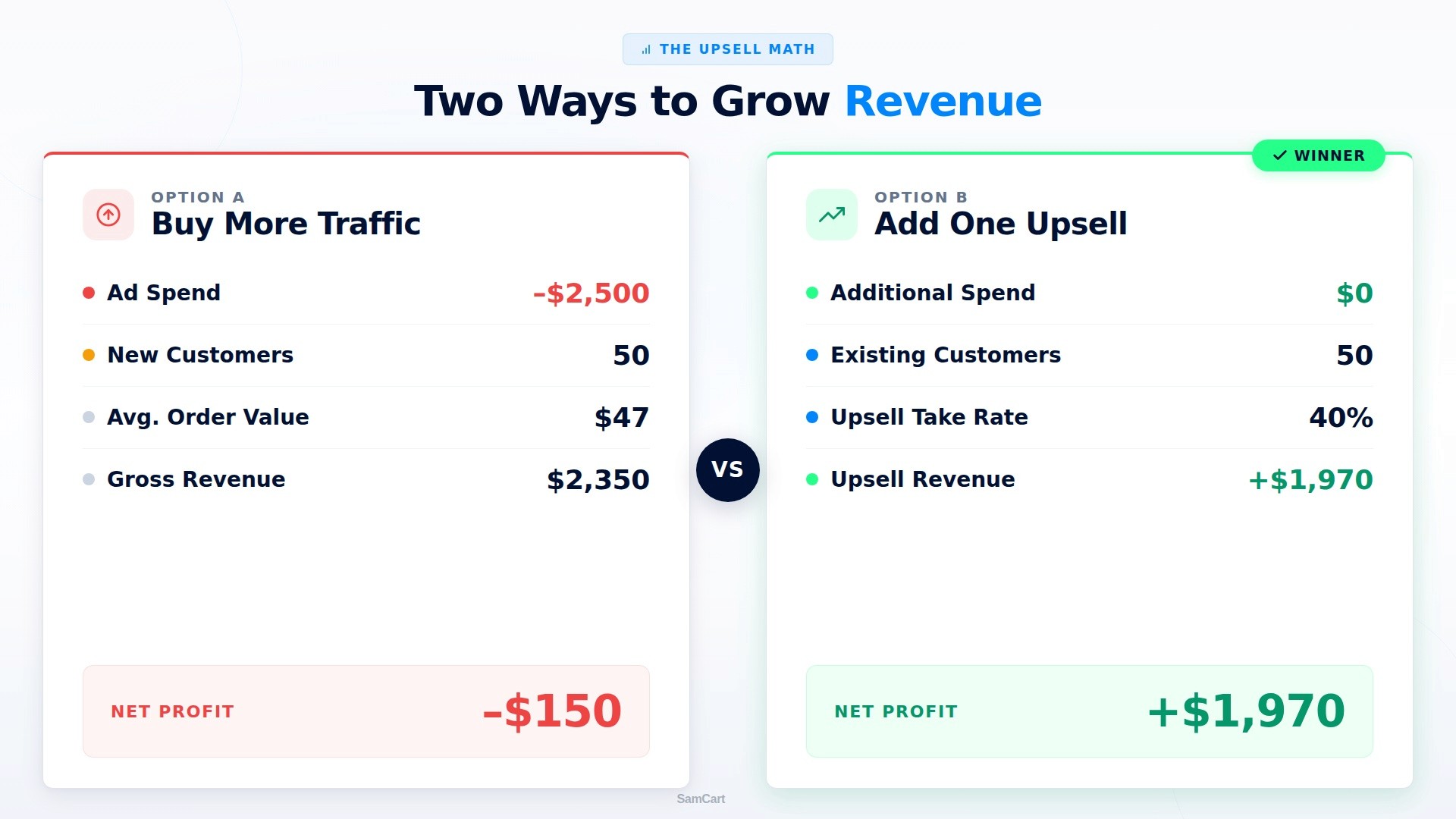
Option B: Add one upsell. You offer a $197 advanced course after checkout. Even if only 10% of your existing 100 buyers say yes, that’s 10 additional sales x $197 = $1,970 in extra revenue. Zero extra ad spend. Pure profit.
That’s the math. A 10% upsell rate on your existing orders is almost always more profitable than chasing 10 new customers.
And it compounds. SamCart’s data shows that creators who add a single one-click upsell increase their average customer value by 68.1%. If you’re doing $10K/month right now, that’s an extra $6,810/month from the exact same number of customers.
This is why the smartest creators focus on revenue per customer before they scale traffic. Get the economics right first, then pour fuel on the fire. (For a deeper look at how upsell strategies work for digital creators, we break down additional techniques in our companion guide.)
The 8 highest-converting upsell strategies
These aren’t ranked by popularity. They’re ranked by what actually converts, based on the data we’ve seen across thousands of creators.
1. One-click post-purchase upsells
This is the single most powerful upsell strategy for digital products. After a customer completes their purchase, you show them a relevant offer they can add with one click. No re-entering payment info.
Why it works: The customer just bought from you. Trust is at its peak. The friction of paying is already behind them. And because you already have their card on file, saying “yes” is literally one click.
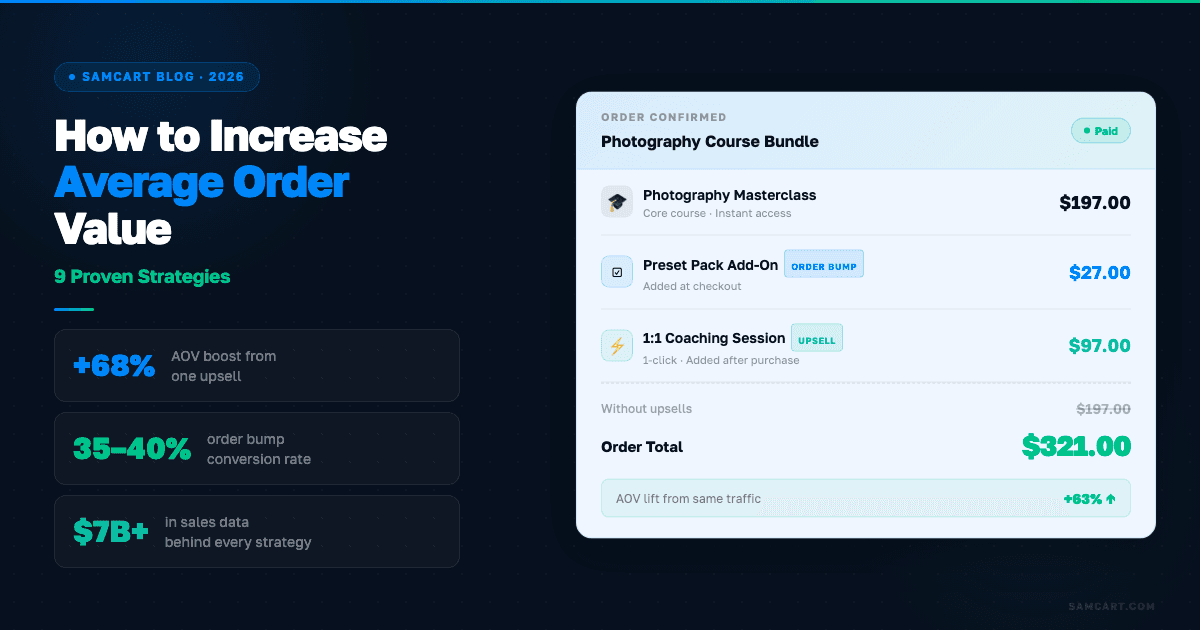
SamCart creators using one-click upsells see a 68.1% increase in average order value. That stat alone should be enough to stop what you’re doing and set one up right now.
Best for: Complementary courses, advanced training, templates, coaching add-ons, or discounted bundles of related products.
2. Order bumps
An order bump is a small, low-cost add-on that appears directly on the checkout page, usually as a checkbox. Think of it like the candy bar at the grocery store register.
The key is keeping the price low relative to the main product. If someone’s buying a $197 course, a $27 template pack or workbook is a no-brainer add-on.
Order bumps work because they don’t interrupt the checkout flow. The buyer doesn’t leave the page. They just check a box. That simplicity drives high take rates.
Best for: Worksheets, checklists, templates, swipe files, bonus modules, or resource packs that complement the main offer.
3. Product bundles
Bundling groups related products together at a discount compared to buying them individually. Instead of selling a course for $197 and templates for $47 separately, you offer both for $197, making the templates feel free.
The psychology here is powerful. Customers feel like they’re getting a deal, and your AOV goes up because they’re buying more than they originally planned.
Bundling also reduces decision fatigue. Instead of choosing between four products, they buy one package that has everything they need.
Best for: Course + template combos, beginner-to-advanced bundles, or “everything you need to get started” packages.
4. Premium tier upgrades
Offer a standard version and a premium version of the same product. The standard course includes video lessons. The premium version adds live coaching calls, a private community, or 1-on-1 feedback.
This works because it gives your buyers a choice, not a yes-or-no decision. Research consistently shows that when people are presented with two or three options, they tend to pick the middle tier. Suddenly your “premium” offer becomes the anchor that makes the standard offer feel like a deal.
Best for: Courses with coaching add-ons, membership tiers with different access levels, or products with varying levels of support.
5. Subscription conversions from one-time purchases
This is a long-game strategy that can massively increase your lifetime customer value. After someone buys a one-time product, you offer them an ongoing subscription: updated content, a community, monthly coaching, or new resources delivered regularly.
The key: make the subscription feel like a natural extension of what they just bought, not a separate purchase. “You just got the course. Want ongoing access to monthly updates, new templates, and our private community for $29/month?”
Best for: Course creators, membership community builders, coaches who offer ongoing support, and anyone with content they update regularly.
6. Complementary product offers
This is cross-selling meets upselling. When someone buys your social media marketing course, you offer them your email marketing course at a discount. The products aren’t the same. They’re related.
The trick is relevance. The offer has to feel like a logical next step, not a random pitch. Ask yourself: “What would this customer need next to succeed with what they just bought?”
Best for: Product catalogs with multiple related offers, creators selling across adjacent topics, or anyone with 3+ products.
7. Time-limited offers
Urgency works, but only when it’s real. A post-purchase offer that’s only available for 15 minutes, or a special bundle price that expires at midnight, can push conversion rates significantly higher.
The key word is real. Fake urgency (countdown timers that reset every visit) destroys trust fast. But a genuine limited-time discount or bonus that’s only available right after purchase? That creates honest urgency that respects your customer.
Best for: Post-purchase upsell pages, special launch pricing, early-bird bonuses, or limited-enrollment programs.
8. Strategic downsells
When a customer says “no” to your upsell, don’t just send them to a thank-you page. Show them a lower-cost alternative instead.
If they passed on your $497 coaching program, offer them a $97 self-paced version. You didn’t lose the upsell. You recovered revenue from someone who was interested but price-sensitive.
Downsells are the safety net of your upsell funnel. They capture revenue that would otherwise disappear completely.
Best for: Any upsell funnel. Always have a downsell as a backup offer after a declined upsell.
When should you offer an upsell? Timing matters.
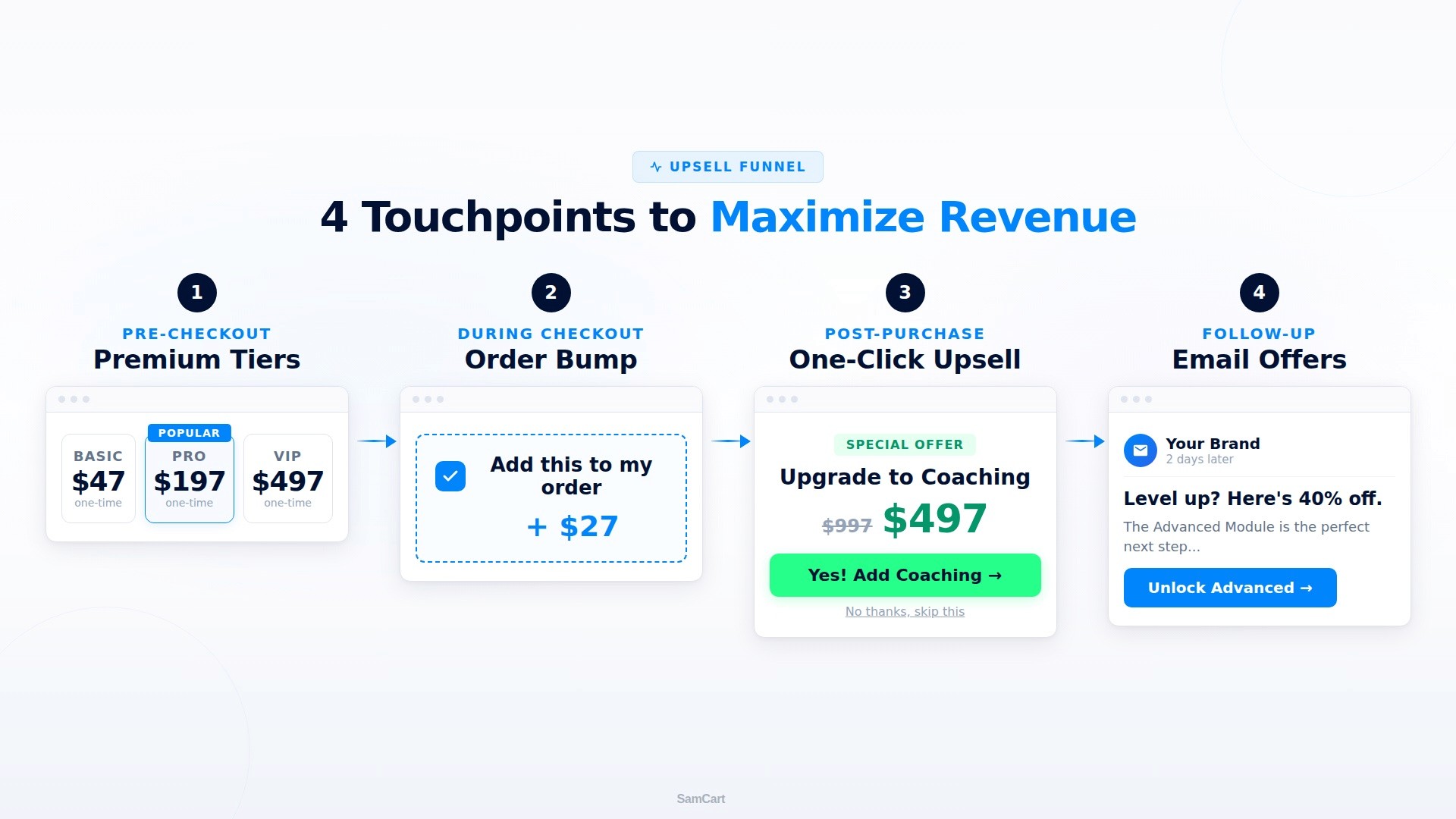
Not every upsell belongs at the same moment. Here’s when each type works best:
Timing | Upsell Type | Why It Works |
Pre-checkout | Premium tier upgrades, bundles | Buyer is comparing options before committing |
During checkout | Order bumps | Low-friction add-on that doesn’t interrupt the buying flow |
Post-purchase | One-click upsells, downsells, time-limited offers | Trust and momentum are highest right after a purchase |
Email follow-up | Complementary products, subscription offers | Gives buyer time to use the product and see value first |
The biggest mistake creators make is showing too many offers at the wrong time. A simple, proven sequence: order bump on the checkout page, one-click upsell immediately after purchase, and a downsell if they decline. That’s three touchpoints that work together without overwhelming the buyer.
For email follow-ups, wait 3 to 7 days after purchase. Let them experience what they bought first. Then introduce the next logical step.
How to set up upsells (step by step)
Setting up upsells used to be a nightmare. Expensive developers, clunky plugins, and hours of configuration. That’s exactly why we built upsells directly into SamCart so any creator can set them up in minutes.
Here’s how it works:
Step 1: Create your upsell product. In SamCart, navigate to your products and either create a new product specifically for the upsell, or select an existing product you want to offer.
Step 2: Set up the upsell offer. Go to the product you want to attach the upsell to, click the “Offers” tab, and select “Create a New Upsell.” Give it an internal name and description so you can identify it later.
Step 3: Configure your upsell page. SamCart automatically generates professional upsell templates that pull in your product images and content. Add a video if you have one (upsell pages with video tend to convert higher). If not, use the editor to add text, images, and your offer details.
Step 4: Set your pricing. Choose the upsell price. This is often a discount from the standard price to make the offer compelling. You can also add multiple payment options.
Step 5: Build your funnel. If you want more than one upsell, create a funnel to chain them together. For example: main product, then upsell #1 (premium course), then downsell (self-paced version), then thank you page.
Step 6: Test the entire flow. Always run through the checkout yourself. Click every button. Make sure the upsell shows up, the pricing is correct, and the downsell triggers when you decline.
That’s it. No developer. No custom code. The whole setup takes 15 to 20 minutes, and it can permanently increase your revenue by 50% or more.
For order bumps, the process is even simpler. Just toggle on the order bump option in your product settings and select which product to offer on the checkout page.
Set up your first upsell with a free SamCart trial →
Real examples from SamCart creators
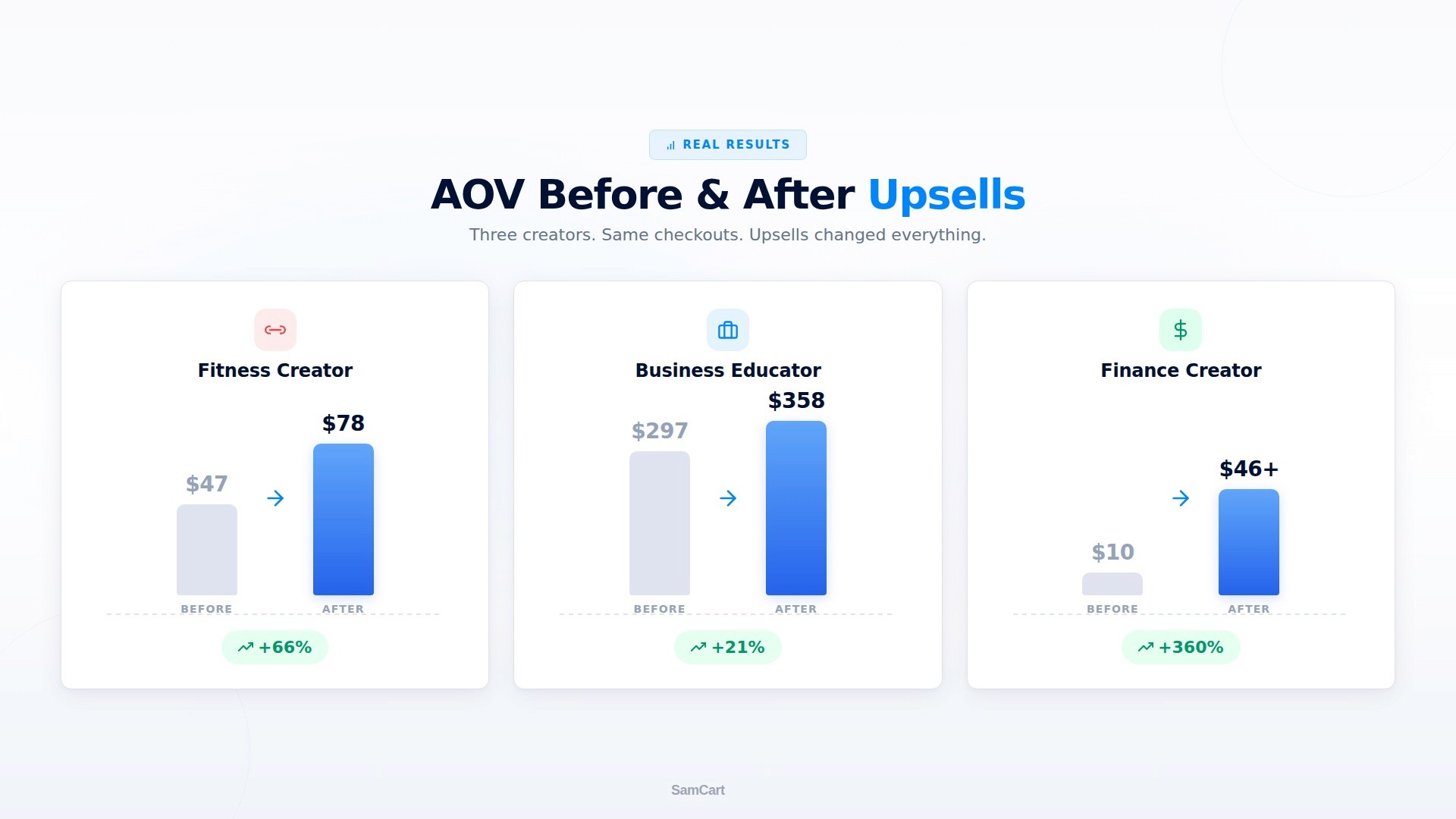
We’ve seen these strategies work across every niche. Here are a few patterns from top performers (anonymized to protect their data):
Fitness creator, online workout programs. Main product: $47 workout plan. Order bump: $17 nutrition guide (43% take rate). Post-purchase upsell: $197 12-week coaching program (11% take rate). Result: AOV went from $47 to $78, a 66% increase without a single extra ad dollar.
Business education creator, course seller. Main product: $297 course. One-click upsell: $497 advanced course at a discounted $297 (8% take rate). Downsell: $97 template bundle (15% take rate). Result: average customer value jumped from $297 to $358. Across 400+ monthly orders, that’s an extra $24,400/month.
Finance creator, eBook seller. Main product: $10 eBook. One-click upsell #1: $197 premium course at 50% off ($97). 12% of buyers took the offer, generating $2,955 in extra revenue from a single promotion. One-click upsell #2: a $1,997 premium course. Even at just 1% take rate, this added significant high-ticket revenue.
The pattern across all of them: one or two well-placed upsells, relevant to what the customer just bought, offered at the right moment. That’s the formula.
Upsell mistakes that kill conversion
Knowing what works is half the equation. Here’s what to avoid:
Offering irrelevant products. Your cooking course buyer doesn’t want your photography course. Every upsell should feel like the obvious next step for the person who just bought.
Too many offers at once. One order bump + one upsell + one downsell is plenty. Stack five offers in a row and you’ll annoy people and spike your refund rate.
Pricing upsells too high relative to the main product. If someone just bought a $27 eBook, a $997 coaching offer feels jarring. Keep your upsell price within 1 to 3x the original purchase price. The sweet spot for post-purchase upsells is usually 50 to 100% of the original product price.
Skipping the downsell. When someone says no to your upsell, a downsell can still capture revenue. Without one, you get zero. Always have a backup offer.
Using fake urgency. Countdown timers that reset every time someone visits your page? Your customers aren’t stupid. They’ll notice, and you’ll lose their trust permanently.
Making it hard to say no. Your “No thanks” button should be easy to find and guilt-free. Passive-aggressive decline text like “No, I don’t want to grow my business” is a fast way to lose customer trust.
Not testing your upsell flow. Run through it yourself. Have a friend run through it. Make sure every step works, the pricing is correct, and the experience feels smooth, not confusing.
Start making more per customer today
Here’s the bottom line: upselling is the fastest path to growing your revenue without spending more on ads or chasing more traffic.
Add one order bump. Set up one post-purchase upsell. Include a downsell as backup. That simple three-step sequence can increase your average order value by 50 to 68%, based on the real data we’ve seen across $7B+ in creator sales.
The math works. The strategies are proven. And with SamCart, the setup takes minutes, not months.
Start your free SamCart trial and set up your first upsell today →
Already using SamCart? See how one-click upsells work →
SamCart Editorial Team
Brian Moran
Founder
Samara Lemon
VP of Marketing
Leilani Treuting
Marketing Director
Scott Moran
Co-Founder