Best AI tools for online business in 2026 (I tested 134)
Reading Time
9
Published On
Updated On

Brian Moran
Founder

Samara Lemon
VP of Marketing

Leilani Treuting
Marketing Director

Scott Moran
Co-Founder

SamCart is the digital business platform that builds, runs, and scales your online business. AI handles the hard parts, so you keep more of what you earn.
Table of Contents
Title
Share this article
The best AI tools for running an online business in 2026 are Claude (and Claude Code), ChatGPT, and a custom AI agent layer (like OpenClaw or Hermes) that ties everything together. Most of the "must-have" AI tools people hype on X do almost nothing for revenue. The 7 below are the only ones I'd pay for out of my own pocket.
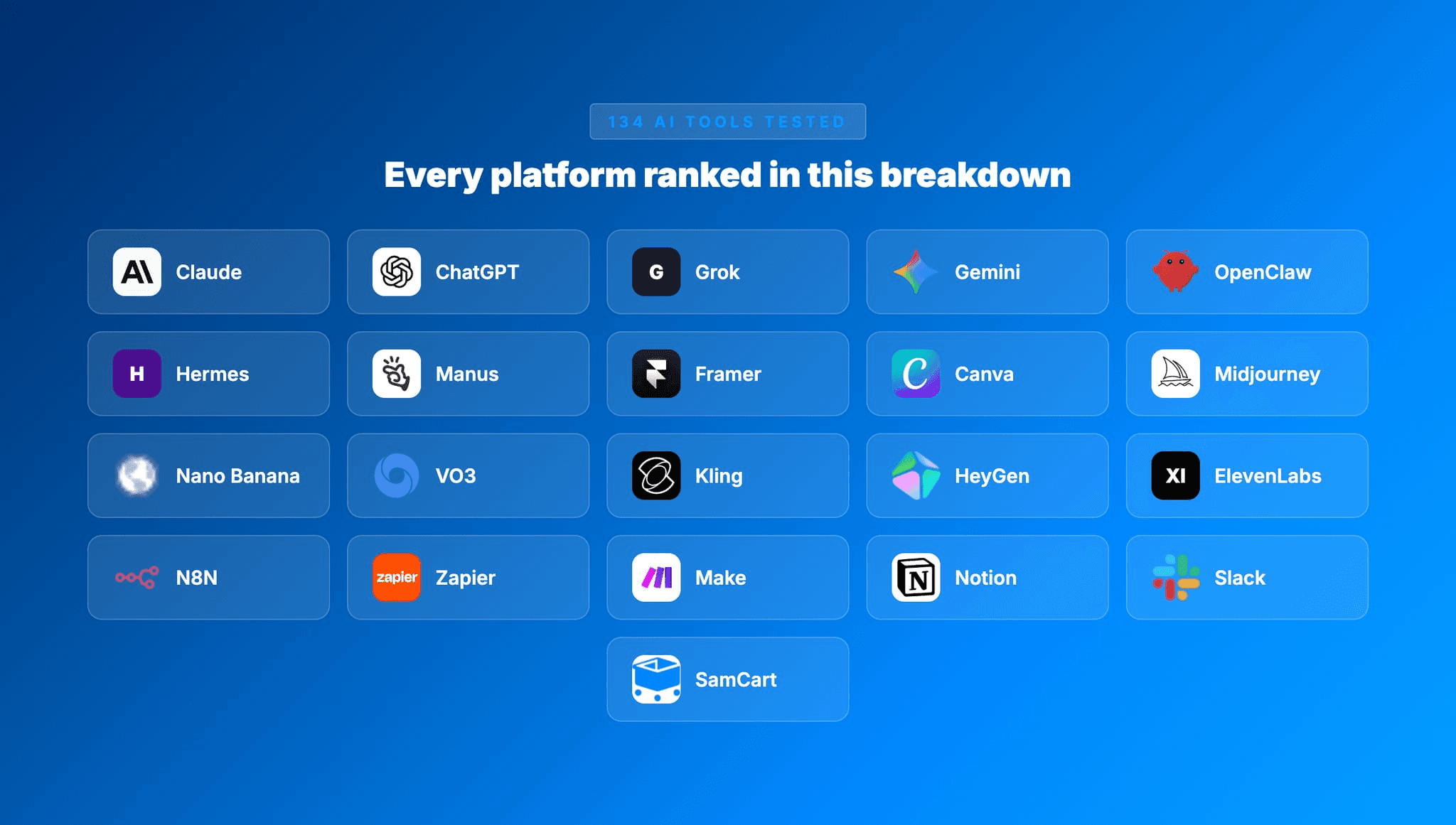
I spent over $100,000 testing 134 AI tools over the last six months. Most were a complete waste of time and money. A handful of them quietly print money for my business every single day. This is the honest ranking of what worked, what didn't, and exactly how I use each one.
Full video breakdown here:
I'm Brian Moran. I built SamCart, the platform that's helped 75,000+ businesses process over $7 billion in sales. So when I look at an AI tool, I only care about one thing. Does it make me money?
Here's what I found.
Every online business really has two jobs
Strip away all the hype and running an online business comes down to two buckets.
The first is traffic. That's everything under marketing. Social content, YouTube scripts, thumbnails, Instagram reels, LinkedIn posts, SEO, blog posts, paid ads, and recruiting partners.
The second is sales. That's conversion. Writing sales scripts and VSLs, building promotions, creating new products, running webinars, and writing marketing emails.
Then there's a third layer sitting underneath both. Productivity and reporting. Checking email, managing your to-do list, setting strategy, and watching every number that matters. Conversion rates, traffic, SEO rankings, email deliverability. Someone has to keep an eye on all of it, every day.
So the real test for any AI tool is simple. How many of these jobs can it do well, so there's less work on your plate or your team's plate? That's the lens I used for every single tool below.
The real problem: who sits in the brain seat?
Here's the part almost nobody talks about, and it's the whole reason most people feel overwhelmed by AI right now.
You, the business owner, sit in the brain seat of your business. You're the one who has to understand everything going on across your entire tool stack, then point the right AI at the right job. And to make even one good decision, you have to hold a ton of data in your head at once. How a specific Facebook ad is doing. How your last promo went. Which landing page copy actually converted. Your community's churn rate. Your upsell take rate.
Think about making one great Facebook ad. The best marketer alive wouldn't just open a blank page and start typing. They'd first check how that product converted before. Then they'd pull the landing page copy that worked. Then they'd look at what you posted on social about it and which words landed. Then, and only then, they'd study which past ads, images, and calls to action performed best. After all of that, they'd finally write the ad.
That's the job. That's what's actually in your head. And when you try to do it by duct-taping a dozen disconnected AI tools together, you don't save time, you drown. I know, because I've sat in that exact seat.
This is why the tools that impressed me most weren't the flashiest ones. They were the ones that could see my real business data and take work off my plate. Most tools can't. They read a couple of things, forget the rest, and lose the context that makes a decision good in the first place. The few that hold all of it are the ones that finally start to run your business instead of just answering one question at a time.
Keep that in mind as you go through the list. The higher a tool ranks, the closer it gets to sitting in that brain seat for you.
How I ranked every AI tool
Two questions. That's it.
Does it help me get more traffic to my website?
Does it help me convert more of that traffic into sales?
Everything else is noise. Not "does it have a slick interface." Not "is it the newest thing everyone's tweeting about." Not even "how smart is the model."
If it can't move the needle on traffic or sales, it doesn't make the cut.
Beyond those two questions, I ran each tool through 4 filters:
How effective is it? Can it actually do the job, or does it need constant hand-holding?
How easy is it to set up? A genius tool that takes 6 weeks to configure is useless to most people.
How expensive is it? Both the subscription and the API cost when you run it hard.
How automated is it? Do I have to prompt it 40 times a day, or can it run on its own?
Now let's get into the actual list.
The best AI tools for online business, ranked
7. Notion AI, Slack AI, and SaaS built-in AI
Best for: Searching your own data inside one tool.
Every SaaS tool you already use is bolting AI onto their product. Notion, Slack, HubSpot, Shopify, and yes, SamCart. These are useful, but limited. Notion AI only knows what's inside Notion. Slack AI only knows what's inside Slack.
They're easy to use because they're already sitting in the tools you use every day. They just aren't the tool that runs your business. They're the tool that answers one question inside the tool you're already in.
Use them for what they're good at. Search your Slack for that update from 3 months ago. Find the Notion doc you can't remember. Move on.
6. Framer AI (and other design tool AI)
Best for: Speeding up work inside a design tool you already use.
Framer, Canva, and Figma all have AI baked in now. It's genuinely helpful when you're already inside the tool building a website or a graphic. Framer can generate a section layout in seconds. Canva can write copy for a graphic in a click.
But you can't extend it. Framer's AI can't write your marketing emails. Canva's AI can't improve your checkout page. They're one-task tools, and that's fine. Just don't expect them to run your business.
5. Voice and video cloning tools (HeyGen, ElevenLabs)
Best for: Cloning your voice or face for ads and video content.
This category shocked me. Voice cloning is scary good in 2026. I have ads running on Facebook right now for SamCart where I never said the words. AI wrote the script, cloned my voice, added the pauses and inflection, and nobody can tell.
Video cloning, meaning replacing your face on camera, is getting close but isn't there yet for anything longer than a quick ad. The uncanny valley is still real.
If your business needs a face or a voice to scale, HeyGen and ElevenLabs are worth every penny. But they only do one thing. They don't run your business.
4. Image and video generation (ChatGPT Images, Nano Banana, Veo 3, Kling)
Best for: Making ad creative and social content at scale.
ChatGPT's image tool and Nano Banana are incredibly cost-effective. They make great images fast, especially for social ads and thumbnails.
For video, Veo 3, Kling, and Seedance are the ones I trust. Here's the trick most people miss. Use ChatGPT Images to build a storyboard first, then hand that storyboard to a video model. Without a storyboard, video AI just makes wild-looking clips you can't actually use.
Great images and video are half of great ads. If you're running paid traffic and you're not using these, you're leaving money on the table.
3. Grok and Gemini
Best for: Live research (Grok) and Google Workspace tasks (Gemini).
Grok is my go-to for research. Because it has live X data, it knows what's trending and what people are actually saying right now. If a new AI model dropped yesterday, Grok knows about it. ChatGPT and Claude usually don't.
Gemini is the king inside Google Workspace. If I need to search my inbox, summarize a Google Doc, or work across Sheets and Slides, nothing beats it.
Both are cheap, easy, and reliable. They won't run your whole business, but they're the best at what they do.
2. ChatGPT (and Claude, Claude Code, Claude Cowork)
Best for: Being your daily AI thinking partner. This is the starter stack.
If you're on a budget, or you just don't want to get lost in the weeds of building a custom AI setup, this is where you live. Claude and ChatGPT are the most effective tools a normal person can actually use.
Claude is the best writer. Best judgment. Best design taste.
Claude Code is the most effective AI I've ever used. Also the hardest to learn.
Claude Cowork is the newer Claude desktop app with better memory, projects, and scheduled automations. Easier than Claude Code. Almost as powerful.
ChatGPT is the most well-rounded. Great images, great voice, great memory, and Codex now competes directly with Claude Code.
If you only have 30 minutes a day to spend on AI, use one of these. Set up a project. Load in your business data. Ask it questions every morning. You'll see the difference in a week.
1. A custom AI agent (OpenClaw, Hermes, Manus)
Best for: Running your entire business on autopilot. Advanced only.
This is where the real leverage is. It's also where the real cost, complexity, and headaches are.
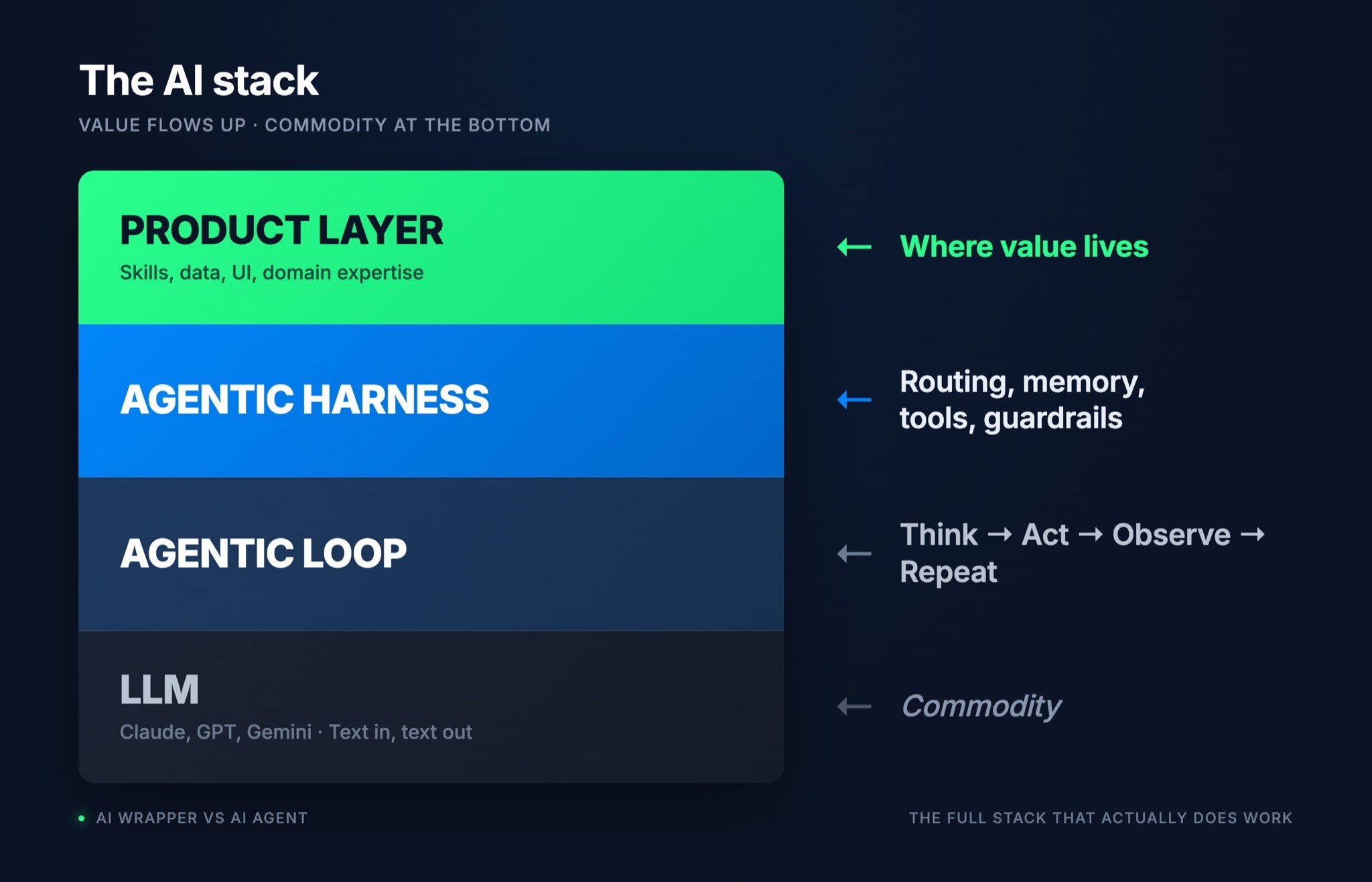
An AI agent layer is a tool that sits above every other tool you use. It's plugged into your Facebook ads, your SamCart account, your Slack, your email, your website. It can see all your data, and it can take action across all of it. That's the tool that finally sits in the brain seat for you.
I use OpenClaw. I have 16 AI agents running 24/7. One runs my ads. One approves community comments. One writes and posts thumbnails. One sends me a morning briefing every day with what my team is working on, what I need to focus on, and what should get killed.
The cost? On a good month, I spend around $10,000. On a heavy month, closer to $15,000. It's not for the average person yet.
But this is the future. In 12 to 24 months, an AI agent that runs your business will be as normal as having a website. The people setting it up now will have a massive head start.
The 4-part filter every AI tool must pass
Before you spend a dollar on any AI tool, run it through these 4 questions:
Does it help me get more traffic? If no, move on.
Does it help me convert more of that traffic into sales? If not, move on.
Can I set it up without a full-time engineer? If it takes weeks of custom code, it's not a tool. It's a project.
Will it still be useful in 6 months? AI moves fast. If a tool feels like a novelty, it probably is.
Everything on the list above passes all 4. Everything I cut didn't.
The AI stack I'd pay for out of my own pocket
If I were starting over today with no budget, here's the exact stack I'd build:
Job | Tool | Cost |
|---|---|---|
Daily thinking partner | ChatGPT Plus or Claude Pro | ~$20/mo |
Writing and copywriting | Claude | Included above |
Ad creative (images) | ChatGPT Images / Nano Banana | Included or ~$10/mo |
Video creative | Veo 3 or Kling (as needed) | Pay-per-use |
Business platform (with AI baked in) | $79/mo | |
Live research | Grok (X Premium) | ~$8/mo |
Total: under $150/mo for a stack that would have cost a business $10K a month in salaries and software just a few years ago.
That's the wild part about AI right now. Not that you can spend $15K a month like I do. It's that you can do 80% of what I do for under $150.
Where SamCart fits into the AI stack
Full transparency: I built SamCart, so I'm biased. But here's why it earns a spot on this list.
The AI inside SamCart is trained on $7 billion in real transaction data across 75,000+ online businesses. That means when you ask it to write a landing page, it doesn't guess. It knows what actually converts in your niche, at your price point, for your audience.
SamCart writes your page and designs it at the same time. It sets up your upsells. It runs your checkout. It handles the parts of your business that used to take weeks of setup and a team of freelancers.
Kajabi hosts your content. SamCart builds, runs, and scales the business around it.
That's the difference between AI as a novelty and AI as a business.
The problem with AI agents (and why most people should wait)
I love OpenClaw. It runs my life. But I'll be honest. It took weeks to train, it breaks all the time, and it costs a fortune.
That's exactly why my team and I are building something new. A version of my OpenClaw setup that's ready out of the box, doesn't need weeks of training, remembers everything, and doesn't break. Same superpowers. None of the setup pain.
It's not public yet. If you want the early-bird list, you can get on the waitlist here.
The bottom line
The AI tool market is loud. Everyone is trying to sell you something. Most of it doesn't move revenue.
The 7 on this list do. Start with the starter stack (ChatGPT or Claude, plus a business platform like SamCart, plus one creative tool). Give it 60 days. Then decide if you're ready for the agent layer.
If you want to see what I've been building to replace my custom OpenClaw setup, a version that works out of the box, join the waitlist here.
And if you want to start a real online business today, without hiring designers, developers, or copywriters, SamCart builds, runs, and scales it for you.
That's the whole game now. Pick the right stack. Let AI do the work. Keep more of what you earn.
SamCart Editorial Team
Brian Moran
Founder
Samara Lemon
VP of Marketing
Leilani Treuting
Marketing Director
Scott Moran
Co-Founder
Frequently Asked Questions
What are the best AI tools for a small online business in 2026?
The best AI tools for a small online business are Claude (or ChatGPT), a business platform with AI built in (like SamCart), and 1 or 2 creative tools (ChatGPT Images or Nano Banana for graphics). This starter stack costs under $150 per month and covers about 80% of what most creators need.
Which AI tool actually makes money for entrepreneurs?
Custom AI agents that connect to your business data (like OpenClaw or Hermes) drive the most measurable revenue lift because they can see your ad spend, sales, and content in one place. For most people, Claude paired with a data-trained business platform like SamCart delivers the fastest ROI without the cost or complexity of a custom setup.
Is Claude or ChatGPT better for running a business?
Claude is better for writing, design taste, and judgment-heavy tasks. ChatGPT is better for image generation, voice features, and being the most well-rounded generalist. Most people should pick one and go deep. Switching between both every week is a waste of time.
How much does it cost to run AI tools for an online business?
A solid AI stack for a solopreneur costs $100 to $200 per month (Claude or ChatGPT, plus a business platform, plus a creative tool). A full AI agent setup that runs the entire business costs $5,000 to $15,000 or more per month in API and token costs. Most creators should start at the $150 tier and grow into the agent layer over time.
What AI tools should I avoid?
Skip anything that does one novel trick without connecting to the tools you actually use. Voice cloning, image generation, and general chat tools are only worth it when they plug into a real workflow. Most standalone "AI SEO" or "AI email" tools are worse than using Claude or ChatGPT directly.
Can AI really run my whole business?
Not fully, not yet. An AI agent can handle 60 to 80% of the daily work in an online business today, like writing copy, designing pages, running ad reports, and replying to community comments. The strategy, judgment calls, and creative direction still need a human at the wheel. That gap is closing fast.