AI wrapper vs AI agent: The Full Stack that Actually Does Work
Published On
Updated On

Brian Moran
Founder

Samara Lemon
VP of Marketing

Leilani Treuting
Marketing Director

Scott Moran
Co-Founder

SamCart is the digital business platform that builds, runs, and scales your online business. AI handles the hard parts, so you keep more of what you earn.
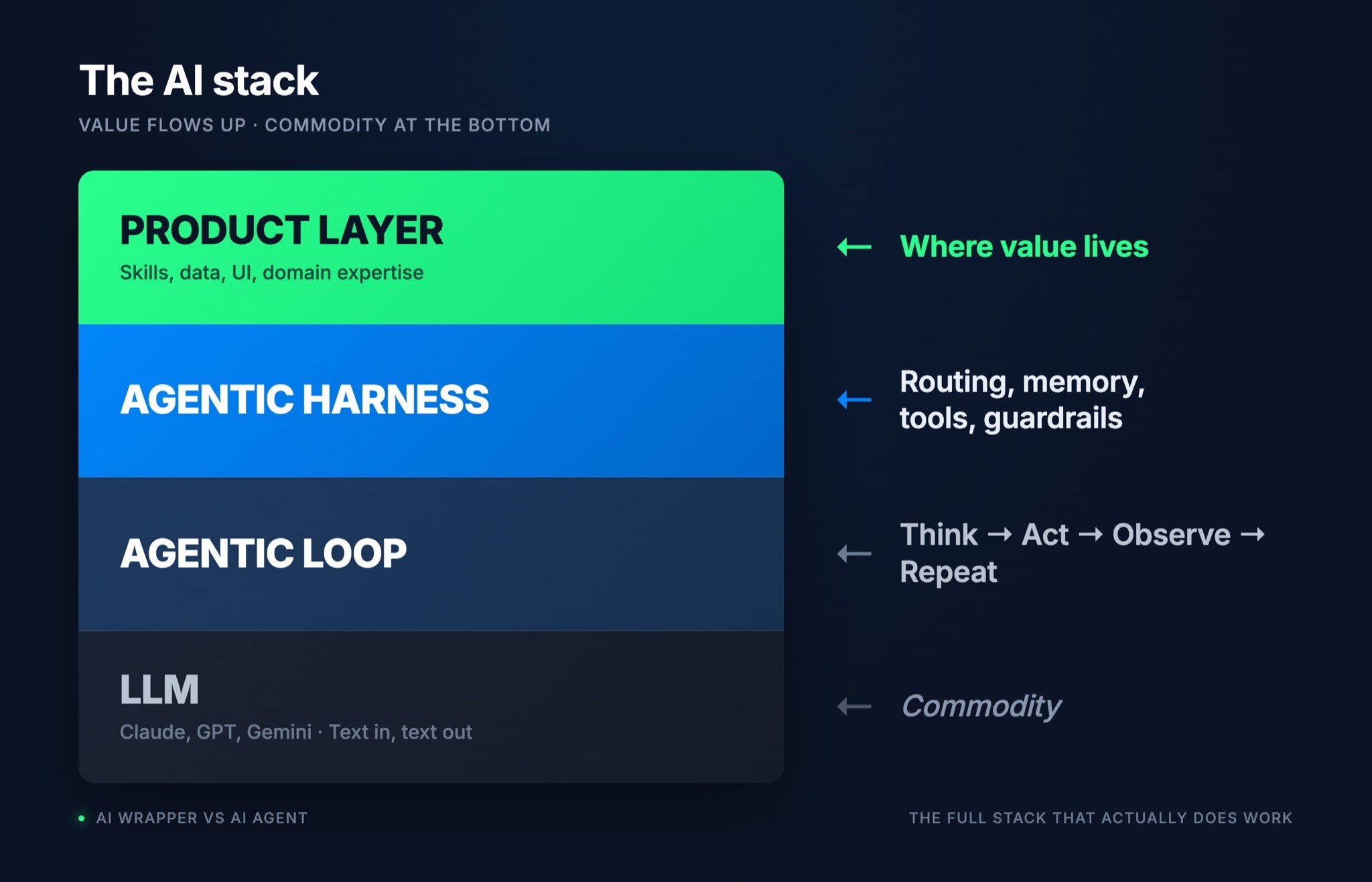
Table of Contents
Title
Share this article
Last updated: May 2026 By Justin Smith, CEO at SamCart
Every new AI product gets the same question: "Isn't this just a ‘wrapper’ around ChatGPT?"
Fair question. A lot of them are. But there's a clear technical line between an AI product that rewrites your prompt and one that actually does work, and most people have never seen the difference explained. This post breaks down the four layers of the AI product stack, from the commodity model at the bottom to the product layer where real value gets built. Once you can see the layers, you'll know which side of the line any AI tool sits on.
What is an LLM?
A Large Language Model is a foundation model trained on huge amounts of public text. Claude, GPT, Gemini, Llama. You give it text. It gives you text back. That's the entire interface.
An LLM doesn't know your business. It can't check your Stripe balance, look at your customer list, or build a landing page. It only knows what was in its training data, which is mostly the public internet. If you want it to know something specific to you, you have to paste it in. Every time.
When you open ChatGPT and type "write me an email," you're using the LLM almost directly. One prompt in, one response out. Copy. Paste.
Think of it as a brilliant consultant locked in an empty room. You slide a note under the door. They slide one back. No access to your files, your tools, or your customers. Just the note.
What is an AI wrapper?
An AI wrapper is a product that puts a nicer interface on top of an LLM and sells it as software. Under the hood, it does the same thing the raw model does: one prompt goes in, one response comes out.
Wrappers usually look like this:
A chatbot with friendlier styling than ChatGPT
A library of prompt templates ("click here to write a blog post")
Saved conversation history
Some pre-written system prompts that tell the AI to "act like a marketing expert"
The give-away is simple. If you could get the same result by copy-pasting the prompt into ChatGPT, it's a wrapper.
That doesn't mean wrappers are useless. Some of them save real time. But they have a ceiling. A wrapper can only do what a single LLM call can do, which means it can write you some text. It can't pull data from your Stripe account, cross-reference it with your sales sheet, generate matching images, and ship a finished product. It can’t take ACTION. That kind of work needs more than one prompt.
What is an AI agent? The agentic loop, explained
An AI agent is what you get when you give an LLM two things a raw model doesn't have: the ability to use tools and the ability to decide what to do next. Instead of answering once and stopping, the agent runs a loop. Think, act, observe, repeat.
Here's what that actually looks like.
Say you ask the agent: "Build me a sales page for my new course."
A raw LLM would write some generic sales copy and call it done. One shot. Good luck.
An AI agent does this:
Reads your brand profile to get your voice, colors, and positioning
Checks your existing content to understand what you've already said
Pulls your product data for pricing, features, and testimonials
Drafts the headline and hero section
Generates images that match your brand
Writes the body copy, using what it learned in steps 1-3
Reviews its own work, decides the CTA is weak, and rewrites it
Assembles the final page and ships it
That's eight steps. At every step the LLM is thinking about what to do, calling a tool (read a file, generate an image, write to a page builder), looking at the result, and choosing the next move. The LLM is the brain. The loop is what turns a brain into something that does real work.
The pattern: Think → use a tool → look at the result → think again → use another tool → repeat until done.
This is the core pattern behind every AI product that actually does things instead of just talking. ChatGPT's code interpreter, Claude's artifacts, Cursor, Devin - all of them run agentic loops. The differences between them come from what tools the agent has, what data it can see, and what it's trained to be good at.
What is an agentic harness?
The agentic loop is the pattern. The agentic harness is the system you build around the loop so it works in real life and not just in a demo.
A raw agentic loop without a harness is like giving someone a brain and a pair of hands but no job description, no training, no manager, and no guardrails. It will probably do the wrong thing.
The harness is everything that makes the agent useful and safe to ship:
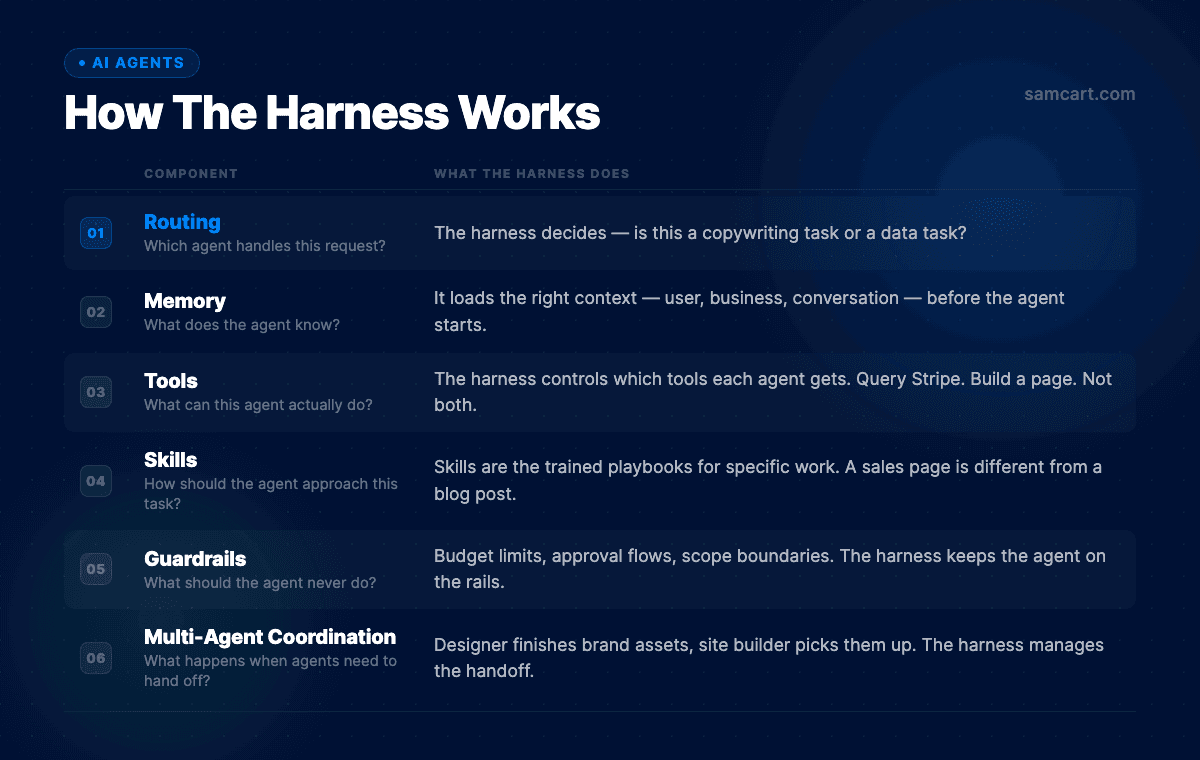
Routing. Which agent handles this request? Is this a copywriting task or a data task? The harness decides.
Memory. What does the agent know about this user, this business, this conversation? The harness loads the right context before the agent starts.
Tools. What can this agent actually do? Can it query Stripe? Build a page? The harness controls which tools each agent gets.
Skills. How should the agent approach this type of task? A sales page has a different structure than a blog post. Skills are the trained playbooks for specific work.
Guardrails. What should the agent never do? Budget limits, approval flows, scope boundaries. The harness keeps the agent on the rails.
Multi-agent coordination. Sometimes one agent needs to hand work to another. Designer finishes brand assets, site builder picks them up. The harness manages the handoff.
This is the layer where AI products actually differentiate. Every AI product that does real work has an agentic harness. The only real question is whether that harness is general-purpose (can do anything, specialized at nothing) or built for one vertical.
The full AI stack at a glance
The bottom layer is commodity. Everyone has the same models. The top layer is where value comes in.
The SaaS parallel: LLMs are the new database
This exact pattern already played out once before. With SaaS.
In the early days of software the core technology was the database. MySQL, PostgreSQL, Oracle. Every software product needed one. And most software products were, underneath, a nice interface on top of a database.
CRM? A database of contacts and deals with a sales-focused UI. Project management? A database of tasks with a kanban view. Help desk? A database of tickets with a queue. E-commerce platform? A database of products and orders with a checkout flow.
Even though huge SaaS companies are at their core a database, no one thought or thinks of them that way. The value is in the workflows baked into the interface, the integrations, the reporting, etc. The database is the storage layer. The product is the opinion.
The exact same thing is happening with AI.
The LLM is the new database. It's the foundation layer. Every AI product uses one (or several). And just like databases, the LLM itself is becoming a commodity. Two years from now, swapping one for another will be a configuration change.
So the question for AI products is the same one it was for SaaS products: what did you build on top of the commodity layer?
Why "general AI" wins horizontally and "vertical AI" wins deeply
Look at where the big AI labs sit on the stack and the picture gets very clear.
Claude (Anthropic). Anthropic builds Claude, one of the best LLMs in the world. They also build claude.ai (the chat product), Claude for Work (team features), and the API (raw access for developers to build on top of). They have the model, a thin agentic loop, and a general-purpose product layer. They're building the engine.
ChatGPT (OpenAI). Same structure. GPT is the model. ChatGPT is the chat product with a slightly thicker agentic loop (code interpreter, browsing, image generation). General-purpose. Knows nothing about your business when you open a new conversation. They're trying to be the platform everyone builds on.
Frameworks like LangChain or open-source agent kits. These give you the building blocks: agentic loop, tool system, memory, multi-agent orchestration. They're powerful. But they're a platform, not a product. You get the parts. You have to assemble them yourself - write the skills, build the integrations, train the agents, design the UI. A framework says "you can build anything." A product says "we already built the thing you need."
Vertical AI products. These take the same stack - loop, harness, tools, skills, memory - and build it specifically for one type of customer doing one type of work. Every skill is trained for that use case. Every integration is chosen for that user. Every UI decision is made for that workflow. Generic AI is good at everything and great at nothing. Vertical AI is great at one thing on purpose.
This is the bet for the next five years. Models commoditize. Agentic loops become table stakes. The value moves up the stack into the harness and the product layer, where the data, the skills, the integrations, and the domain expertise live.
How to tell a real AI agent from a wrapper (a simple test)
Five questions. If the answer to most of them is yes, you're looking at an agent. If most are no, you're looking at a wrapper.
Does it take multiple steps to finish a task, or does it answer once and stop?
Does it have access to your real data (customer records, sales, files), or does it only see what you paste in?
Does it call other tools (search, design, payments, integrations), or is it text-in, text-out?
Does it have specialized skills for specific kinds of work, or is it the same generic chat for everything?
Could you get the same output by copy-pasting the prompt into ChatGPT?
A wrapper hits "no" on the first four and "yes" on the fifth. An agent flips every one of those.
What we're building at SamCart
This isn't abstract theory for us. We've spent two years building at the top of this stack, specifically for one vertical: people who sell products online —>courses, coaching, services, digital products, and physical products.
We use the same foundation models everyone else uses. We run the same agentic loop pattern. Those are table stakes. The part we've been obsessing over is the harness and product layer, because that's where vertical AI either works or doesn't.
A few things we've learned building it:
Specialist agents beat generalists. An agent trained on sales pages, brand systems, and e-commerce data does better work than a general-purpose chatbot you have to brief from scratch every session. The specialization compounds.
Connected data changes everything. When agents can pull from your real Stripe transactions, your content library, your product catalog, your SamCart account…the output stops feeling generic. It starts feeling like it actually knows your business, because it does.
Skills need domain depth. Our agents are fine-tuned on $7B+ in real transaction data across 75,000+ businesses. That's not a marketing number. That's the training set. The agents know what a high-converting sales page looks like in fitness, in coaching, in finance, because they've seen tens of thousands of them.
We're not done. There's a lot more coming, and the product layer is where most of the interesting problems still live. See what a vertical stack actually looks like in SamCart.
Bottom line
Foundation models will commoditize. Agentic loops will become table stakes. The lasting value in AI products is going to sit in the harness and the product layer - the skills, the training data, the integrations, the agent specialization, the UI, the domain expertise.
That's what separates a chatbot from a coworker. And that's what gets built when an AI company decides to go deep in one vertical instead of wide across everything.
If you're picking AI tools for your business this year, look for the stack. The wrappers are easy to spot once you know what the layers are.
Want to see what a vertical AI stack looks like in practice? Start a free trial at samcart.com/pricing. $79/mo, no setup fees, AI fine-tuned on $7B+ in real transaction data.
SamCart Editorial Team
Brian Moran
Founder
Samara Lemon
VP of Marketing
Leilani Treuting
Marketing Director
Scott Moran
Co-Founder
Frequently Asked Questions
What is the difference between an AI wrapper and an AI agent?
An AI wrapper sends a single prompt to an LLM and returns the response. An AI agent runs a loop: it thinks, uses tools, looks at the results, and decides the next step until the task is finished. Wrappers write text. Agents do work.
Is ChatGPT an AI agent?
ChatGPT has agent-like features (code interpreter, browsing, image generation) so it runs a thin agentic loop. But it's a general-purpose chat product. It doesn't have access to your real business data unless you paste it in, and it doesn't have specialized skills for any one type of work. It sits between a pure wrapper and a vertical agent.
What is an agentic loop in AI?
An agentic loop is the pattern an AI agent runs: think, use a tool, look at the result, think again, use another tool, repeat until the task is done. It's what turns a text generator into a system that can take real action across multiple steps.
What is an agentic harness?
An agentic harness is the system built around the agentic loop to make it production-ready. It handles routing (which agent gets the task), memory (what does the agent know), tools (what can the agent do), skills (how does the agent approach the task), guardrails (what is off-limits), and multi-agent coordination.
Why is the LLM becoming a commodity?
Foundation models are converging on similar quality, getting cheaper, and getting faster. In two years, swapping Claude for GPT or Gemini will be a config change, not a rewrite. That moves the value up the stack into the harness and the product layer - the skills, data, integrations, and domain expertise that make an AI product useful for a specific job.
How do I know if an AI product is a wrapper or a real agent?
Ask whether it takes multiple steps to finish a job, whether it has access to your real data, whether it calls other tools, whether it has specialized skills for the work, and whether you could get the same result by pasting the prompt into ChatGPT. Agents are yes on the first four. Wrappers are not.