How to Sell Digital Products Online: The Complete Guide
Published On
Updated On

Brian Moran
Founder

Samara Lemon
VP of Marketing

Leilani Treuting
Marketing Director

Scott Moran
Co-Founder

SamCart is the digital business platform that builds, runs, and scales your online business. AI handles the hard parts, so you keep more of what you earn.
Table of Contents
Title
Share this article
If you already know what you want to sell online, this guide is for you.
Most "how to sell digital products" content starts at the beginning: what a digital product is, why they are good, what types exist. If you need that foundation, read our guide to what digital products are and how to create them first.
This guide starts where most creators actually get stuck: after the product idea. It covers pricing, platform selection, building a checkout that converts, and the revenue tools that make every sale worth more than the sale itself.
The difference between a digital product business that earns $500/month and one that earns $5,000/month is rarely the product. It is usually the checkout. SamCart has helped 75,000+ businesses sell digital products online, processing over $7 billion in sales. Sellers who add one order bump to their checkout see an average 42% increase in day-one revenue. That single change, applied to an existing product, is often the fastest path to doubling income.
How to price your digital product
Pricing is where most new sellers undersell themselves. The instinct is to start low to attract buyers. The result is a business that needs 10 times as many sales to hit the same revenue goal.
The right frame: you are not pricing pages, videos, or hours. You are pricing the outcome your product delivers. A $47 template that saves a designer 5 hours per week is worth far more than $47. A $197 course that helps someone land a $15K salary increase is a bargain at that price. Start from the transformation, then work backwards to a number that feels like a fair trade.
Three pricing tiers that work
Most successful digital product businesses use a tiered model. Each tier serves a different buyer and creates a natural upgrade path.
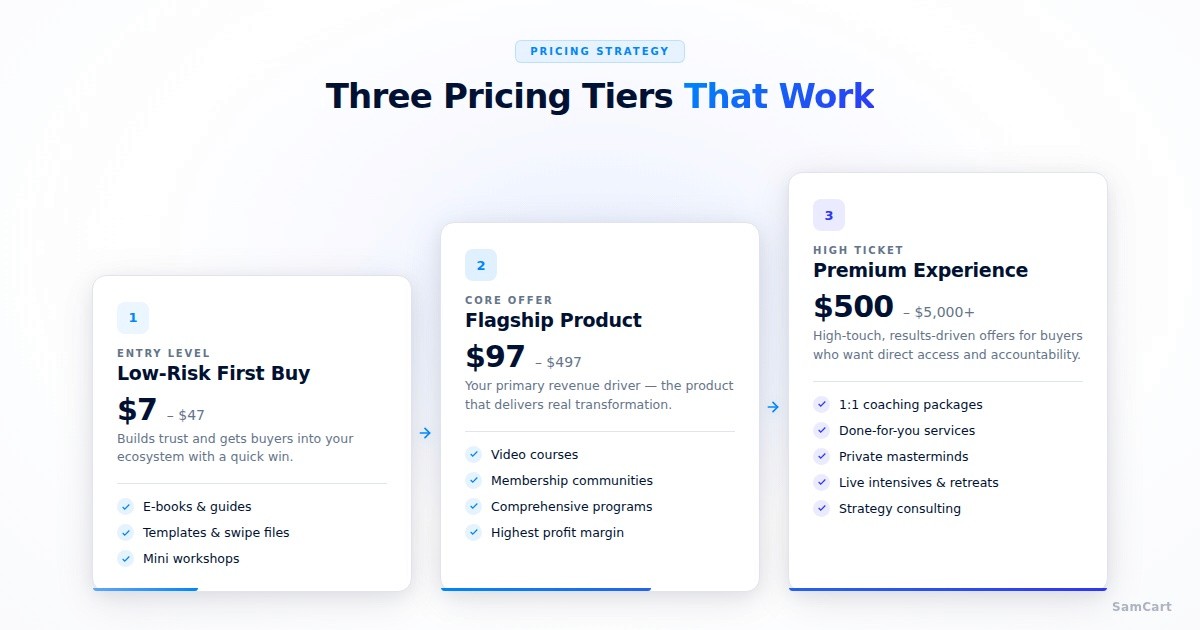
Entry-level ($7 to $47): Removes the risk of a first purchase. Ebooks, templates, mini-courses, swipe files. The goal is to acquire a buyer, not maximize revenue on the first transaction.
Core offer ($97 to $497): Your main product. A comprehensive course, group coaching program, or bundle. This is where the majority of your revenue comes from.
High-ticket ($500 to $5,000+): Done-with-you services, masterminds, or intensive programs. Lower volume, higher margin, reserved for buyers who have already trusted you at a lower level.
If you are starting with one product, launch at a price you can defend based on outcomes. You can always adjust. What you cannot easily recover from is training an audience to expect low prices.
Pricing psychology that actually moves buyers
A few things that consistently improve conversion at pricing:
Anchor with what the problem costs. If your course helps someone stop wasting $500/month on the wrong tools, $197 is an obvious yes.
Name the specific outcome in the price context. Not "online course for $197" but "get your first 1,000 email subscribers in 30 days, $197."
Offer a payment plan for anything over $200. Adding a 2-payment option typically increases conversions by 15 to 25% on higher-priced offers.
Test your price. Run the same page at two price points for two weeks. The data will tell you more than any pricing guide.
How to write a sales page that converts
Your sales page is the most important page in your business. It is where someone who has never heard of you decides whether to become a customer. Most creators spend weeks building the product and an afternoon on the page. That is the wrong ratio.
A converting sales page has six components, in this order:
A headline that names the specific outcome, not the product. "How to build a 1,000-person email list from scratch" converts better than "Email marketing course."
A problem statement that shows you understand exactly where your buyer is right now, not where they want to be.
Proof that you can solve it: your own story, a customer result, or a specific credential that makes you credible on this topic.
What they get: a clear breakdown of the product with enough specificity that they can picture using it.
Social proof: testimonials, results, or usage numbers. One specific result from a real customer outperforms five generic endorsements.
A CTA that is direct and frictionless. "Get instant access" with a clear price performs better than "Learn more."
SamCart's AI writes your sales page copy and designs the page simultaneously, based on what actually converts across $7B+ in real sales data. You describe your product and your buyer. The AI builds the page. You review and publish.
How to build a checkout that actually converts
Most digital product sellers lose a significant percentage of potential revenue at checkout. Not because their product is wrong or their price is off, but because their checkout experience introduces friction that costs sales.
Checkout conversion is the highest-leverage optimization available to any digital product seller. SamCart's checkout converts 51% higher than standard checkout pages. Applied to an existing business doing $5,000/month, that is thousands of additional dollars from the same traffic, with no new product, no new audience, and no additional ad spend.
What a high-converting checkout needs
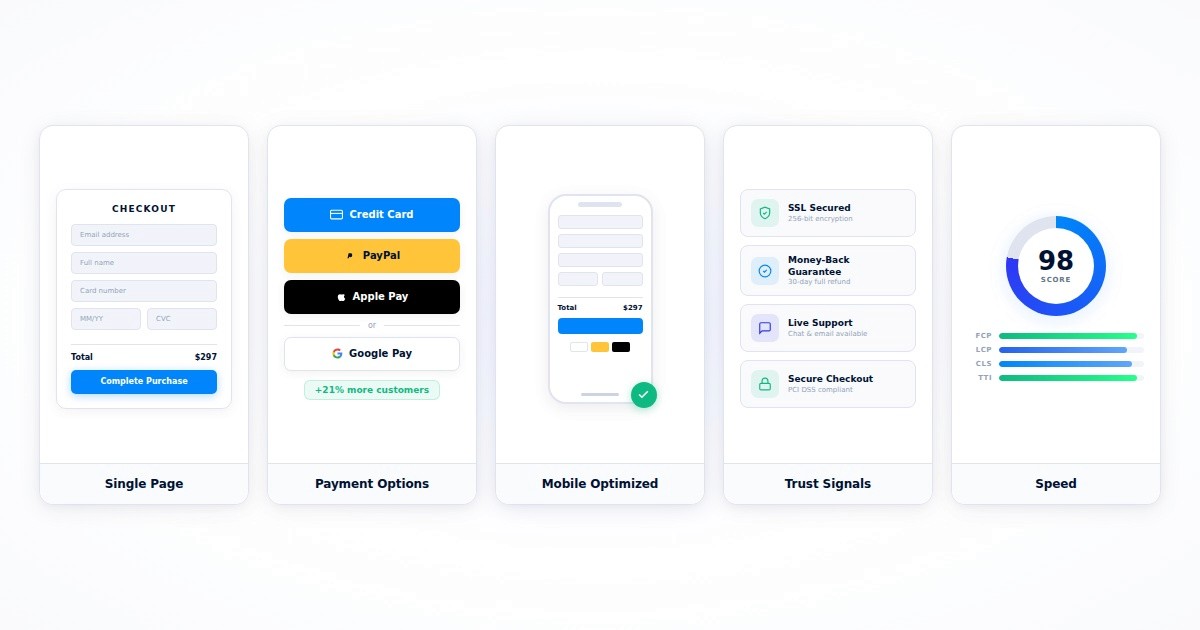
Single page. Every additional step costs conversions. Your buyer should be able to complete their purchase without navigating away.
Multiple payment options. Offering a second payment method captures an average of 21% more customers, according to SamCart data.
Mobile optimization. More than half of digital product purchases happen on mobile. A checkout that is not designed for mobile is leaving money behind.
Trust signals. Security badges, a money-back guarantee, and a visible support contact reduce abandonment at the decision moment.
Speed. A slow checkout page loses buyers before they enter their card number.
The revenue tools most sellers ignore
Here is the honest math most digital product guides skip. Getting someone to your checkout is expensive, whether you paid for traffic with ads, time with content, or both. The difference between a sustainable business and one that is always chasing the next sale is what happens after someone decides to buy.
Order bumps
An order bump is a one-click add-on that appears at checkout, before the buyer completes their purchase. It is the single highest-ROI revenue tool available to digital product sellers.
Setup time: about 10 minutes. Average revenue increase: 42% on day-one order value for SamCart sellers who use one. A $97 course with a $27 order bump (a related checklist, template, or quick-start guide) frequently converts at 30 to 50%. That means roughly one in three buyers adds $27 without any additional effort on your part.
If you are selling digital products and you do not have an order bump on your checkout, this is the first thing to add.
One-click upsells
A one-click upsell appears after the purchase is complete, when the buyer is at peak trust and commitment. It offers a related product or upgrade using the payment information they just entered, so there is no new form to fill out.
Done well, a upsell sequence can double the revenue from a single transaction. Done poorly, it feels pushy and damages the customer relationship. The key is relevance: the upsell should be the obvious next step for someone who just bought your core offer.
Cart abandonment recovery
A meaningful percentage of people who start your checkout do not finish it. Without abandonment recovery, that revenue is gone. With it, an automated sequence of follow-up emails recovers a share of those incomplete purchases.
SamCart's cart abandonment recovery runs automatically. You set it up once. It works whether you are online or not.
Marketplace vs. direct sales: which platform is right for you
This is the most consequential platform decision a digital product seller makes. The answer depends on where you are in your business.
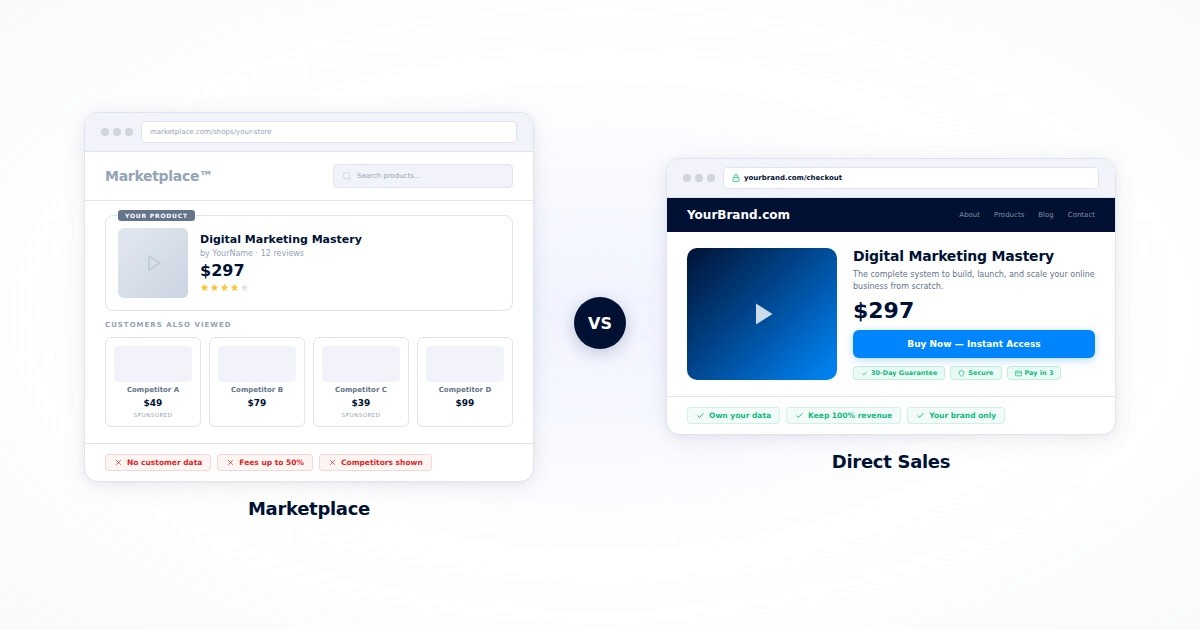
Marketplaces (Etsy, Gumroad, Amazon)
Marketplaces provide built-in discovery. Buyers are already there, searching for products like yours. That is the upside.
The downside is significant. Marketplaces take a percentage of every sale. They own the customer relationship: you never get the buyer's email address, cannot follow up, and cannot upsell. Your pricing is constrained by competitive pressure. Your business depends on an algorithm you do not control.
Marketplaces make sense for testing a product idea with minimal setup, or for selling commodity digital products (printables, stock assets) where discovery is the primary challenge. They make less sense for building a real business.
Direct-sales platform (SamCart)
A direct-sales platform gives you full control. You own the customer data, set your own prices, and keep the revenue from every upsell and order bump. Your checkout is optimized for conversion rather than marketplace browsing.
SamCart's AI builds everything you need to sell, without a separate website. Sales pages, landing pages, link-in-bio pages, and even full microsites are created directly inside SamCart. You can embed a converting checkout anywhere, or let SamCart build the entire front end. Many sellers run their whole business from pages they built in SamCart in an afternoon.
The trade-off: you are responsible for driving traffic. But the economics are dramatically better. One order bump on a direct checkout often generates more revenue than dozens of marketplace sales, with no platform fees eating the margin.
The hybrid approach
Some sellers start on a marketplace to validate demand and build initial reviews, then migrate to a direct-sales platform once they have proof the product sells. This is a reasonable path. The important thing is not to stay on a marketplace longer than necessary once you have evidence the product converts.
How to get your first sales without a big audience
The most common reason people delay launching a digital product is that they believe they need a large audience first. They do not. You need to reach the right people with a clear offer.
Organic content
Post about the problem your product solves, not the product itself. A creator teaching email marketing who posts about common email mistakes they see, real subject line tests, and specific tactical tips will attract buyers more reliably than one who posts product announcements.
The goal is to demonstrate expertise publicly so that when you offer something for sale, the audience already trusts you. SamCart's AI generates social media content, email copy, and marketing materials from a single prompt, so you can produce consistent content without spending hours writing from scratch.
If you have any email list at all (even 50 people), that is your first audience. Email converts at a higher rate than social media for digital product sales because the relationship is direct and the reader chose to hear from you.
One well-written email that names a specific problem and positions your product as the solution will outperform any social media campaign at the early stage. Write it the way you would explain the product to a friend: the problem you saw, why you built this, what it does, and a direct link.
Paid traffic
Paid ads become viable once you have two things in place: a sales page that converts and at least one order bump on your checkout. Without those, you are paying to send traffic to a leaky bucket.
With them, paid traffic is a multiplier. SamCart's affiliate center is also worth setting up early. It lets other people promote your product for a commission, turning your buyers into a distribution channel without requiring you to grow your own following.
Don't know where to start with traffic? SamCart teaches you that too.
Knowing the channels is one thing. Knowing how to actually execute them is another. CreatorU, SamCart's built-in education platform, gives you access to training from creators who have already built audiences and scaled digital product businesses from scratch. It is not generic marketing advice. It is taught by people using the same platform you are selling on.
And while you are learning, SamCart's AI is working alongside you. It generates the content, writes the emails, and produces the marketing copy so you can show up consistently even before the strategy fully clicks. Most creators find that the act of publishing AI-assisted content is what builds the skill, not studying it first.
How SamCart builds, runs, and scales your digital product business
SamCart is the digital business platform built to take you from your first digital product to your first million, without switching tools along the way.
The AI writes your sales page copy, designs your pages, and generates your marketing emails. SamCart's platform handles checkout, payments, upsells, order bumps, cart abandonment recovery, course hosting, subscriptions, and affiliate management automatically.
75,000+ businesses have processed over $7 billion in sales on SamCart. Every page the AI builds is informed by what actually converts across that data.
What you get:
AI that writes your sales page copy and marketing emails from a single prompt
Checkout that converts 51% higher than standard checkout pages
One-click upsells and order bumps that add an average 42% to day-one order value
Cart abandonment recovery that wins back lost sales automatically
Checkout Anywhere: embed your checkout on any page, link, or social bio
Built-in course hosting, memberships, and subscriptions
Affiliate center to build a team of promoters
Revenue-based pricing starting at $79/month
The bottom line
Most digital product businesses do not fail because the product is bad. They fail because the selling infrastructure was never built.
SamCart builds it for you. The pages, the checkout, the upsells, the revenue tools. AI handles the hard parts. You keep more of what you earn.
From your first product to your first million, it all starts here.
SamCart Editorial Team
Brian Moran
Founder
Samara Lemon
VP of Marketing
Leilani Treuting
Marketing Director
Scott Moran
Co-Founder