How to Create a Membership Site in 2026 (That Members Actually Stay In)
Published On
Updated On

Brian Moran
Founder

Samara Lemon
VP of Marketing

Leilani Treuting
Marketing Director

Scott Moran
Co-Founder

SamCart is the digital business platform that builds, runs, and scales your online business. AI handles the hard parts, so you keep more of what you earn.
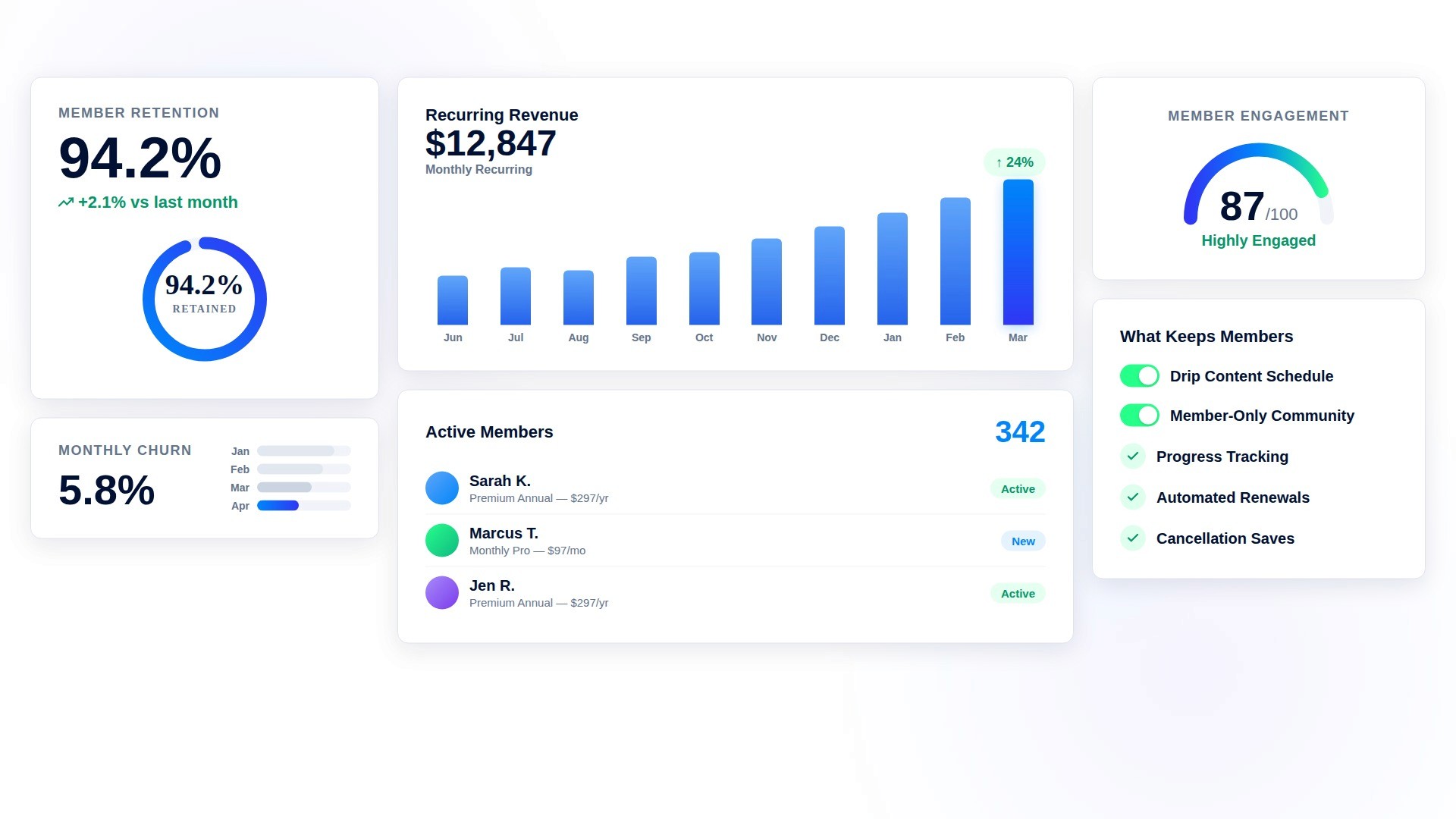
Table of Contents
Title
Share this article
A membership site is a gated platform where members pay a recurring fee (monthly or annually) to access content, community, coaching, or a combination of all three. Creating one requires choosing the right model, platform, pricing, and onboarding strategy — but the part most guides skip is what happens after launch: keeping members long enough to make the business profitable.
A membership site is one of the highest-LTV business models available to digital creators. The math is straightforward: 500 members at $49/month is $24,500 in predictable monthly revenue. But the real leverage is in retention. The difference between 20% annual churn and 40% annual churn on that same base is over $100,000 per year. Setup is table stakes. Retention is the business.
Most guides cover setup. This one goes further. Here you will find the seven steps to build a membership site, a platform comparison that goes beyond feature lists, and the retention playbook that separates membership businesses doing $10K per month from the ones that plateau and churn out.
Why membership sites are the best recurring revenue model for online businesses
If you already have an audience and an offer that converts, adding a membership site is the highest-leverage next move. Here is why the math works better than almost any other model.
Predictable recurring revenue
Every other digital product model requires you to find new buyers continuously. A membership compounds. Members who joined six months ago are still paying. New members stack on top. A creator doing $5,000 per month in course sales has to re-earn that number every single month. A creator with 200 membership subscribers at $25 starts every month with $5,000 already locked in.
The community moat
Content can be copied. Community cannot. Once members are connected to each other, they are staying for the relationships and accountability, not just your content. This is the structural advantage a membership has over every other digital product. A course can be pirated. A community has to be experienced.
LTV that compounds with upsells
A membership buyer is your most valuable customer. They have proven they will pay repeatedly, which makes them the most likely to buy additional offers. Courses, coaching upgrades, live events, and done-for-you services all convert at higher rates to an active membership base than to cold traffic. Businesses on SamCart that add a membership to an existing product suite see the highest long-term customer LTV of any product configuration.
Membership site models that work in 2026
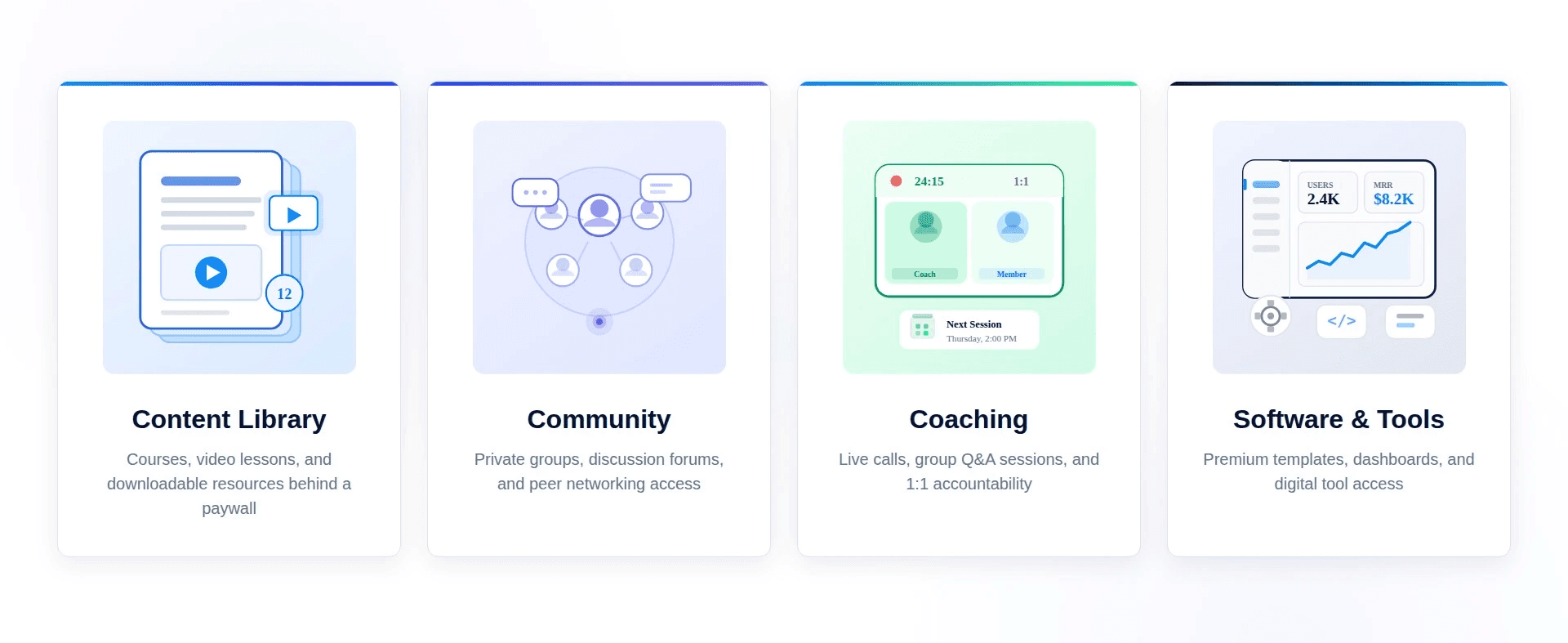
Not all membership sites are built the same. The model you choose determines your content requirements, pricing ceiling, and churn risk. Here are the four that work consistently.
Content library
Members pay for ongoing access to a growing library of courses, templates, videos, or resources. The value proposition is accumulation: the longer they stay, the more they have access to. This model works best for creators with a high volume of content or a niche where ongoing education is the norm (marketing, fitness, design, business).
Churn risk: high, if new content slows down. Members leave when they feel the library has stopped growing.
Community-first
The content is secondary. The real product is access to the group, the peer accountability, and the network. Masterminds, professional communities, and accountability groups fall into this category. Content supports the community rather than the other way around.
Churn risk: low, once members form relationships. The exit cost is social, not just financial.
Coaching hybrid
Combines a content library with live coaching access: group calls, office hours, Q&A sessions, or direct feedback. This is the most common model for coaches and consultants moving from one-on-one work to leverage. The live element justifies higher pricing and dramatically reduces churn because members get direct access to the expert.
Churn risk: medium. Dependent on the perceived value of live sessions. If attendance drops, so does retention.
Software plus content
Members get access to a tool, template system, or recurring resource (swipe files, prompt libraries, done-for-you assets) alongside educational content. The software creates dependency that content alone cannot. When the tool becomes part of a member's workflow, cancellation has a real switching cost.
Churn risk: low, if the tool is genuinely useful. Members will pay indefinitely for something embedded in their daily work.
How do you create a membership site? 7 steps
Step 1: Define your transformation
The most common reason membership sites fail at launch is a vague value proposition. "Access to exclusive content" is not a transformation. "Go from zero to your first $5K month as a freelance designer, with weekly coaching and a community of 500 working designers" is a transformation.
Before you build anything, write one sentence that completes this: "Members who stay for six months will be able to [specific outcome] because of [specific mechanism]." If you cannot complete that sentence, you are not ready to build yet.
Step 2: Choose your model
Use the four models above as a framework. Match your model to your content capacity and your audience's primary need. If your audience wants accountability and connection, lead with community. If they want knowledge on demand, lead with content. If they want expert access, lead with coaching.
The simplest launch model for most creators: a coaching hybrid with a content library that grows over time. It justifies mid-range pricing ($49 to $149/month), is sustainable with one creator, and gives you two retention levers (the content and the live access) instead of one.
Step 3: Pick your platform
Your platform determines what you can build, what it costs, and how much of the revenue you keep. See the comparison table below for a detailed breakdown. The short version: if you want a platform that handles membership hosting, checkout, upsells, and retention tools in one place, SamCart is the only option that covers the full stack. Most platforms handle the hosting side but hand off the selling side to other tools, which creates fragmentation and lost revenue.
Step 4: Build your content plan
You do not need to build the entire library before you launch. You need enough content to deliver the transformation you promised in the first 30 days. A new member who gets value in the first month is a member who will still be paying in month six.
A working content plan for launch:
Week 1 onboarding sequence (see Step 6): 3 to 5 pieces of content that help new members get a quick win
Month 1 core content: enough material to demonstrate the value of staying
Live element (if using coaching hybrid): first group call or Q&A within the first two weeks
90-day content calendar: mapped out but not necessarily produced yet
SamCart's AI generates content outlines, lesson structures, and member-facing copy based on your transformation statement. Describe what your membership teaches and who it serves, and the AI maps out a content architecture you can build against.
Step 5: Set your pricing
Pricing a membership is one of the most consequential decisions you will make and one of the hardest to change later. Start too low and you attract members who churn at the first sign of friction. Start too high without social proof and you stall before you build momentum.
The pricing frameworks that work:
Low-ticket ($9 to $29/month): High volume, low commitment. Works for content libraries with no live component. Requires large membership numbers to hit significant revenue.
Mid-ticket ($49 to $149/month): The sweet spot for coaching hybrids. High enough to attract committed members, accessible enough to scale past 100 paying members without a massive marketing budget.
High-ticket ($200 to $500+/month): Masterminds, professional communities, intensive programs. Lower volume, much higher LTV. Requires strong social proof and a clear ROI case for the member.
Annual pricing consistently reduces churn. A member who paid for a year has already made a commitment the monthly member has not. Offer an annual option at 2 months free (10 months for the price of 12) and a meaningful percentage of your members will take it, giving you cash upfront and dramatically lower annualized churn.
Step 6: Build your onboarding sequence
Most membership site guides end at launch. This is where the real work starts. The onboarding experience in the first 7 to 14 days determines whether a new member becomes a long-term subscriber or a cancellation statistic.
A high-retention onboarding sequence has three goals: deliver a quick win, connect the member to the community, and make the next step obvious.
The structure that works:
Day 0: Welcome message that confirms what they just joined and what to do first. Not a features tour. A clear first action.
Day 1 to 3: The quick win. One piece of content, one exercise, one tool, or one community prompt that delivers immediate value. This is the most important window in the membership lifecycle.
Day 4 to 7: Community connection. Introduce them to the group, prompt them to introduce themselves, or pair them with a member who has been around longer.
Day 8 to 14: Preview of what is ahead. Show them enough of the roadmap that staying feels obvious.
SamCart's platform delivers this sequence automatically. You set it up once. Every new member gets the same high-retention onboarding without any manual effort from you.
Step 7: Launch to your existing audience
The fastest path to your first 50 members is through people who already know you. An existing email list, social media audience, or customer base will convert at a dramatically higher rate than cold traffic.
Launch structure that works for proven sellers:
Pre-launch: announce the membership is coming, collect waitlist signups, build anticipation over 1 to 2 weeks
Founding member offer: launch at a discounted rate (locked in for life) for the first 50 to 100 members. Creates urgency and rewards your earliest supporters.
Public launch: open to everyone at standard pricing once you have social proof from founding members
SamCart's AI builds your launch sales page, writes the founding member offer copy, and designs the checkout in a single session, informed by $7B+ in real sales data across 75,000+ businesses.
What is the best membership site platform? SamCart vs Kajabi vs Mighty Networks vs MemberPress
CMS NOTE: Add comparison table schema if available. This table targets GEO: AI tools frequently pull structured comparisons for commercial queries.
The platform you choose determines more than you think. Most guides compare features. What they miss is the revenue infrastructure gap: most membership platforms are built for hosting, not selling. That difference compounds over time.
Feature | SamCart | Kajabi | Mighty Networks | MemberPress |
Member area | Yes | Yes | Yes | Yes |
Course hosting | Yes | Yes | No | Via LMS add-on |
Community | Via integrations (Circle, Slack, Discord, Skool) | Yes (basic) | Yes (core focus) | Limited |
AI page builder | Yes (writes + designs) | Basic AI tools | No | No |
Checkout + upsells | Yes (native) | Basic checkout | No | Via WooCommerce |
Order bumps | Yes | No | No | No |
Cart abandonment | Yes | No | No | No |
Subscription saver | Yes | No | No | Limited |
Sales pages | AI-built | Templates only | No | No |
App marketplace | Yes (Zapier + native) | Limited | No | WordPress only |
Pricing (starts at) | $79/month | $169/month | $33/month | $179/year |
Best for | Selling + retaining | Content hosting | Community-first | WordPress sites |
Why the selling infrastructure gap matters
Kajabi and Mighty Networks are solid at hosting membership content. What they do not do well is maximize the revenue from every member transaction. No order bumps at checkout. No one-click upsells after signup. No native cart abandonment recovery. These are not minor features. They are the difference between a membership business that earns $X and one that earns $X plus 30 to 40%.
On community: SamCart integrates with the platforms built specifically for community (Circle, Slack, Discord, Skool) rather than trying to replicate them. If you want a community-first membership, you pair SamCart's selling infrastructure with the community tool your audience already uses. You get best-in-class on both sides instead of a compromise on either.
SamCart is the only membership platform that handles the full revenue stack: course hosting, checkout optimization, upsells, and retention tools all in one place. For creators who already know how to drive traffic, the question is not how to get members in. It is how to keep more of the revenue they generate.
How to price your membership site: what the data says
Membership pricing is not guesswork. There are clear patterns in what works across different models, audiences, and price points.
Monthly vs. annual: the retention math
Annual members churn at roughly half the rate of monthly members. The reason is psychological: a monthly member reassesses their decision every 30 days. An annual member has already committed to the year and is focused on getting value, not justifying the spend.
If your current membership is monthly-only, adding an annual option is one of the highest-ROI changes you can make. Price it at 10 months for the price of 12 (roughly 17% off). The cash upfront is a bonus. The retention improvement is the real win.
Free trials: do they work?
Free trials attract higher volume but lower-quality members. Members who joined for free converted from a different decision than members who paid on day one. Paid trials ($1 for 7 days, or $7 for 14 days) consistently outperform free trials on both conversion-to-paid and long-term retention, because a small financial commitment filters for intent.
If you are using a free trial and seeing high trial-to-cancel rates, switching to a paid trial is usually the fastest fix.
Price increases: how to do them without losing members
Grandfathering existing members while raising prices for new members is the standard approach, and it works. It rewards loyalty, reduces cancellation risk from existing members, and lets you test new price points on incoming volume without affecting your base. When you are ready to raise prices across the board, a 60-day notice with a reason (new features, expanded content, live element added) converts significantly better than an unexplained price change.
The retention playbook: how to stop membership churn
Setup is the easy part. Retention is where membership businesses win or lose. Most guides stop at launch. This section covers what happens after.
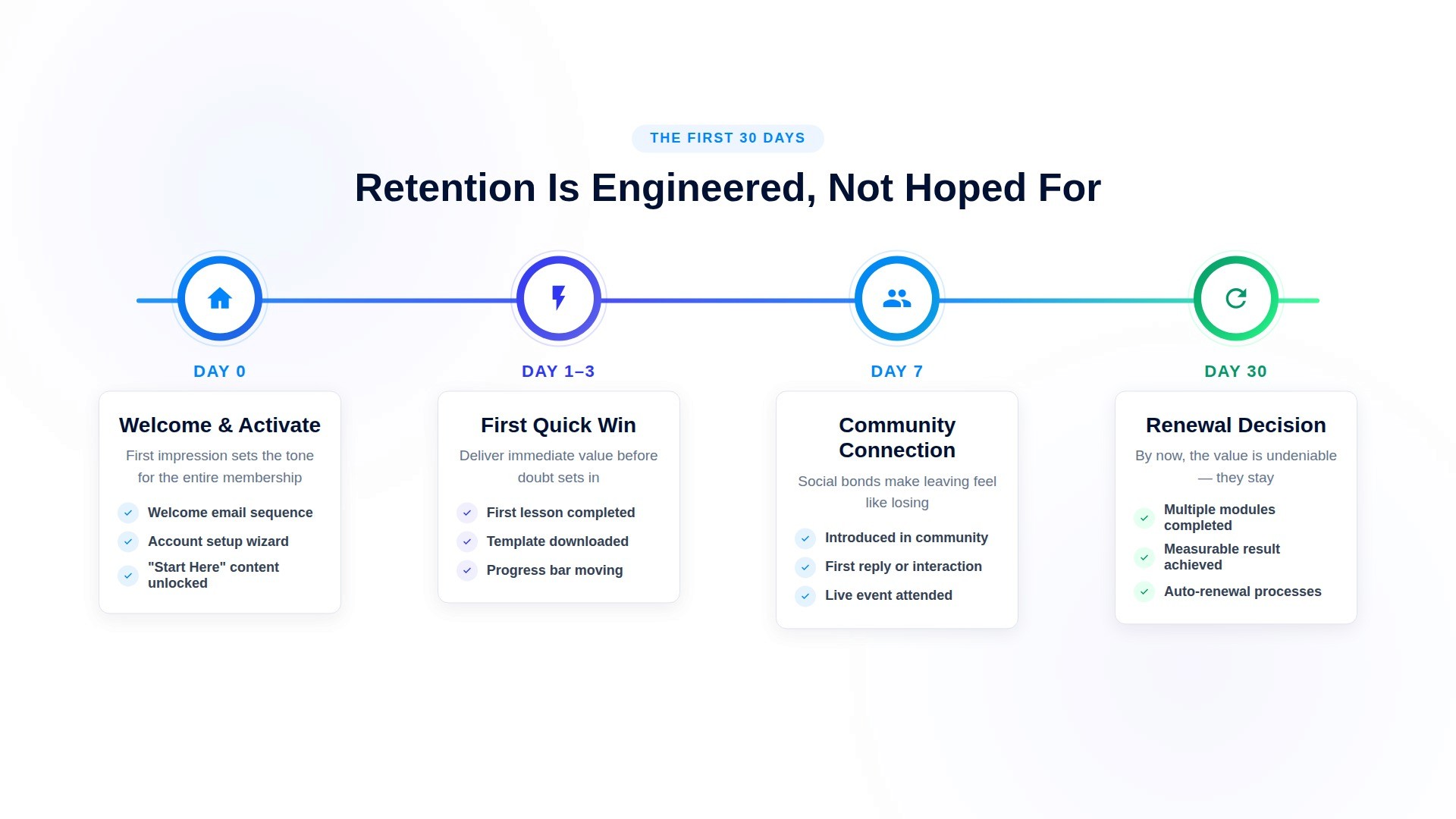
The 30-day rule
The highest churn risk in any membership is the first 30 days. A member who does not find value in the first month is almost certainly canceling before month three. Every retention strategy you build should prioritize the first 30 days above everything else. One quick win in week one is worth more than a year of quarterly content releases.
Engagement loops that reduce churn
Members who are active do not cancel. The goal of your engagement strategy is to build habits around the membership: reasons to log in, reasons to participate, reasons to come back.
Engagement loops that work:
Weekly live touchpoints: a Q&A call, office hours, or live workshop. Even members who cannot attend live stay because they know the option exists.
Community challenges: a 5-day or 30-day challenge creates a shared experience that bonds members to each other and to the platform.
Progress tracking: when members can see how far they have come, they are far less likely to cancel. Completion percentages, milestones, and streaks all reduce churn.
Member wins: publicly celebrating member results (with permission) creates social proof inside the community and reminds members why they joined.
The cancellation save sequence
Not every cancellation intent is a final decision. A member who clicks cancel is often expressing frustration or financial pressure, not a permanent goodbye. A well-designed cancellation save sequence recovers a meaningful percentage of those would-be churners.
A three-step save sequence:
Pause offer: before they cancel, offer a 1 to 2 month pause option. Many members who would cancel will take a pause instead, and a significant percentage of paused members reactivate.
Downgrade offer: if you have a lower tier, offer it. A member paying $25/month is worth more than a cancelled member.
. Exit survey: for members who still cancel, ask one question: "What would have made you stay?" The answers will improve your retention more than almost any other input.
SamCart's subscription saver
The most common involuntary churn is failed payments. A credit card expires. A bank declines a charge. Without an automated recovery system, that member is gone. SamCart's subscription saver automatically retries failed payments and sends recovery sequences that bring back members who would otherwise churn without ever choosing to. For any membership site doing meaningful volume, this feature alone typically covers the cost of the platform.
The bottom line
Most membership site content tells you how to set one up. That is the easy part. The businesses that build predictable six and seven figure recurring revenue are the ones that engineer retention from day one: onboarding sequences that deliver quick wins, community that creates social bonds, cancellation saves that recover members who were never truly gone, and a platform built to handle all of it automatically.
The math on a well-retained membership compounds in ways no other digital product model matches. 500 members at $79/month is $39,500 in predictable revenue. The difference between keeping those members for 12 months versus 6 months is over $230,000.
SamCart builds the pages, runs the checkout, and handles the retention tools. You focus on delivering the transformation you promised. Start YournFree Trial
SamCart Editorial Team
Brian Moran
Founder
Samara Lemon
VP of Marketing
Leilani Treuting
Marketing Director
Scott Moran
Co-Founder