How Much Money Can I Make Selling Online Courses? (Calculator + Real Numbers)
Published On
Updated On

Brian Moran
Founder

Samara Lemon
VP of Marketing

Leilani Treuting
Marketing Director

Scott Moran
Co-Founder

SamCart is the digital business platform that builds, runs, and scales your online business. AI handles the hard parts, so you keep more of what you earn.
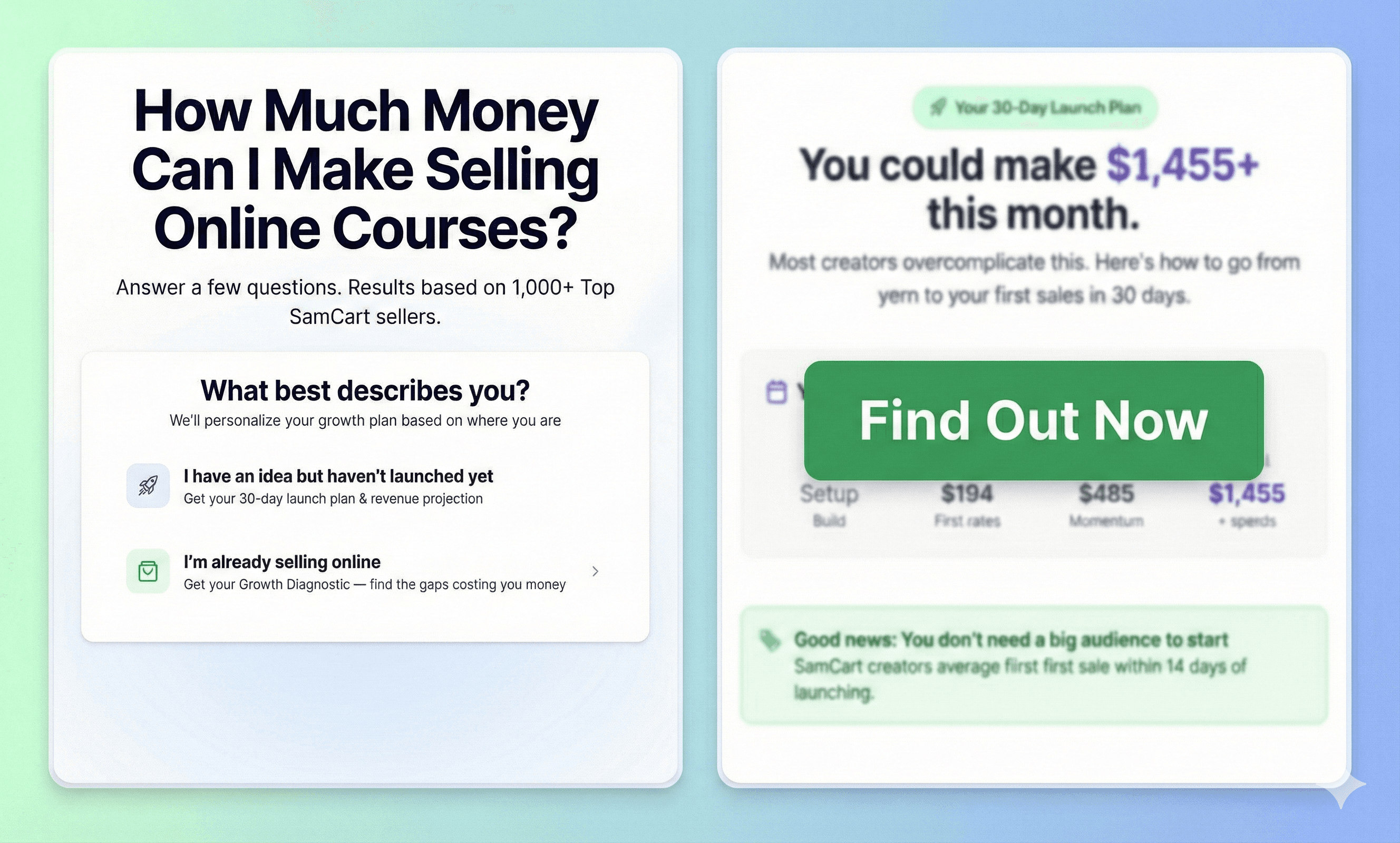
Table of Contents
Title
Share this article
You've got the knowledge. You've got the audience—or at least the beginnings of one. But before you invest hundreds of hours building an online course or digital product, you need to know the answer to one question: Can I actually make money doing this?
It's the question every aspiring creator asks. And the frustrating part? Most advice either oversells the dream ("Six figures in six months!") or undersells the reality ("You need 100,000 followers first"). The truth is more nuanced—and more encouraging than you might think.
After analyzing $7 billion in creator sales across 100,000+ sellers, we've learned something surprising: small audiences can generate substantial income with the right strategy. The key isn't just traffic—it's understanding the creator revenue formula and the often-overlooked multipliers that can 3x your earnings from the same customer base.
In this guide, we'll break down what creators at different stages actually earn, explain the core revenue formula, and show you how to calculate your own earning potential using our free Creator Revenue Calculator.
What Do Course Creators Actually Make? Real Revenue Benchmarks
Let's start with honest numbers. The creator economy spans from side hustlers to seven-figure entrepreneurs, and your earning potential depends heavily on where you are in your journey.
Beginner Creators: $0-2K/Month
If you're just starting out—maybe you have a few hundred email subscribers or a modest social following—$500 to $2,000 per month is a realistic initial target. This typically comes from:
A $97-297 flagship course or digital product
5-20 sales per month
Conversion rates around 1-3% from your audience
Minimal upsells or additional offers
At this stage, most creators underestimate what's possible because they're focused solely on that initial sale. But here's where it gets interesting: even small creators can significantly increase revenue by adding simple revenue multipliers (more on this shortly).
Scaling Creators: $2K-10K/Month
Once you've validated your offer and started building systems, the $2,000-10,000 per month range becomes achievable. Creators at this level typically have:
1,000-5,000 engaged subscribers or followers
Multiple offers at different price points ($97-997)
Order bumps or add-ons on their checkout page
Basic upsell sequence after purchase
Conversion rates of 3-8%
The jump from beginner to scaling isn't about 10x-ing your audience. It's about optimizing the revenue formula and implementing the multipliers most calculators completely miss.
Established Creators: $10K+/Month
When you hit five figures monthly, you've built a real business. These creators have:
Proven offers with consistent demand
Sophisticated funnel with multiple revenue touch points
Active upsell and cross-sell strategy
Payment plans and subscription offers
Often a small team or automation systems
Many creators at this level process $150K-500K+ annually, and the common thread isn't massive audiences—it's maximizing revenue per customer through strategic pricing and offer architecture.

The Creator Revenue Formula: Why Most Calculators Get It Wrong
Every online course income calculator uses the same basic formula:
Revenue = Audience Size × Conversion Rate × Price
That's not wrong—it's just incomplete. This formula tells you what you'll make from your initial sale, but it ignores how most successful creators actually build sustainable income.
Let's break down each variable:
Audience Size: Smaller Than You Think
One of the biggest myths in the creator economy is that you need tens of thousands of followers to make meaningful money. The data shows otherwise.
An engaged email list of 1,000 people converting at 5% (50 sales) for a $197 course generates $9,850. Scale that to 2,000 subscribers with the same conversion rate and price, and you're at $19,700 from a single launch or promotion.
The key word is engaged. A list of 10,000 unresponsive subscribers is worth less than 500 people who actually open your emails and trust your recommendations.
Conversion Rate: The Most Controllable Variable
Your conversion rate—the percentage of people who actually buy—is where optimization happens. Industry benchmarks:
Cold traffic (ads, SEO): 1-3%
Warm traffic (email list): 3-8%
Hot traffic (webinar attendees, waitlist): 10-25%
Small improvements here compound dramatically. If you have 2,000 subscribers and increase your conversion rate from 3% to 5%, that's 40 additional sales. At $197, that's $7,880 in additional revenue from the exact same audience.
How do you improve conversion rates? This is where your checkout experience matters enormously. Checkout optimization can increase conversions by 30% or more through friction reduction, trust elements, and streamlined payment processing.
Price: Where Fear Holds Creators Back
Most new creators underprice drastically. They think, "I'm not established enough to charge $297." But here's what the data shows: customers don't buy based on your follower count—they buy based on the transformation you're selling.
A $97 course needs 3x the sales of a $297 course to generate the same revenue. That means 3x the customer support, 3x the onboarding, 3x the marketing effort—for the same income.
When you understand how to price an online course based on value delivered rather than competitor pricing, you unlock significantly higher revenue with less volume required.
The Hidden Multipliers: What Most Revenue Calculators Miss
Here's where it gets exciting. The basic revenue formula shows your initial sales, but successful creators multiply that baseline revenue by 2-3x through strategic add-ons.
These are the four revenue multipliers that separate five-figure creators from those stuck at a few hundred dollars per month:
1. Order Bumps: The Immediate Add-On
An order bump is a checkbox offer on your checkout page—think of it like Amazon's "frequently bought together" suggestions. It's a complementary, lower-priced product ($27-97) that customers can add with a single click before completing their purchase.
The impact: 20-40% of customers add order bumps, instantly increasing your average order value. If your course is $297 and you add a $47 workbook as an order bump, every fifth customer who takes it raises your average order to $306. Over 100 sales, that's an extra $900 with zero additional marketing.
Order bumps work because the buyer is already in purchasing mode—you're not asking them to make a separate decision or re-enter payment information.
2. One-Click Upsells: Post-Purchase Magic
After someone completes their initial purchase, you can offer them additional products without them re-entering payment details. This is a one-click upsell, and it's where revenue multiplies fast.
The impact: 25-35% of customers accept a relevant upsell. If you sell a $197 course and upsell a $97 implementation package, 30 out of 100 buyers adding that upsell generates an extra $2,910.
The key is relevance—upsells should be logical next steps. If someone just bought "YouTube Growth 101," they're primed to buy "Advanced Thumbnail Design" or "Viral Video Scripts Pack."
Creators using one-click upsells see an average 30% revenue lift from the same traffic. That means if you were making $5,000 per month, implementing strategic upsells can push you to $6,500 with no additional audience building required.
3. Payment Plans: Making Premium Accessible
High-ticket offers ($997+) feel out of reach for many customers—until you split them into installments. A $997 course might seem expensive, but "4 payments of $249" frames the same price as more manageable.
The impact: Payment plans typically increase conversions by 30-50% for offers over $500. The tradeoff is receiving revenue over time instead of upfront, but the net increase in total sales often outweighs the delayed cash flow.
Flexible payment options including buy-now-pay-later services further reduce friction, especially for younger audiences who prefer installment payments.
4. Subscriptions: The Recurring Revenue Game-Changer
Instead of a one-time $297 sale, what if that customer paid $29/month for ongoing access, community, or updated content? After 12 months, that's $348—more than your one-time price—and they may stay for years.
The impact: Even small subscription additions transform business models. If 20% of your one-time customers convert to a $29/month membership, you're building recurring revenue that compounds monthly. This is how creators build truly sustainable businesses rather than relying on constant launches.
Calculate Your Real Earning Potential
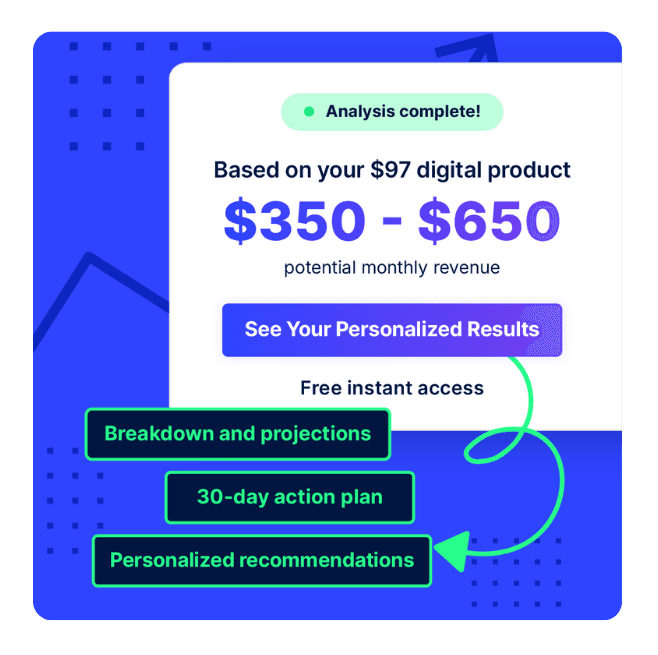
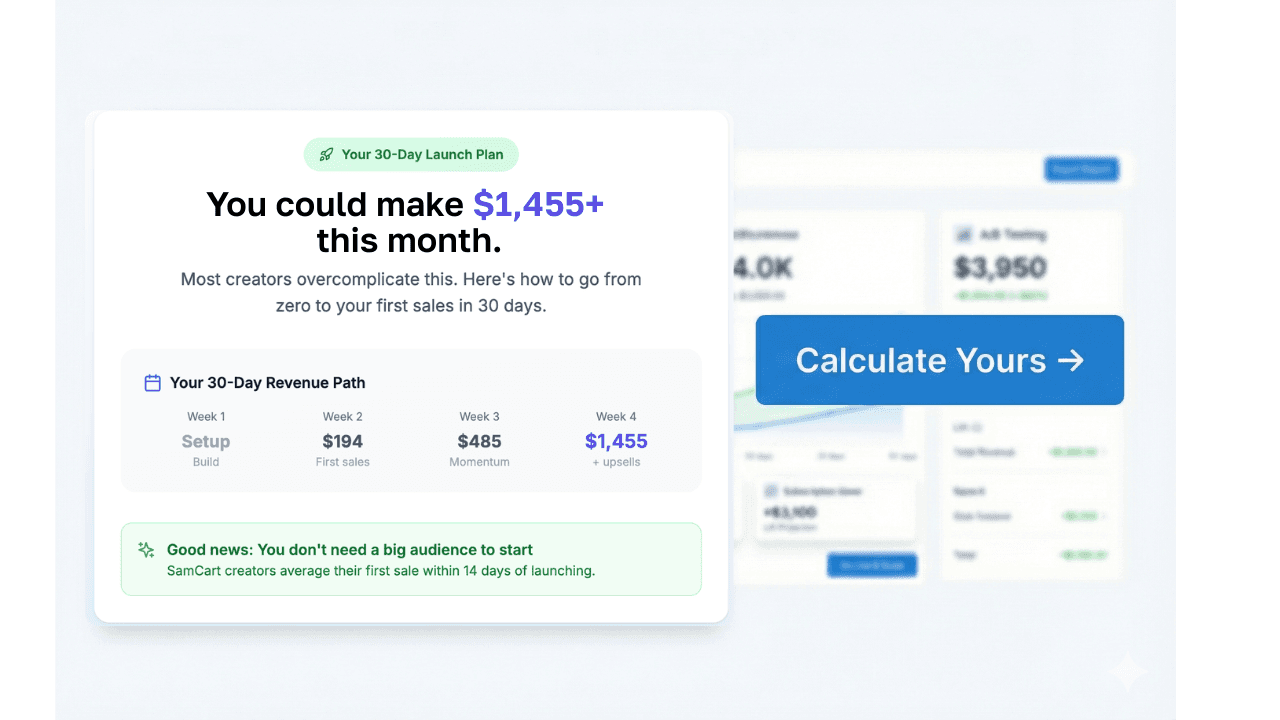
Theory is helpful, but you need to see your own numbers. Our Creator Revenue Calculator takes your specific situation—your niche, audience size, intended price point, and goals—and projects your earning potential with and without revenue multipliers.
Here's what the calculator shows you:
Baseline revenue: What you'll make from initial sales only
Optimized revenue: What's possible when you add order bumps, upsells, and payment plans
Path to your income goal: How many sales you actually need to hit your target monthly revenue
Recommended pricing: Whether you're charging too little for the value you deliver
The calculator is built on real data from $7 billion in creator sales processed through SamCart's platform. It's not guesswork—it's pattern recognition from 100,000+ sellers at every stage of the creator journey.
Try the Creator Revenue Calculator now →
Why Small Audiences Can Generate Big Revenue
Let's work through a real example using the complete formula with multipliers:
Scenario: You have 1,500 email subscribers and sell a $297 course on content marketing.
Baseline calculation:
Audience: 1,500
Conversion rate: 5% (75 sales)
Price: $297
Revenue: $22,275
With revenue multipliers:
Order bump ($47 workbook): 30% take rate = 23 sales = $1,081
Upsell ($97 template pack): 30% take rate = 23 sales = $2,231
Payment plan conversion lift: 40% more sales at $997 (5 additional) = $4,985
Total optimized revenue: $30,572
That's a 37% increase from the same 1,500-person audience. Scale this to a quarterly launch schedule, and you're looking at $120K+ annually from what many would consider a "small" list.
This is why the digital product revenue potential for creators is higher than most calculators suggest—they're only showing you one slice of the revenue picture.
How SamCart Helps You Hit These Numbers
Understanding the formula is step one. Actually implementing these revenue multipliers is step two—and that's where your platform matters.
SamCart is built specifically for creators who want to maximize revenue per customer. The platform handles:
High-converting checkout pages that reduce cart abandonment and increase conversion rates by 30%+
One-click upsells that present additional offers immediately after purchase without requiring new payment info
Order bumps that let customers add complementary products with a checkbox
Flexible payment plans that make premium offers accessible to more customers
Subscription management for building recurring revenue streams
The platform is trained on success patterns from 100,000+ creators who've processed nearly $1 billion in sales in 2024 alone. It's not just checkout software—it's a revenue optimization system designed specifically for digital creators.
Your Next Step: See Your Personalized Projection
Every creator's situation is different. Your niche, audience engagement, pricing strategy, and goals all factor into what's realistic for you.
Stop guessing what you might make selling online courses. Get a personalized revenue projection based on $7 billion in real creator sales data.
Calculate your creator revenue potential now →
The calculator takes less than 2 minutes to complete and shows you exactly what's possible at your current stage—plus the roadmap to get to your income goal faster by implementing the revenue multipliers most creators overlook.
Your audience doesn't need to be massive. Your pricing doesn't need to be bargain-basement. You just need to understand the formula, apply the multipliers, and use tools built for creator success.
Ready to see your numbers? Start the calculator here.
SamCart Editorial Team
Brian Moran
Founder
Samara Lemon
VP of Marketing
Leilani Treuting
Marketing Director
Scott Moran
Co-Founder