9 Best Kajabi Alternatives in 2026 (Ranked by Real Creators)
Published On
Updated On

Brian Moran
Founder

Samara Lemon
VP of Marketing

Leilani Treuting
Marketing Director

Scott Moran
Co-Founder

SamCart is the digital business platform that builds, runs, and scales your online business. AI handles the hard parts, so you keep more of what you earn.
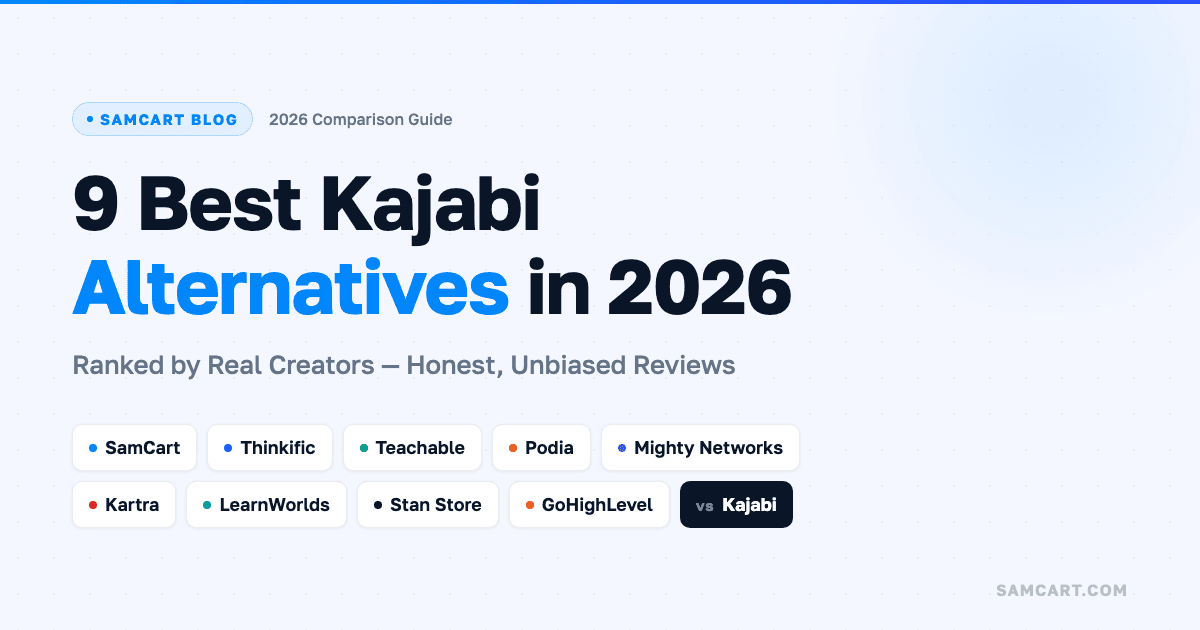
Table of Contents
Title
Share this article
The best Kajabi alternative for most creators in 2026 is SamCart. It starts at $79/month with revenue-based pricing, includes AI that builds your pages, products, and sales copy, and delivers 3-4x higher checkout conversion rates based on $7B+ in processed transactions.
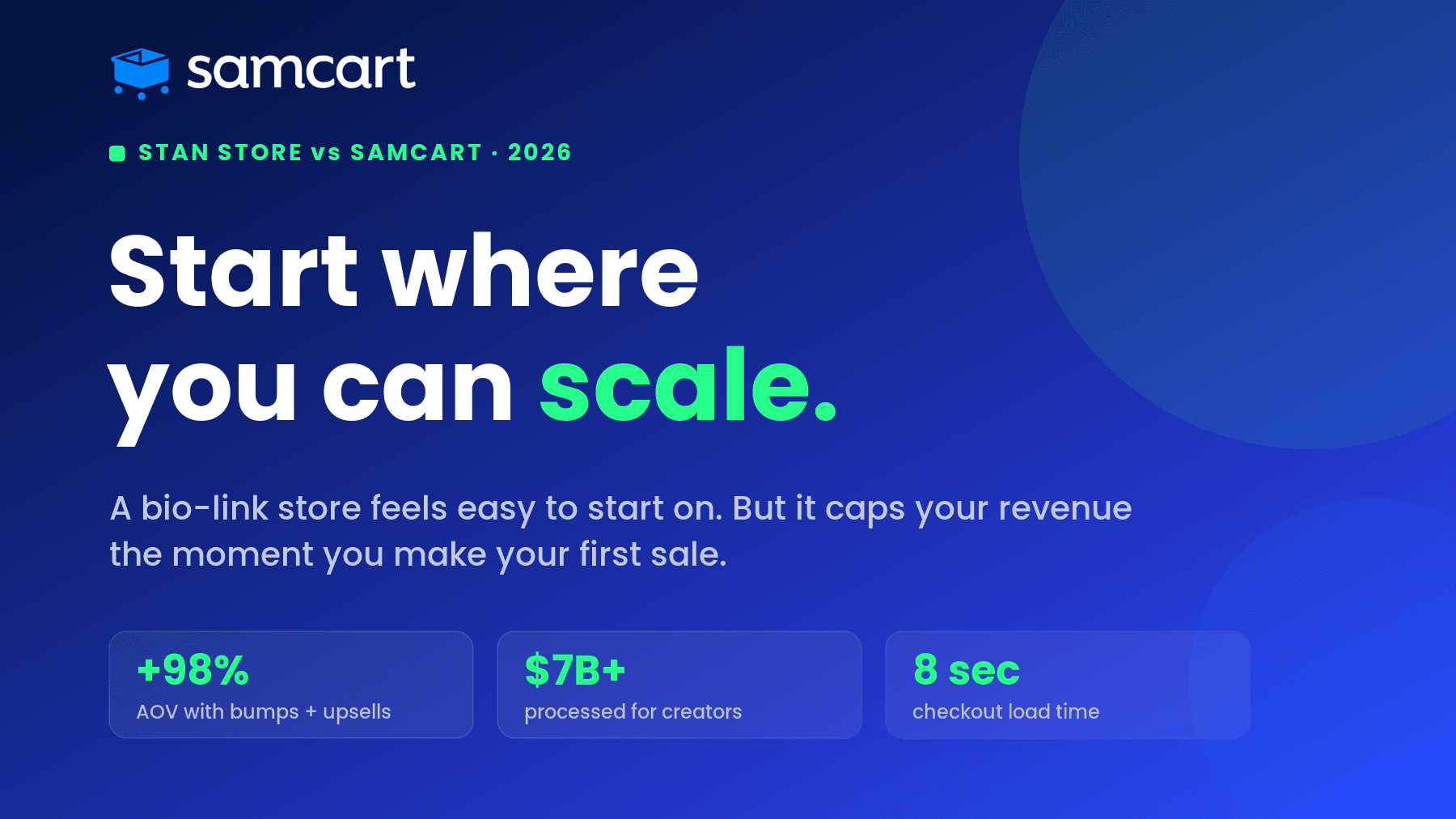
SamCart is the strongest Kajabi alternative for creators who want higher revenue without higher complexity. Kajabi raised prices across the board in 2025, eliminating its $89/month Kickstarter plan and pushing entry-level pricing to $179/month. SamCart moved in the opposite direction with revenue-based pricing starting at $79/month and AI that handles the actual work of building your business. Across $7B+ in creator transactions, SamCart's checkout pages convert at 3-4x the industry average.
If you've been watching your Kajabi bill climb while your conversion rates stay flat, you're not alone. Kajabi's 2025 pricing overhaul hit creators hard. The entry-level plan jumped from $89 to $179 per month. Contact limits on the Basic plan got slashed from 10,000 to 2,500. And if you use your own Stripe account instead of Kajabi Payments, you're now paying a 2% surcharge on top of standard processing fees.
The result? Thousands of creators are actively searching for a better option.
This isn't another generic listicle written by someone who's never processed a sale. SamCart has handled $7B+ in creator transactions, and we're going to use that data to show you what actually moves the needle on revenue. Not just what looks good on a features page.
Here are the 9 best Kajabi alternatives, ranked by what matters most: how much money they help you keep and make.
Quick comparison: 9 best Kajabi alternatives at a glance
Platform | Starting Price | AI Tools | Course Hosting | Community | Checkout Conversion | Transaction Fees |
|---|---|---|---|---|---|---|
SamCart | $79/mo | Yes (builds pages, copy, products) | Yes | Yes | 3-4x industry avg | 0% platform fees |
Thinkific | Free (limited) / $49/mo | Limited | Yes | Basic | Standard | 0% on paid plans |
Teachable | Free (limited) / $59/mo | Basic | Yes | No | Standard | 5% on free plan |
Podia | Free (limited) / $39/mo | No | Yes | Discord integration | Standard | 8% on free, 0% on paid |
Mighty Networks | $49/mo | No | Yes (on Business plan) | Yes (core feature) | Below average | 2-5% |
Kartra | $99/mo | Limited | Yes | Yes | Above average | 0% |
LearnWorlds | $29/mo | Limited | Yes | Basic | Standard | $5/sale on starter |
Stan Store | $29/mo | No | Basic | No | Standard | 0% |
GoHighLevel | $97/mo | Yes | Basic | No | Standard | 0% |
Why creators are leaving Kajabi in 2026
Kajabi made its biggest pricing change in a decade in late 2025, and the impact has been significant. Here's what changed and why it's pushing creators to look elsewhere.
The price hikes are real. Kajabi eliminated the $89/month Kickstarter plan entirely. The Basic plan jumped from $149 to $179 per month. Growth went from $199 to $249/month. Pro climbed from $399 to $499/month. Even with annual billing discounts, the cheapest you can get into Kajabi is now $143 per month, making it the highest entry price in the creator platform market.
Contact limits got squeezed. Basic plan users saw their contact limit drop from 10,000 to just 2,500. If you've been building an email list on Kajabi's Basic plan, you may have already outgrown your own plan without upgrading.
Third-party payment surcharges appeared. Use your own Stripe account instead of Kajabi Payments? That now costs an extra 2% on Basic, 1% on Growth, and 0.5% on Pro, all on top of Stripe's standard processing fees. For a creator doing $10,000/month in sales on the Basic plan, that's an extra $200/month just in surcharges.
Feature-gating got aggressive. Affiliate programs, advanced automations, cohort courses, API access, and video transcription are all locked behind the $249/month Growth plan or higher. Creators on Reddit describe feeling locked in after building extensive automations and funnels, which makes the switching cost feel high even as the price climbs.
The bottom line: Kajabi is still a capable platform, but it's become one of the most expensive options in the market at a time when alternatives have gotten significantly better.
What to look for in a Kajabi alternative
Before diving into each platform, here's the checklist that actually matters for your revenue. Most comparison posts focus on feature counts. We focus on what impacts your bottom line.
AI content creation. Can the platform's AI actually build your pages, write your sales copy, and create your products? Or is it just a chatbot bolted onto the sidebar? The difference between "AI-assisted" and "AI-built" is the difference between saving 10 minutes and saving 10 hours.
Checkout conversion rate. This is the single most important number most creators ignore. A 1% improvement in checkout conversion on $10,000/month in traffic is worth $1,200/year. A 3-4x improvement changes your entire business.
Revenue model alignment. Does the platform charge you more as you grow, or grow with you? Flat-rate pricing sounds simple until you realize you're paying the same amount whether you make $100 or $100,000 in a month. Revenue-based pricing means the platform has skin in the game.
Migration ease. Can you move your courses, subscribers, and checkout flows without losing weeks of work? The best platforms make this painless.
All-in-one vs. duct tape. How many separate tools do you need to run your business? Every additional integration is a potential point of failure and another monthly bill.
9 best Kajabi alternatives (compared)
1. SamCart: best for creators who want AI to handle the hard parts
Pricing: Starts at $79/month, revenue-based (scales as you grow) Best for: Creators selling courses, coaching, memberships, or digital products who want the highest possible revenue per visitor
SamCart isn't a course platform that added a checkout. It's an AI-powered business platform that builds everything for you (pages, products, sales copy, checkout flows) and then helps you sell more of it.
Here's the real difference. Most platforms give you a blank editor and say "good luck." SamCart's AI is fine-tuned on $7B+ in transaction data. It knows what converts because it's seen what converts across hundreds of thousands of creators. When it builds your sales page or writes your product description, it's pulling from real performance data, not generic templates.
What stands out:
The checkout experience is where SamCart really separates itself. One-click upsells, order bumps, subscription management, cart abandonment recovery, and A/B testing are all built into every plan, not locked behind a premium tier. Creators who add a single upsell see a 42% jump in Day 1 average order value. That's not a theoretical number. That's from real SamCart transaction data.
Revenue-based pricing means SamCart starts at $79/month and only increases as your sales grow. Every feature is included from day one. No tier-gating, no "upgrade to access upsells." You get the same tools whether you're making your first sale or your millionth.
Course hosting is fully built in. That means unlimited courses, unlimited students, built-in video hosting, drip content, quizzes, and worksheets. You don't need a separate LMS. Membership and community features are included too, so you can deliver your courses, run a paid community, and sell through a high-converting checkout all from one platform.
Where it's not the best fit: If you're looking for a dedicated learning management system with advanced student assessments, quizzes with branching logic, or SCORM compliance, a pure LMS platform like Thinkific or LearnWorlds will have deeper course-specific features.
See SamCart pricing (starts at $79/mo)
2. Thinkific: best for pure course delivery
Pricing: Free plan available; paid plans from $49/month Best for: Educators and instructors focused on structured course delivery with detailed student analytics
Thinkific is a dedicated course platform that does course creation well. The drag-and-drop course builder is intuitive, student progress tracking is solid, and you get zero transaction fees on all paid plans.
What stands out: The free plan is genuinely useful for testing the waters. Course completion certificates, quizzes, and multimedia lessons are well-built. Thinkific also has a growing app store for extending functionality.
Where it falls short: Marketing automation is basic. You'll likely need an external email marketing tool and a separate checkout solution if you want upsells and order bumps. There's no real AI content creation, and the built-in community features are limited to basic posts and comments, not the kind of engaged community that drives retention.
Pricing note: The free plan limits you to three courses. The $99/month Pro plan is where most serious creators end up, especially once you need the Growth add-on ($50/month extra) for features like removing Thinkific branding and advanced integrations.
3. Teachable: best for easy setup
Pricing: Free plan available; paid plans from $59/month Best for: First-time course creators who want the simplest possible setup experience
Teachable has been around long enough that it's a familiar name, and its ease of use is a genuine strength. Over 150,000 instructors have used the platform, and getting your first course live is about as simple as it gets.
What stands out: The onboarding experience is smooth. Payment processing is built in with Teachable Payments. The coaching product is a nice addition for creators who sell one-on-one or group sessions.
Where it falls short: Customer support quality has been a consistent pain point in recent reviews. AI innovation is minimal compared to newer platforms. Transaction fees on the free plan (5%) add up fast, and conversion-focused features like one-click upsells are limited.
4. Podia: best budget-friendly option
Pricing: Free plan (8% transaction fee); Mover plan at $39/month; Shaker plan at $75/month Best for: Creators on a tight budget who need courses, downloads, and basic community in one place
Podia's pitch is simplicity at a low price, and it delivers. The Mover plan at $39/month includes courses, digital downloads, a website builder, email marketing, and community access through Discord integration.
What stands out: The all-in-one approach at this price point is hard to beat for beginners. Free migration service from other platforms is a nice touch. No transaction fees on paid plans.
Where it falls short: Advanced checkout features like one-click upsells, order bumps, and A/B testing are missing. If you're trying to maximize revenue per visitor, Podia's checkout is functional but not optimized for conversion. The platform is designed for simplicity, which means you'll hit a ceiling as you scale.
5. Mighty Networks: best for community-first creators
Pricing: Community plan at $49/month (3% transaction fee); Business plan at $119/month (2% fee) Best for: Creators who prioritize community engagement over course sales
Mighty Networks built its entire platform around community, and it shows. The mobile app experience is excellent, live events and groups integration is smooth, and the community engagement features are best-in-class.
What stands out: If your business model is centered on building a paid community with courses as a secondary feature, Mighty Networks is the strongest option. Member profiles, match-making features, and the native mobile app create genuine engagement.
Where it falls short: This is not a sales platform. Checkout optimization is minimal, there are no upsells or order bumps, and transaction fees (2-5% depending on plan) eat into your margins. Course creation is only available on the $119/month Business plan. You'll also need separate tools for your website, landing pages, and email marketing.
6. Kartra: best for marketing automation power users
Pricing: Starts at $99/month Best for: Experienced marketers who want deep automation capabilities and don't mind a learning curve
Kartra packs more marketing automation features into one platform than almost any competitor. Sales funnels, email sequences, membership sites, helpdesk, video hosting, calendars, and forms are all built in.
What stands out: The automation builder is genuinely powerful. IF/THEN behavioral triggers, lead scoring, split testing, and detailed analytics give sophisticated marketers everything they need. Zero transaction fees on all plans.
Where it falls short: The learning curve is steep. Kartra's interface can feel overwhelming, especially for solo creators who don't have a marketing background. The course delivery experience is functional but not as polished as dedicated course platforms. And at $99/month for the starter plan with limited contacts, the value comparison gets challenging.
7. LearnWorlds: best for interactive learning experiences
Pricing: Starts at $29/month (with $5 per sale fee); Pro Trainer at $99/month Best for: Educators who want interactive video, social learning, and advanced assessment features
LearnWorlds differentiates itself with interactive video features. You can add clickable elements, questions, and branching paths directly into your video content. The social learning features encourage student interaction.
What stands out: Interactive video is genuinely unique. The built-in assessment and certification tools are among the best in the market. SCORM/HTML5 compliance makes it work for corporate training use cases.
Where it falls short: The $5 per sale fee on the starter plan adds up quickly. The platform is complex to set up, and the marketing tools are basic compared to dedicated marketing platforms. Most creators will still need external tools for email marketing and checkout optimization.
8. Stan Store: best for link-in-bio selling
Pricing: Creator plan at $29/month Best for: Social media creators who want the simplest possible way to sell digital products from their bio link
Stan Store turns your link-in-bio into a simple storefront. If you're primarily selling through Instagram, TikTok, or YouTube and want the least friction between your audience and a purchase, Stan keeps it dead simple.
What stands out: Setup takes minutes. The mobile-first design matches how social media audiences actually browse. Zero transaction fees. Integrations with Calendly and Zoom for booking sessions.
Where it falls short: This is a starter tool, not a growth platform. No AI, no advanced upsells, no membership features, no email marketing, limited analytics. If you're doing more than $2-3K/month, you'll outgrow Stan Store quickly.
9. GoHighLevel: best for agencies and multi-client businesses
Pricing: Starts at $97/month Best for: Marketing agencies and consultants who manage multiple client businesses
GoHighLevel is a CRM and marketing automation platform built for agencies. It includes funnels, email and SMS marketing, reputation management, and a white-label option for reselling to clients.
What stands out: The breadth of features is enormous. If you run an agency and want one platform for all your clients, GoHighLevel's white-label capability and multi-account management are unmatched.
Where it falls short: For solo creators, GoHighLevel is overwhelming. The interface is complex, the course delivery features are basic, and the platform assumes you have marketing experience. This is a power tool for power users, not a "build my first course" solution.
Kajabi vs SamCart: the real comparison
This is the head-to-head most creators searching for a Kajabi alternative want to see. Let's break it down honestly.
Category | Kajabi (Basic Plan) | SamCart |
|---|---|---|
Monthly price | $179/mo ($143 annual) | $79/mo (revenue-based) |
All features included | No (tier-gated) | Yes (every feature on every plan) |
AI content creation | Basic (paid add-ons) | Full AI (builds pages, copy, products) |
Checkout conversion | Standard | 3-4x industry average |
One-click upsells | Yes | Yes |
Order bumps | Yes | Yes |
Course hosting | Yes | Yes |
Community | Yes | Yes |
Memberships | Yes | Yes |
Email marketing | Built-in | Integrates with your preferred tool |
Transaction fees | 0% (with Kajabi Payments); 2% surcharge with Stripe | 0% |
Contact limits | 2,500 (Basic) | Unlimited |
Products limit | 5 (Basic) | Unlimited |
Affiliate center | Growth plan ($249/mo) only | Included |
The pricing math. Kajabi's Basic plan at $179/month gives you 5 products and 2,500 contacts. SamCart starts at $79/month with unlimited products, unlimited contacts, and every feature included. Over a year, that's a $1,200+ difference before you even factor in the revenue impact of better checkout conversion.
The AI difference. Kajabi has added some AI features, but many (like video transcription) come as paid add-ons at $90/month extra. SamCart's AI is the core of the platform. It builds your pages, writes your sales copy, and creates your products. It's trained on $7B+ in transaction data, so it's not generating generic content. It's building what actually converts.
The conversion difference. This is where the gap is widest. Kajabi is a course platform that added marketing. SamCart is a revenue platform built from the ground up around conversion. One-click upsells alone drive a 42% increase in Day 1 average order value for SamCart creators. When your checkout is built on data from $7B+ in transactions, every element is tested and proven.
The philosophy difference. Kajabi charges flat monthly fees that go up as they add features and raise prices. SamCart uses revenue-based pricing, so the platform only costs more when you're making more money. That alignment matters. It means every product decision SamCart makes is oriented toward helping you sell more.
Where Kajabi still wins. Kajabi has built-in email marketing that's solid enough for most creators. SamCart integrates with external email tools instead. If having everything in one platform, including email, is your top priority and you don't mind paying the premium, Kajabi delivers that. Kajabi's podcast hosting and blog builder are also nice extras that SamCart doesn't offer natively.
Calculate your revenue potential
Who should NOT switch from Kajabi
Honest take: not everyone should leave Kajabi. Here's when staying makes sense.
You've built deep automations. If you have complex email sequences, behavioral triggers, and funnel workflows deeply embedded in Kajabi, the migration effort may not be worth it, especially if your current system is generating strong results.
Email marketing integration is a dealbreaker. Kajabi's built-in email is good enough for most creators. If managing a separate email platform feels like too much overhead, Kajabi's all-in-one approach has real value.
You're on a legacy plan with great pricing. Some creators locked in Kajabi pricing years ago. If you're paying significantly less than current rates and you're happy with the features, the math may favor staying.
Your business is course-delivery focused, not conversion-focused. If you're primarily an educator whose success depends on student outcomes rather than checkout optimization, Kajabi's course tools combined with its marketing suite may be the right fit.
How to switch from Kajabi (without losing revenue)
Switching platforms doesn't have to mean weeks of downtime or lost subscribers. Here's the migration checklist.
Step 1: Export your content. Download all course videos, PDFs, and digital assets from Kajabi. Export your email list with all tags and segments intact. Save any landing page copy you want to keep.
Step 2: Set up your new platform first. Build your key pages, checkout flows, and course delivery on your new platform before switching anything public-facing. Test every purchase flow end-to-end.
Step 3: Redirect your URLs. Set up 301 redirects from your old Kajabi URLs to your new pages. This preserves SEO value and ensures anyone with a saved link still reaches your content.
Step 4: Transfer your subscribers. Import your email list to your new email provider. Tag migrated subscribers so you can send them a "we've moved" announcement.
Step 5: Test your checkout. Process test transactions through every product and pricing option. Verify upsells, order bumps, and subscription billing all work correctly before going live.
Step 6: Switch DNS and go live. Point your domain to your new platform. Monitor for the first 48 hours to catch any broken links or failed transactions.
Pro tip: Don't try to migrate everything at once. Start with your highest-revenue product, get it running smoothly, and then move the rest over time.
SamCart Editorial Team
Brian Moran
Founder
Samara Lemon
VP of Marketing
Leilani Treuting
Marketing Director
Scott Moran
Co-Founder
Frequently Asked Questions
Frequently asked questions
Can I migrate my Kajabi courses to another platform?
Yes. You can export your course content (videos, PDFs, text) from Kajabi and re-upload it to any other platform. Your email list can be exported as a CSV file. The process typically takes a few days for a simple course library and one to two weeks for a complex setup with multiple products, automations, and funnels. Some platforms like Podia offer free migration assistance.
Which Kajabi alternative is the cheapest?
Podia offers the lowest paid plan at $39/month with zero transaction fees. However, the cheapest platform isn't always the best value. SamCart starts at $79/month but includes AI content creation and checkout optimization that can significantly increase your revenue, often paying for the platform many times over through higher conversion rates.
Does SamCart have course hosting and community features?
Yes. SamCart includes unlimited course hosting with video, drip content, quizzes, and worksheets. Community and membership features are also built in. Unlike Kajabi, these features are included on every plan with no tier-gating.
Will I lose my subscribers if I switch from Kajabi?
No. You can export your entire email list from Kajabi as a CSV and import it into your new email marketing tool. Active subscriptions can be migrated by setting up the same products on your new platform and redirecting existing subscribers. The key is running both platforms briefly during the transition so no customer experiences a disruption.
What is the best Kajabi alternative for someone just starting out?
For brand new creators making their first sale, SamCart's $79/month plan with AI that builds everything is the fastest path to revenue. The AI handles page design, sales copy, and product creation, so you can go from zero to a live product in minutes rather than weeks. If budget is the primary concern and you're willing to do more manual work, Podia's $39/month plan is a solid starting point. Start a free trial and build your first page in minutes.